
What Is the Fixed Asset Turnover Ratio?
The fixed asset turnover ratio (FATR) is an efficiency metric that measures how effectively a company uses its fixed assets—such as property, plant, and equipment (PP&E)—to generate net sales. A higher ratio indicates the business is producing more revenue from each dollar invested in fixed assets, while a lower ratio may signal underused capacity or over-investment in long-term assets.
How to Use This Calculator
Enter your net sales (gross sales minus returns, allowances, and discounts) for the period, and your average net fixed assets. Average net fixed assets is typically calculated as (beginning net fixed assets + ending net fixed assets) ÷ 2, using values net of accumulated depreciation. The calculator instantly returns the turnover ratio, expressed as the number of times sales cover your fixed asset base.
The Formula Explained
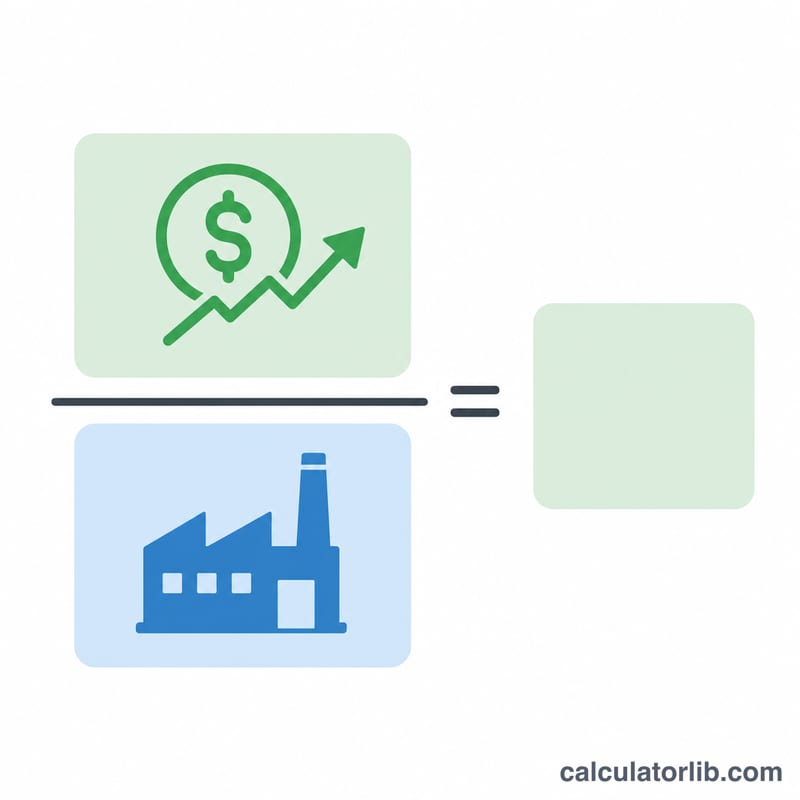
The formula is simply:
$$\text{FATR} = \frac{\text{Net Sales}}{\text{Average Net Fixed Assets}}$$
Net sales sits in the numerator because it represents the output of the assets. The denominator uses an average to smooth out large purchases or disposals of equipment during the year, giving a more representative figure.
Worked Example
Suppose a manufacturer reports net sales of $500,000 and average net fixed assets of $200,000. The ratio is $$\$500{,}000 \div \$200{,}000 = 2.5$$ This means the company generates $2.50 in sales for every $1.00 invested in fixed assets.
FAQ
What is a good fixed asset turnover ratio? It varies widely by industry. Capital-intensive sectors (utilities, manufacturing) tend to have low ratios, while service or asset-light businesses often have high ratios. Always compare against industry peers.
Should I use gross or net fixed assets? The standard is net fixed assets (after accumulated depreciation), though some analysts use gross to remove depreciation policy distortions.
Why use average instead of year-end assets? Averaging beginning and ending balances better matches the asset base to the full period's sales, especially when significant assets were bought or sold mid-year.