

What Is Operating Asset Turnover?
Operating asset turnover is an efficiency ratio that measures how effectively a company uses its operating assets to generate sales. It tells you how many dollars of net sales are produced for each dollar invested in operating assets such as cash, receivables, inventory, and property used directly in operations. A higher ratio generally indicates more efficient use of those assets.
How to Use This Calculator
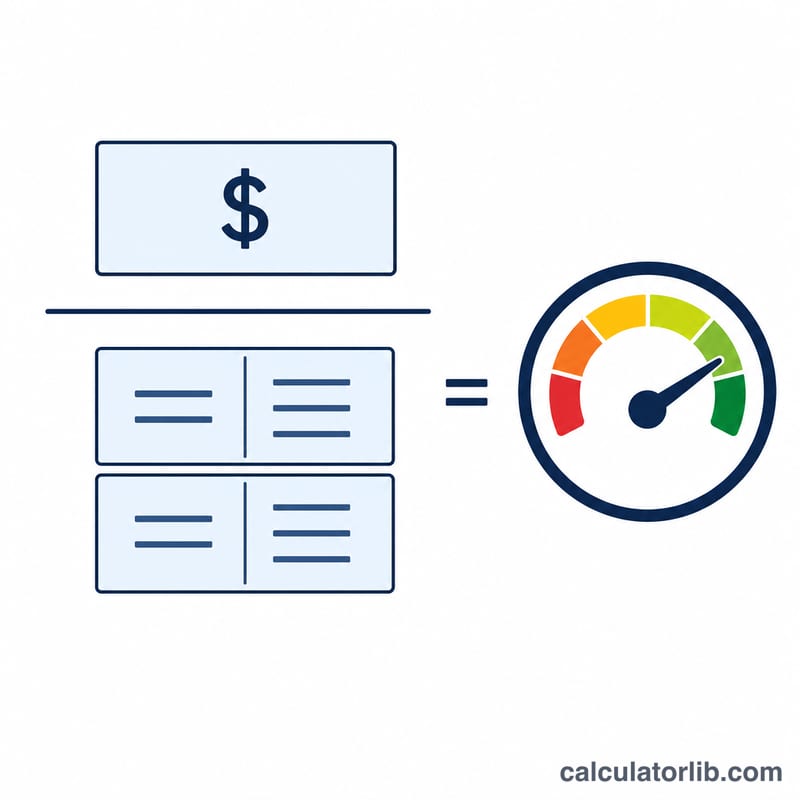
Enter your net sales for the period and your average operating assets (typically the beginning balance plus the ending balance, divided by two). The calculator divides net sales by average operating assets to return the turnover ratio, expressed as the number of times operating assets were "turned over" during the period.
The Formula Explained
The equation is straightforward:
$$\text{Operating Asset Turnover} = \frac{\text{Net Sales}}{\text{Average Operating Assets}}$$
Net sales is revenue after returns, allowances, and discounts. Average operating assets exclude non-operating items like investments or idle land. Averaging the asset base smooths out fluctuations between the start and end of the period.
Worked Example
Suppose a company reports net sales of $500,000 and average operating assets of $250,000. The operating asset turnover is $$500{,}000 \div 250{,}000 = 2.0$$ This means the company generated $2 of sales for every $1 of operating assets during the period.
FAQ
What is a good operating asset turnover ratio? It varies widely by industry. Capital-intensive industries (utilities, manufacturing) tend to have lower ratios, while service or retail businesses often have higher ones. Compare against industry peers and the company's own history.
How is it different from total asset turnover? Total asset turnover uses all assets, including non-operating ones. Operating asset turnover focuses only on assets actively used in core operations, giving a cleaner view of operating efficiency.
How do I find average operating assets? Add the operating assets at the beginning of the period to those at the end, then divide by two.