
What Is PVGO?
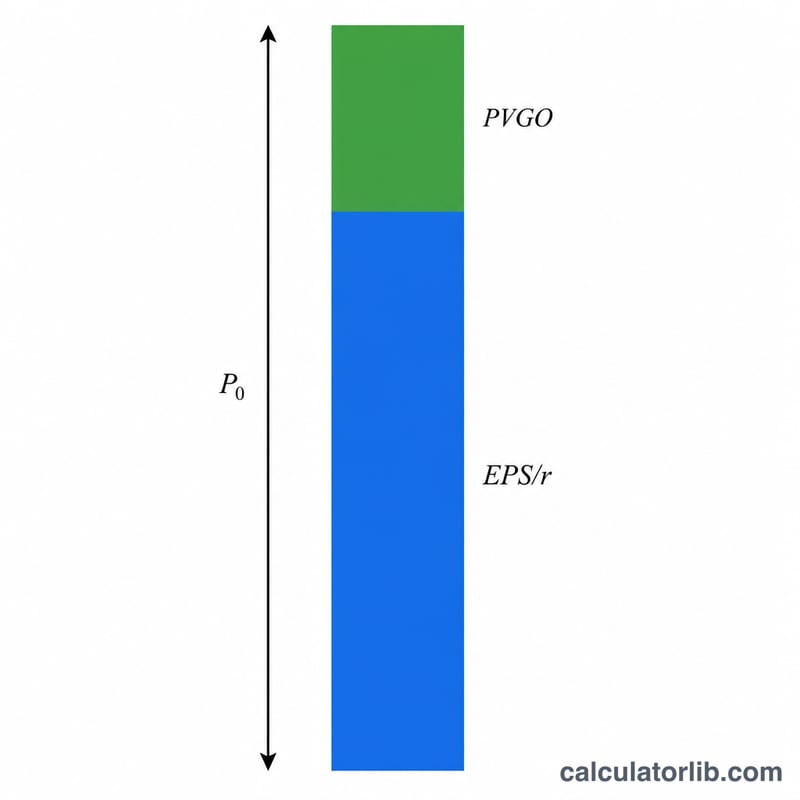
PVGO stands for the Present Value of Growth Opportunities. It measures how much of a company's current share price is attributable to expected future growth, rather than to its existing earnings. The idea is that a stock's price has two parts: the value it would have if it never grew (a no-growth perpetuity) plus the extra value the market assigns to profitable reinvestment and expansion.
How to Use This Calculator
Enter three values: the current share price, the company's earnings per share (EPS), and the investor's required cost of equity (as a percentage). The calculator returns the PVGO in dollars, the underlying no-growth value, and PVGO as a percentage of the share price.
The Formula Explained
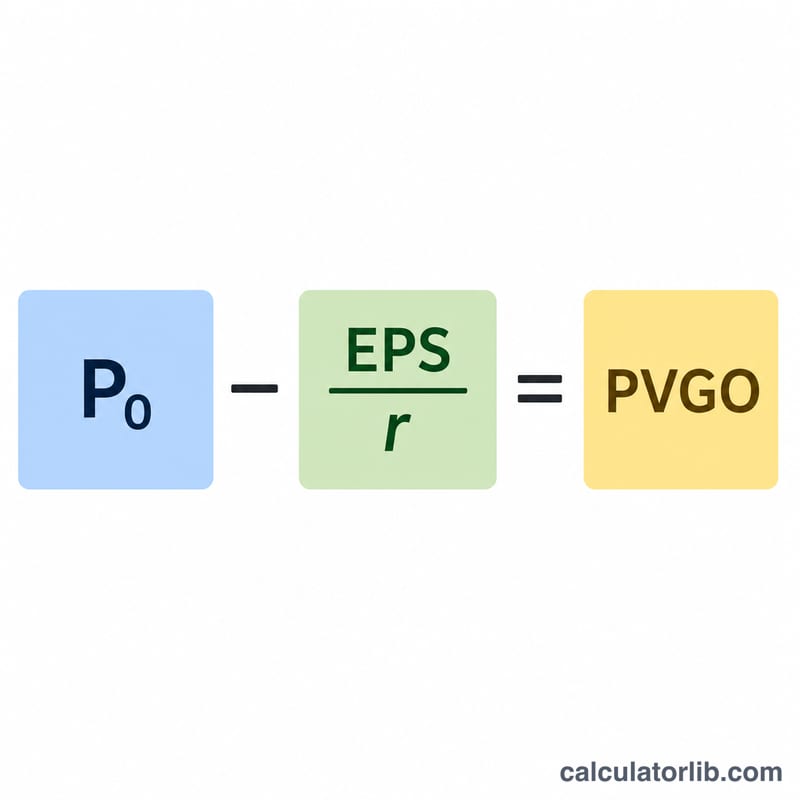
The model treats current earnings as a perpetuity. If the firm paid out all earnings forever, its value would be EPS divided by the cost of equity (\(r\)). Whatever the market pays above that figure is the present value of growth opportunities:
$$\text{PVGO} = \text{Share Price} - \frac{\text{EPS}}{\dfrac{\text{Cost of Equity (\%)}}{100}}$$
A large positive PVGO suggests the market expects significant future growth. A PVGO near zero implies the stock is priced like a mature, no-growth business, while a negative PVGO may signal overvaluation relative to current earnings or anticipated decline.
Worked Example
Suppose a stock trades at $50, has EPS of $4, and the cost of equity is 10%. The no-growth value is $$\$4 \div 0.10 = \$40.$$ $$\text{PVGO} = \$50 - \$40 = \$10.$$ That means $10 of the $50 price (20%) reflects future growth expectations.
FAQ
What does a high PVGO mean? It indicates investors expect strong future earnings growth and are paying a premium for it.
Can PVGO be negative? Yes. A negative PVGO means the share price is below the no-growth value, which can suggest overestimated risk, expected decline, or a potential bargain.
What cost of equity should I use? Commonly the rate from the Capital Asset Pricing Model (CAPM), reflecting the return investors require for the stock's risk.