

What Is a Parking Ratio?
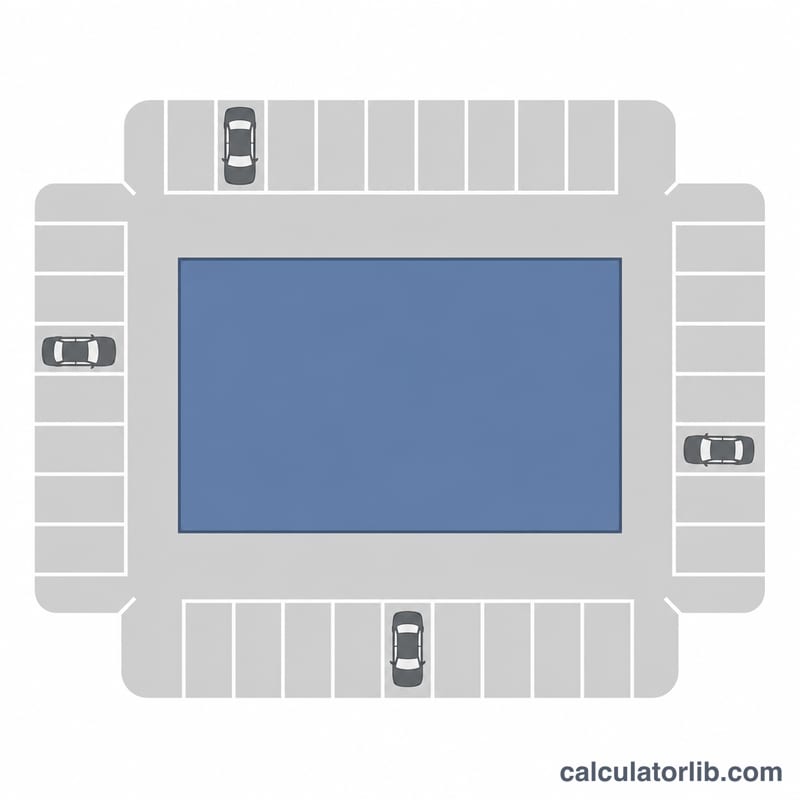
The parking ratio expresses how many parking spaces are available for every 1,000 square feet of building area. It is one of the most widely used metrics in commercial real estate, retail leasing, office development, and municipal zoning. A ratio of 4.0, for example, means there are four parking spaces for each 1,000 square feet of gross building area. Lenders, tenants, and city planners all use the figure to judge whether a property offers adequate parking for its intended use.
How to Use This Calculator
Enter the total number of parking spaces on the site and the gross building area in square feet. The calculator divides the building area by 1,000 and then divides the space count by that result, giving you the parking ratio. It also reports the inverse figure — square feet of building per parking stall — which is handy when comparing properties or checking against a code requirement.
The Formula Explained
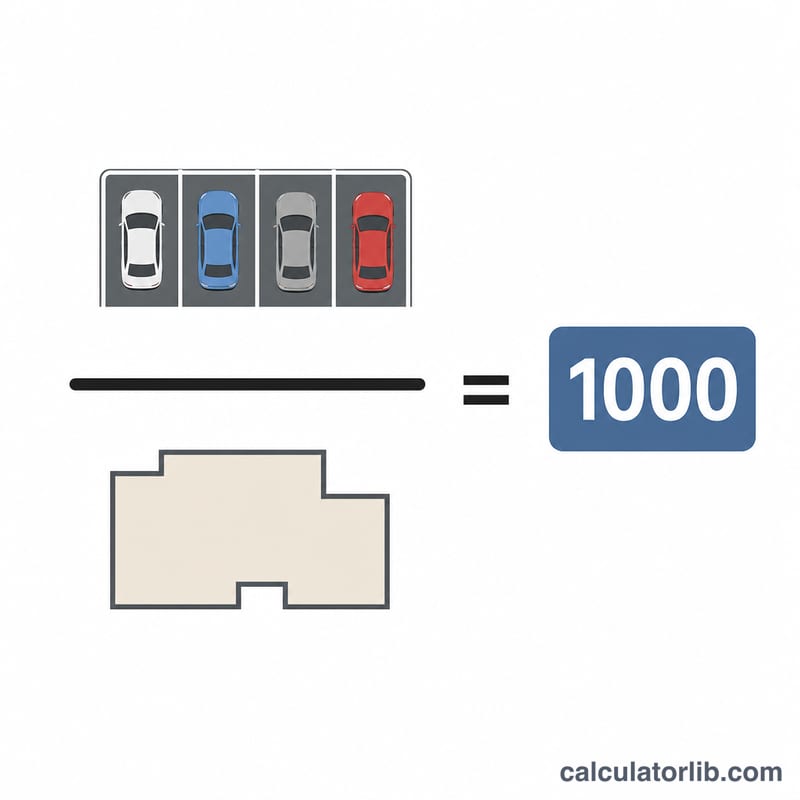
$$\text{Parking Ratio} = \frac{\text{Spaces}}{\dfrac{\text{Building Area (sq ft)}}{1000}}$$ The denominator converts raw square footage into "thousands of square feet," the standard unit used in parking standards. A higher ratio means more abundant parking relative to the building size.
Worked Example
Suppose an office building has 200 parking spaces and 50,000 square feet of floor area. Dividing 50,000 by 1,000 gives 50. Then \(200 \div 50 = 4.0\), so the parking ratio is 4.0 spaces per 1,000 sq ft. The square-feet-per-space figure is \(50{,}000 \div 200 = 250\) sq ft per space.
FAQ
What is a typical parking ratio? Suburban offices often target 3.5–4.0, while retail and restaurants may need 5.0 or more. Always check local zoning codes.
Should I use gross or net building area? Most codes use gross building area, but confirm the definition in your jurisdiction's parking ordinance.
Why convert to thousands of square feet? Parking standards are conventionally written per 1,000 sq ft, so the ratio is directly comparable to published requirements.