
What Is Consumer Surplus?
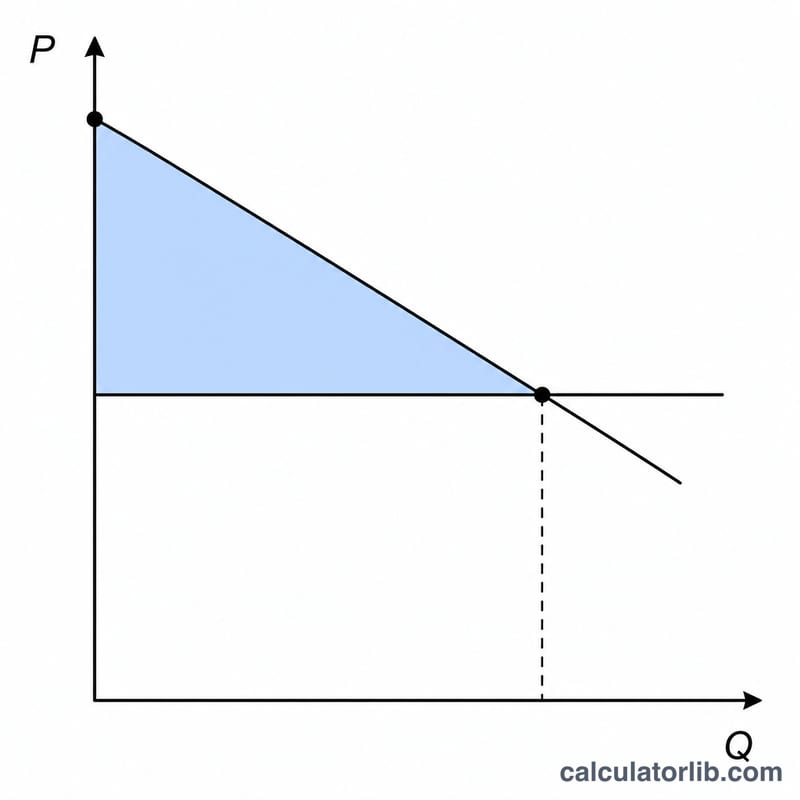
Consumer surplus is the difference between the maximum price a consumer is willing to pay for a good and the price they actually pay in the market. It measures the extra economic benefit, or "value gained," that buyers enjoy when the market price is lower than their personal valuation. Graphically, it is the area of the triangle below the demand curve and above the market price line.
How to Use This Calculator
Enter three values: the maximum price consumers are willing to pay (the highest point on the demand curve), the actual market price they pay, and the quantity traded. The calculator returns the total consumer surplus. If the market price is higher than the maximum willing price, the surplus is shown as zero, since no rational consumer would buy.
The Formula Explained
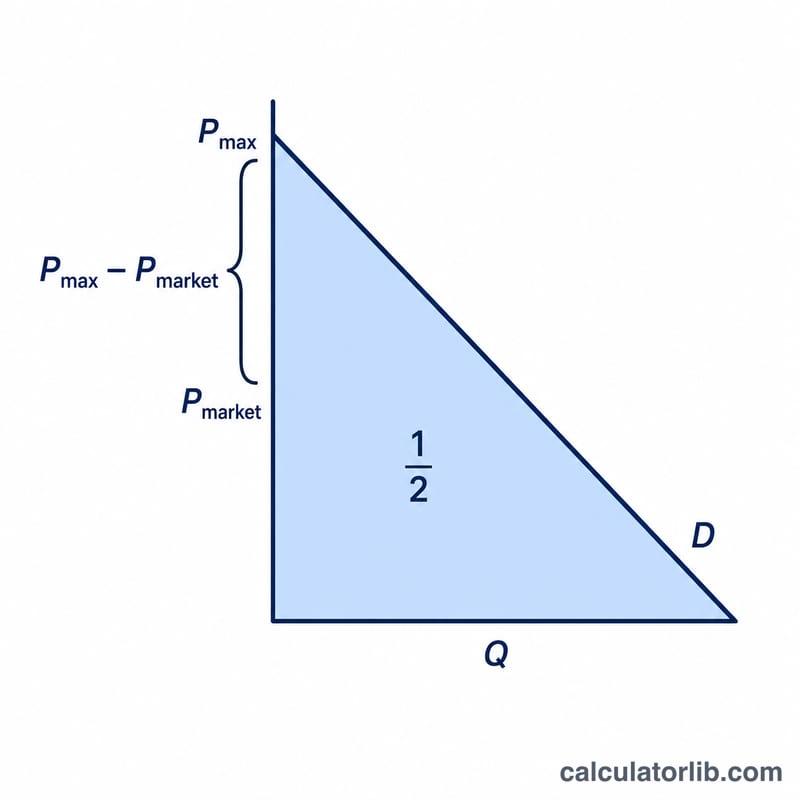
The standard linear-demand approximation is:
$$\text{Consumer Surplus} = \frac{1}{2} \times \left(\text{Maximum Price} - \text{Market Price}\right) \times \text{Quantity}$$The factor of \(\frac{1}{2}\) comes from the area of the triangle formed under a straight-line demand curve. The base of the triangle is the quantity, and the height is the gap between the choke price (maximum price) and the market price.
Worked Example
Suppose consumers are willing to pay up to $100, the market price is $60, and 50 units are sold. The price gap is \(\$100 - \$60 = \$40\). The consumer surplus is $$0.5 \times \$40 \times 50 = \$1{,}000.$$ This means buyers collectively received $1,000 in value above what they paid.
FAQ
Why is there a \(\frac{1}{2}\) in the formula? Because consumer surplus is the area of a triangle under a linear demand curve, and the area of a triangle is half the base times the height.
What if the market price exceeds the maximum price? The surplus becomes zero (or negative in theory). This calculator floors it at zero because no consumer pays more than their maximum valuation.
Does this work for non-linear demand? The \(\frac{1}{2}\) formula assumes a straight-line demand curve. For curved demand, surplus is found by integrating the area, which this simplified tool approximates.