What Is the Seed Spacing Calculator?
The Seed Spacing Calculator helps gardeners and small farmers plan planting by turning row length, in-row seed spacing, and row spacing into the number of seeds each row needs, the total seeds for the whole bed, the planted area, and the resulting plant density. It removes the guesswork from ordering seed and laying out beds so you neither crowd your crop nor waste space.
How to Use It
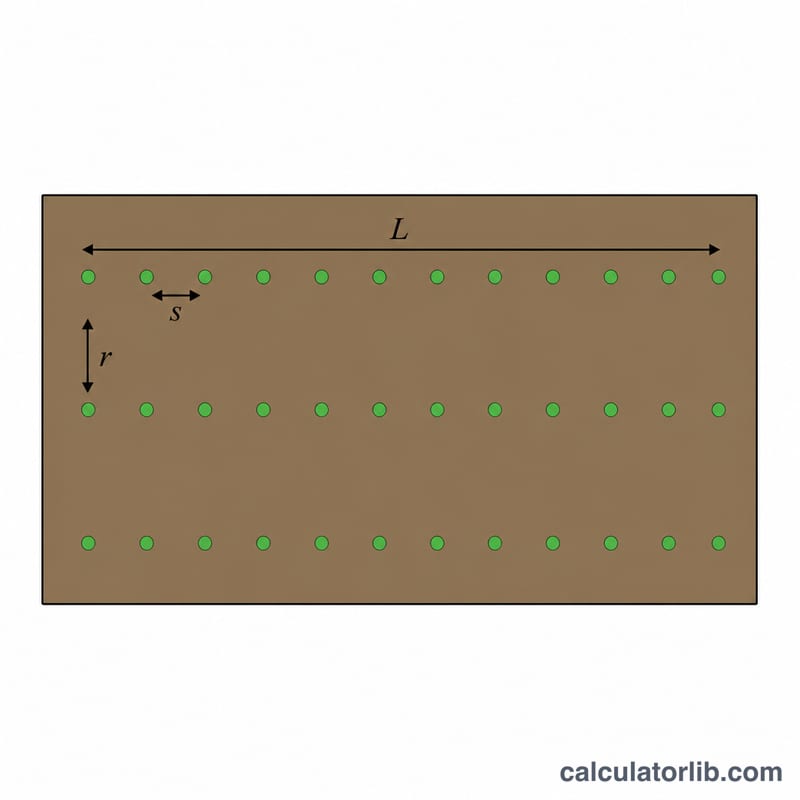
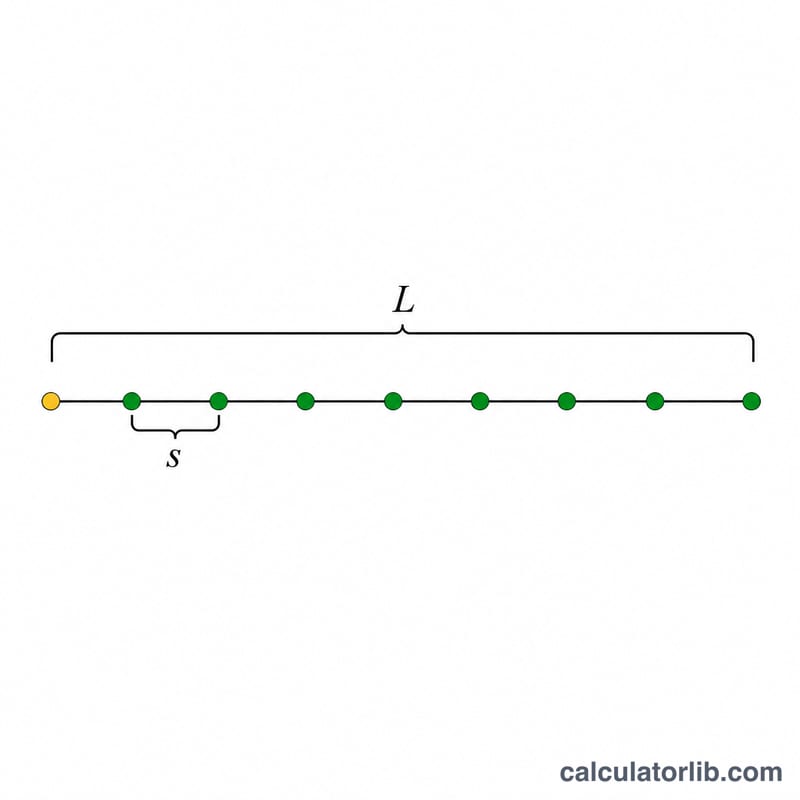
Enter the length of a single row in feet, how many rows you are planting, the desired spacing between seeds along the row in inches, and the spacing between rows in inches. The tool converts feet to inches, divides by seed spacing, and rounds down to whole plants, then adds one for the seed placed at the very start of the row.
The Formula
With \(L\) = row length in feet, \(s\) = seed spacing in inches, and \(R\) = number of rows, the seeds needed per row are:
$$N_r = \left\lfloor \frac{L \times 12}{s} \right\rfloor + 1$$The total number of seeds is \(N = N_r \times R\). The planted area uses the row spacing \(w\) (inches): \(A = L \times \tfrac{R \times w}{12}\) square feet, and plant density is \(N \div A\).
Worked Example
Suppose you have 4 rows, each 50 ft long, with seeds spaced 6 in apart and rows 18 in apart. Per row:
$$N_r = \left\lfloor \frac{50 \times 12}{6} \right\rfloor + 1 = 100 + 1 = 101$$Total seeds: \(101 \times 4 = 404\). Planted area: \(50 \times \tfrac{4 \times 18}{12} = 50 \times 6 = 300\) ft². Density: \(404 \div 300 \approx 1.35\) plants/ft².
Recommended Seed & Row Spacing by Crop
Use these typical ranges as a starting point for the seedSpacing (in-row spacing) and rowSpacing (between-row spacing) fields. Actual spacing varies with variety, soil fertility, and whether you plan to thin seedlings to a final stand. Small seeds (carrots, lettuce, radishes) are usually sown thicker than the figures below and thinned after emergence.
| Crop | In-row seed spacing (in) | Between-row spacing (in) |
|---|---|---|
| Carrots | 2–3 | 12–16 |
| Radishes | 1–2 | 6–12 |
| Beets | 3–4 | 12–18 |
| Lettuce (leaf) | 8–10 | 12–18 |
| Spinach | 3–4 | 12–14 |
| Bush beans | 3–4 | 18–24 |
| Peas | 2–3 | 18–24 |
| Sweet corn | 8–12 | 30–36 |
| Cucumbers | 12–18 | 36–48 |
| Peppers | 18 | 24–30 |
| Tomatoes | 24 | 36–48 |
| Broccoli / Cabbage | 18–24 | 24–36 |
Planning & Seed-Ordering Tips
The calculator gives the theoretical number of seeds to fill your rows at a target spacing. Turn that into a practical purchase and planting plan with the steps below.
- Add an over-seeding factor. No seed lot germinates at 100%. Multiply total seeds by 1.1–1.2 (a 10–20% buffer) for average germination and to allow for thinning. For old seed or difficult crops (carrots, parsnips, peppers), a factor of 1.3 or higher is safer.
- Round up to whole packets. Seed is sold by packet or weight, not by exact count. Check the seed count printed on the packet, divide your buffered total by it, and round up. A little surplus is cheap insurance against thin stands.
- Sow small seed thicker, then thin. For carrots, lettuce, beets and radishes, sow more densely than the final spacing and thin seedlings to the target in-row spacing after they emerge. This ensures a full row even with patchy germination.
- Account for paths and edges. The tool's planted area covers only the rows and row gaps. Add walking paths, bed borders, and headland space when sizing the overall garden footprint — real bed size is typically 20–40% larger than the planted area.
- Match density to the crop. Very high density (small seed spacing on tight rows) increases yield per square foot but also competition, disease pressure, and thinning labor. Wider spacing eases harvest and airflow.
This is general gardening guidance; adjust for your local climate, soil, variety recommendations, and seed-packet instructions.
FAQ
Why add one seed per row? A row of length divisible by the spacing still has a plant at both the 0-inch mark and the final mark, so the count is intervals plus one.
What units should I use? Row length in feet; seed and row spacing in inches. Results come back in seeds and square feet.
Does it account for germination rate? No — it gives ideal counts. Multiply the total by an over-seeding factor (e.g. 1.1 for 90% germination) when ordering seed.