What this calculator does
Press tonnage is the force a mechanical or hydraulic press must deliver to shear a blank, punch a hole, or pierce a slug in sheet metal. Undersizing the press stalls the ram, snaps tooling, and wrecks the die; oversizing wastes energy and floor space. This tool estimates the required force from three quantities every die designer already knows: the total cut perimeter, the material thickness, and the shear strength of the material. It works in either imperial units (inches, psi, US short tons) or metric units (mm, MPa, metric tonne-force).
The formula explained
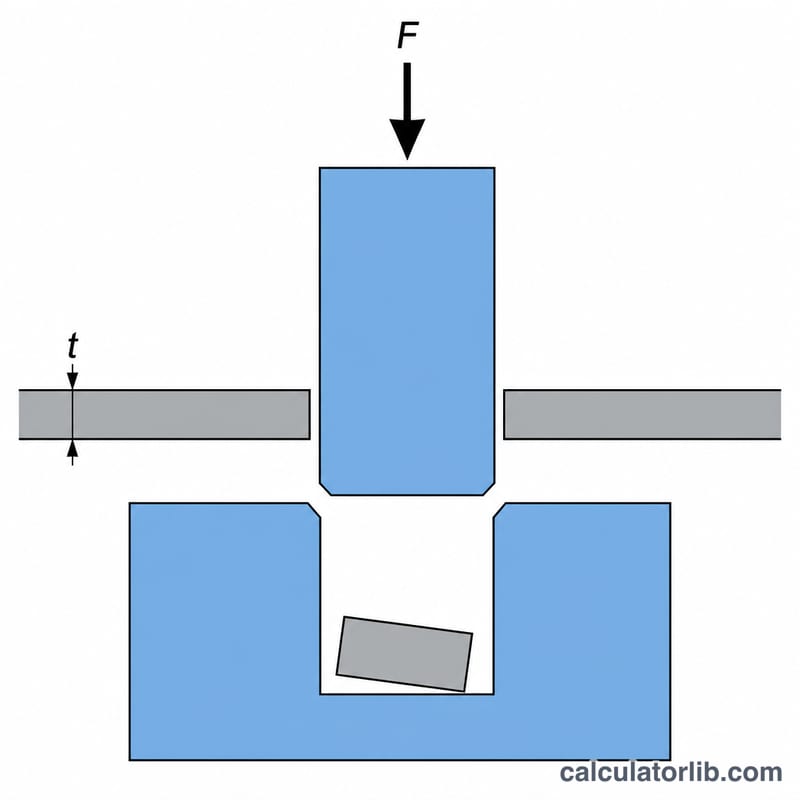
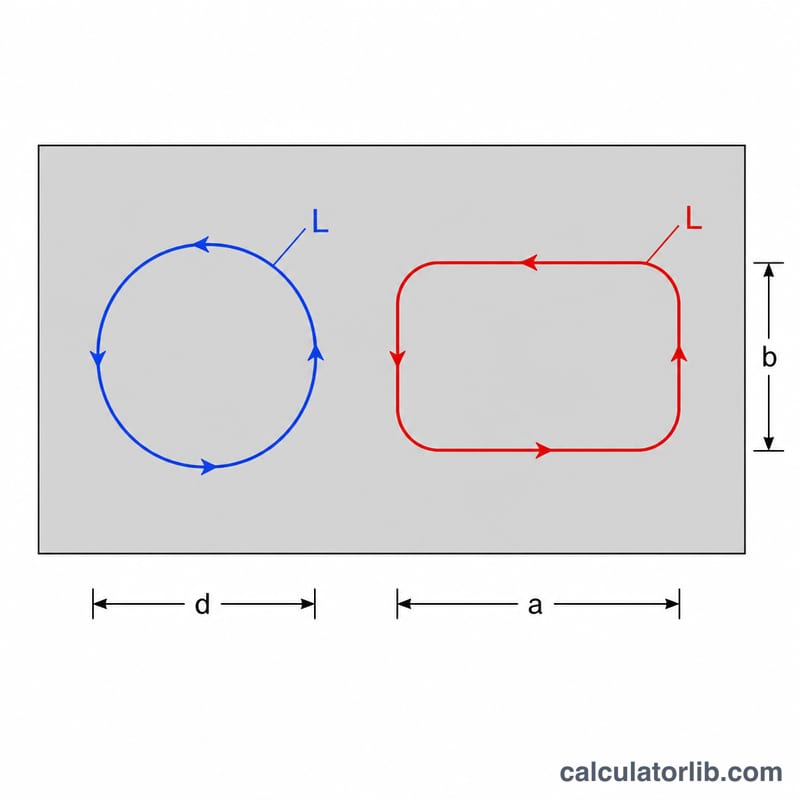
Punching shears a ribbon of material whose area equals the cut perimeter multiplied by the thickness. Multiplying that sheared area by the shear strength gives the force:
$$F_{\text{tons}} = \frac{P \times t \times S}{2000}$$where \(P\) = total cut perimeter (in), \(t\) = stock thickness (in), \(S\) = ultimate shear strength (psi), and 2000 converts pounds to US short tons. In metric, \(P\) and \(t\) are in mm and \(S\) in MPa (N/mm²), so the product is newtons and you divide by 9806.65 for tonne-force. Shear strength is roughly 0.6-0.8 of tensile strength for most steels; mild steel is about 50,000 psi (345 MPa).
Worked example
Punch a 12 in perimeter shape through 0.125 in mild steel with a shear strength of 50,000 psi:
$$F = \frac{12 \times 0.125 \times 50000}{2000} = \frac{75000}{2000} = 37.5\ \text{tons}$$Add a stripping force of 10% (3.75 tons) and a 1.2 safety factor: $$F_{\text{press}} = (37.5 + 3.75) \times 1.2 = 49.5\ \text{tons}$$ A 60 ton press is the sensible pick.
FAQ
What perimeter do I enter for several holes at once? Add the perimeters of every feature cut on the same stroke. A 1 in diameter round hole contributes \(\pi \times 1 = 3.1416\) in.
Why add stripping force? After the punch penetrates, the slug and strip grip the punch; pulling it back out typically needs 5-20% of the punch force, and that load passes through the press too.
Can I reduce the tonnage? Yes. Grinding angular shear onto the punch or die face, or staggering punch lengths so features cut at different moments, spreads the load over the stroke and can lower peak tonnage by 25-50%. This calculator reports the flat-face worst case.