What this calculator does
Diluting a concentrated stock solution is one of the most common bench tasks in chemistry, biology and pharmacy. This calculator applies the dilution equation to find whichever of the four quantities you do not know: the stock concentration \(C_1\), the stock volume \(C_1\) is taken as \(V_1\), the final concentration \(C_2\), or the final volume \(V_2\). It also reports the diluent (solvent) volume to add, the dilution factor and the number of moles of solute carried over.
The formula explained
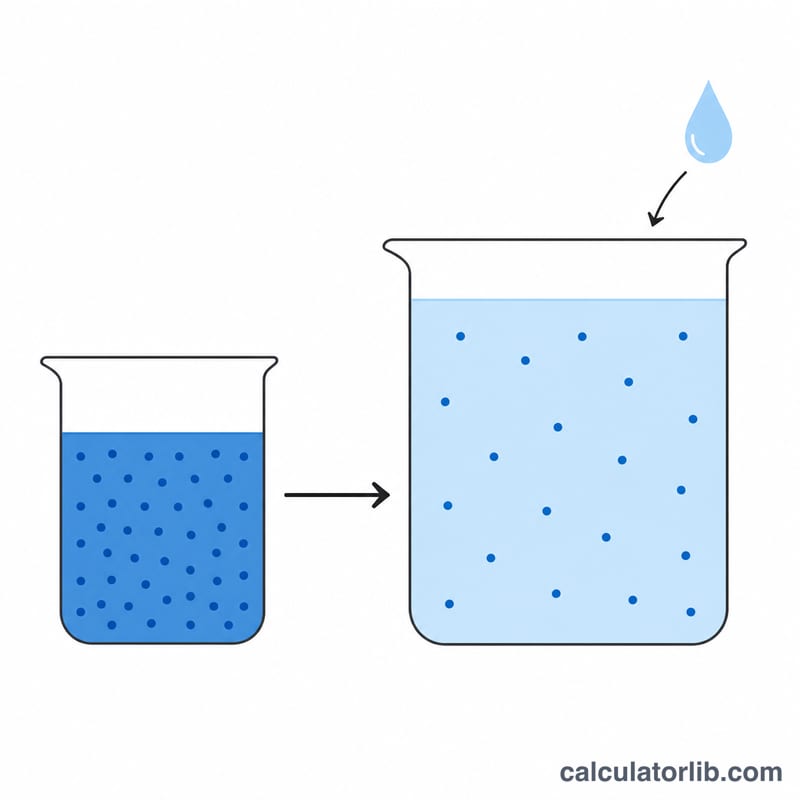
Adding solvent changes the volume but not the amount of solute, so the moles before and after are equal:
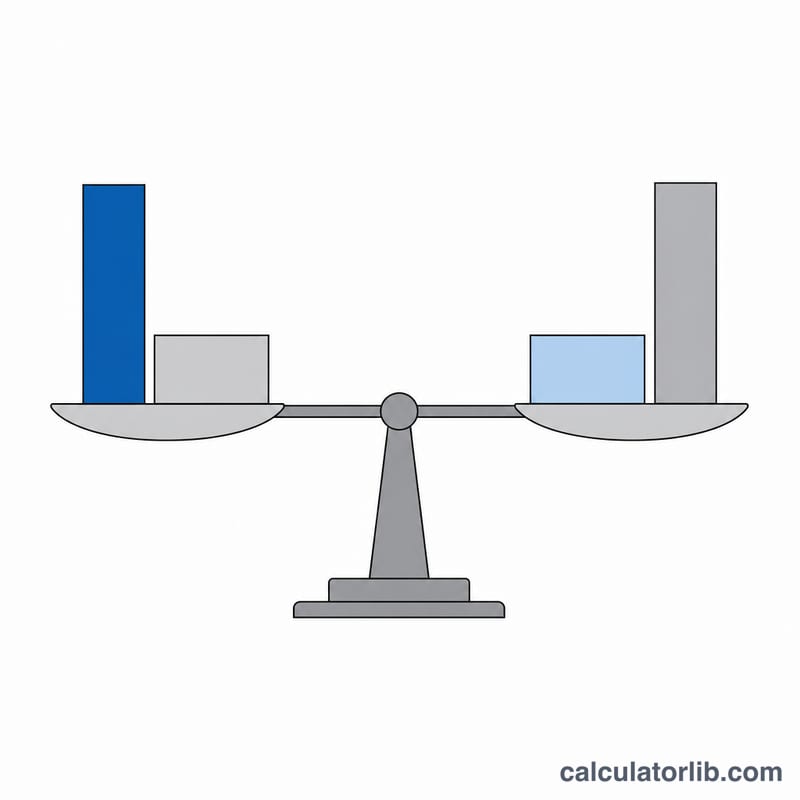
$$C_1 \times V_1 = C_2 \times V_2$$where \(C_1\) = stock concentration (mol/L), \(V_1\) = volume of stock taken (mL), \(C_2\) = concentration after dilution (mol/L) and \(V_2\) = total volume after dilution (mL). Because the volume units appear on both sides they cancel, so mL, L or µL all work as long as you are consistent. The most used rearrangement is
$$V_1 = \frac{C_2 \times V_2}{C_1}$$and the diluent to add is \(V_2 - V_1\).
Worked example
You have a 5 M NaOH stock and need 100 mL of 0.5 M working solution. Solving for the stock volume:
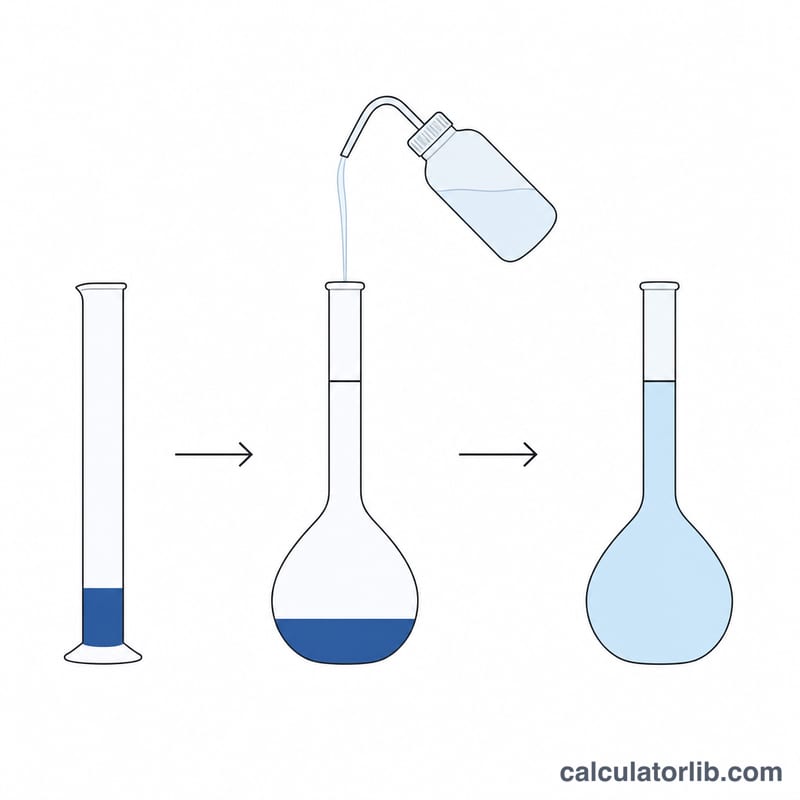
$$V_1 = \frac{0.5\,\text{M} \times 100\,\text{mL}}{5\,\text{M}} = 10\,\text{mL}$$So pipette 10 mL of stock into a 100 mL volumetric flask and bring to the mark with water, which means adding about \(100 - 10 = 90\) mL of solvent. The dilution factor is \(5 / 0.5 = 10\), a 1:10 dilution, and the moles transferred are \(5 \times 0.010 = 0.05\) mol.
Key Terms and Variables
| Term | Meaning and units |
|---|---|
| Stock solution | The concentrated starting solution you dilute from, prepared by weighing solute or bought as a concentrate. Its strength is \(C_1\). |
| C1 — stock concentration | Concentration of the stock, in whatever unit you work in: mol/L (M), mmol/L, mg/mL, % w/v, % v/v, or a fold-strength such as 10×. |
| V1 — aliquot of stock | The volume of stock you take, usually in mL (or µL). This is what the calculator returns most often: \(V_1 = C_2 V_2 / C_1\). |
| C2 — final concentration | Concentration of the solution after dilution, in the same unit as \(C_1\). Always lower than \(C_1\) in a dilution. |
| V2 — final volume | The total volume of the finished solution — stock plus diluent — in the same unit as \(V_1\). It is the volume you make up to, not the volume you add. |
| Diluent (solvent) | The liquid added to reduce the concentration — water, buffer, saline, ethanol. Nominal amount \(V_2 - V_1\); for non-ideal mixtures the true amount is set by making up to the mark. |
| Molarity (M) | Moles of solute per litre of solution (not per litre of solvent). 1 M = 1 mol/L. In strict SI the unit is mol/dm³, but mol/L and M are universal on the bench. |
| Dilution factor (DF) | \(\text{DF} = C_1/C_2 = V_2/V_1\). A 10-fold dilution is written 10× or 1:10, meaning 1 part stock made up to 10 parts total. Beware: some fields use "1:10" to mean 1 part stock plus 10 parts diluent (11 parts total) — state which convention you mean. |
| Serial dilution | A chain of dilutions, each performed on the product of the last. The factors multiply: three successive 10× steps give \(10 \times 10 \times 10 = 1000\times\). Used to reach very large factors accurately instead of pipetting an impractically small \(V_1\). |
| Aliquot | A measured portion taken from a larger volume — here, the \(V_1\) of stock you pipette out. |
| Volumetric flask | Glassware calibrated to contain one exact volume at a single etched ring (typically at 20 °C). Used to make a solution up to \(V_2\), which is what makes \(C_2\) exact. |
| % w/v | Grams of solute per 100 mL of solution, so 5% w/v = 5 g/100 mL = 50 mg/mL. Distinct from % w/w (grams per 100 g) and % v/v (mL per 100 mL). |
| ppm | Parts per million. For dilute aqueous solutions, whose density is close to 1 g/mL, 1 ppm ≈ 1 mg/L = 1 µg/mL. The approximation degrades for concentrated or non-aqueous solutions. |
| Moles of solute | \(n = C \times V\) with \(V\) in litres: 0.25 L of 0.4 mol/L contains \(0.4 \times 0.25 = 0.1\ \text{mol}\). Because dilution adds solvent only, \(n\) is unchanged — which is exactly why \(C_1 V_1 = C_2 V_2\). |
Frequently asked questions
Do I add the diluent volume or bring to final volume? For accurate work, always bring to the final volume \(V_2\) in a volumetric flask. Volumes are not perfectly additive, so adding \(V_2 - V_1\) of solvent is only an approximation, though it is fine for rough buffers.
Can I use percent or mg/mL instead of molarity? Yes. The equation holds for any concentration unit that is linear in amount per volume, including % w/v, mg/mL and ppm, provided \(C_1\) and \(C_2\) share the same unit.
Why is my required stock volume larger than the final volume? That happens when the requested \(C_2\) is greater than \(C_1\). You cannot concentrate a solution by adding solvent, so pick a stronger stock or a lower target concentration.