
What this calculator does
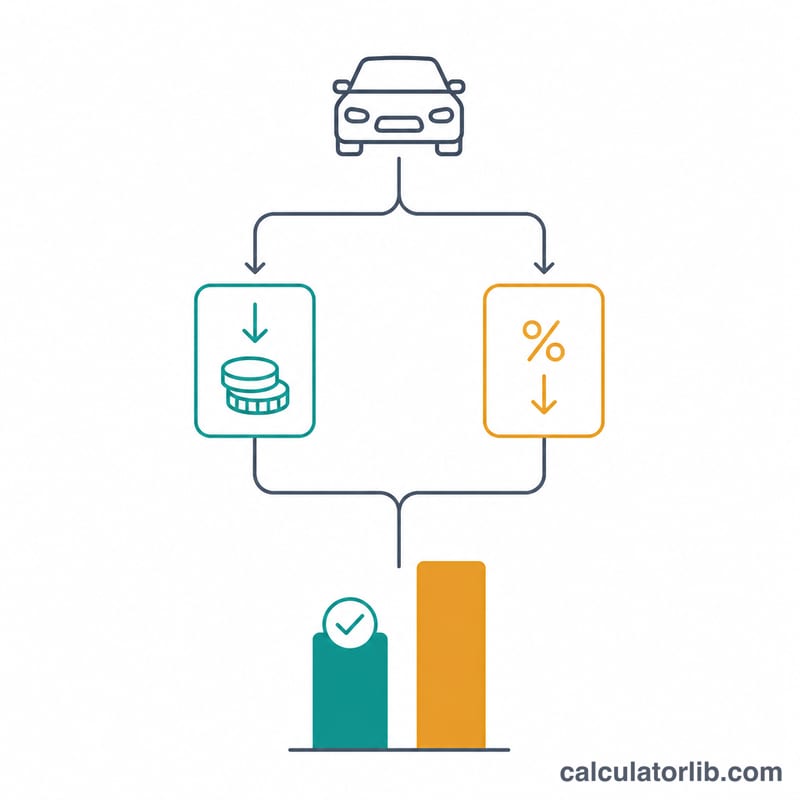
Dealers make you pick one incentive or the other: a cash rebate off the price, or a subsidised financing rate — never both. This calculator prices both versions of the same purchase side by side — loan amount, money due at signing, monthly payment, total interest and all-in cost — then names a winner. You need it the moment a salesperson says "you can have $2,000 back, or 1.9% APR."
How to read each input
Every figure comes off the same deal sheet — fill them in from the worksheet, not from memory.
| Input | Where it comes from | Sensible range |
|---|---|---|
| Cash back amount | The advertised rebate. Applies to the cash-back column only. | $500 – $7,500 |
| Interest rate (with cash back) | What you'd be charged if you take the rebate — your bank's rate, not the promo. | 4% – 12% |
| Interest rate (without cash back) | The promotional APR. Must be strictly lower than the rate above. | 0% – 5% |
| Auto price | Negotiated price before rebate, down payment or trade-in — not the loan. | $10,000 – $90,000 |
| Loan term | Months. Above 0 and up to 360; fractions like 60.7 are allowed. | 36 – 84 |
| Down payment | Cash you hand over at signing. | 0 – 20% of price |
| Trade-in value | The dealer's credit for your old car. Cuts the loan, usually the tax too. | $0 – $30,000 |
| Your state | Sets what the tax is charged on, not the rate. | pick yours, or leave blank |
| Sales tax | Combined state and local vehicle rate — check your county. | 0% – 10% |
| Title, registration and other fees | Doc fee, title, plates, destination. | $300 – $2,500 |
The formula
One calculation runs twice over identical inputs, changing two things: the cash-back column uses rebate \(R\) and your ordinary rate, the promotional column uses a rebate of zero and the promo rate.
With \(P\) = price, \(R\) = that column's rebate, \(D\) = down payment, \(T\) = trade-in, \(t\) = tax rate in percent, \(F\) = fees, \(r\) = that column's annual rate in percent, \(n\) = months:
$$L = P - R - D - T$$ $$B = P - c_T\,T - c_R\,R,\qquad X = B \times \frac{t}{100}$$ $$U = D + X + F$$ $$i = \frac{r}{1200},\qquad M = \frac{L \times i}{1-(1+i)^{-n}}$$ $$I = M \times n - L,\qquad C = M \times n + U + T$$\(L\) is the amount financed, \(B\) the tax base, \(X\) the sales tax, \(U\) the upfront payment, \(M\) the monthly payment, \(I\) total interest and \(C\) total cost. The switches \(c_T\) and \(c_R\) are 1 or 0 by state; at a rate of exactly zero, \(M = L/n\). The verdict compares interest only:
$$S = \operatorname{round}\!\left(I_{\text{cash}} - I_{\text{low}}\right),\qquad \varepsilon = P \times 0.0005$$If \(S \le R\) the cash back wins; if \(S \ge R + \varepsilon\) the low rate wins; between the two it is called a tie.
A worked example
A $32,000 car in New York: $2,000 cash back at your bank's 6.9%, or 1.9% promotional financing with no rebate. You put $4,000 down, trade in a car worth $6,000, pay 6.5% sales tax and $500 in fees, over 60 months.
The rebate comes out of the loan in the cash-back column only:
$$L_{\text{cash}} = 32{,}000 - 2{,}000 - 4{,}000 - 6{,}000 = \$20{,}000$$ $$L_{\text{low}} = 32{,}000 - 0 - 4{,}000 - 6{,}000 = \$22{,}000$$New York credits the trade-in against the tax base but not the rebate, so both columns are taxed alike:
$$X = (32{,}000 - 6{,}000) \times 0.065 = \$1{,}690,\qquad U = 4{,}000 + 1{,}690 + 500 = \$6{,}190$$Monthly payments:
$$M_{\text{cash}} = \frac{20{,}000 \times 0.00575}{1-(1.00575)^{-60}} = \$395.08$$ $$M_{\text{low}} = \frac{22{,}000 \times 0.00158\overline{3}}{1-(1.00158\overline{3})^{-60}} = \$384.65$$Sixty payments, and the interest inside them:
$$I_{\text{cash}} = 23{,}704.86 - 20{,}000 = \$3{,}704.86,\qquad I_{\text{low}} = 23{,}078.94 - 22{,}000 = \$1{,}078.94$$Total cost adds the upfront money and the trade-in:
$$C_{\text{cash}} = 23{,}704.86 + 6{,}190 + 6{,}000 = \$35{,}894.86$$ $$C_{\text{low}} = 23{,}078.94 + 6{,}190 + 6{,}000 = \$35{,}268.94$$The verdict: \(S = 3{,}704.86 - 1{,}078.94 = \$2{,}626\) of interest saved, against a $2,000 rebate and a tie-band of \(32{,}000 \times 0.0005 = 16\). Since \(2{,}626 \ge 2{,}016\), the low interest rate offer is better — by $625.92 over the life of the loan.
Rules that surprise people
Sales tax and fees are not financed. The loan is price minus rebate, down payment and trade-in — nothing else. Tax and fees sit in Upfront Payment, due at signing. If your dealer rolls them into the loan instead, your real monthly payment will be higher than what you see here.
Total Cost includes your trade-in. The label says "price, interest, tax, fees," but the trade-in is added back in — it counts the value you surrendered. Trade in a $6,000 car and Total Cost sits $6,000 above payments plus upfront. The gap between the columns is still right; neither total is cash out of pocket.
Your state changes the tax base, not the rate. Two independent switches are involved, and all four combinations are real:
| Tax charged on | States |
|---|---|
| Price minus trade-in (also the blank default) | AL AR CO CT FL GA ID IL IN ME MS NV NJ NM NY NC ND OH SC SD TN WA WV WI |
| Price minus trade-in minus rebate | AK AZ DE IA KS LA MA MN MO NE NH OK OR PA RI TX UT VT WY |
| Full price, no credits | CA DC HI MD MI VA |
| Price minus rebate only | KY MT |
Blank is not "no credits" — it behaves like New York. On a $50,000 car with a $5,000 trade-in at 7%, blank charges $3,150 of tax where California charges $3,500. Pick your state.
The winner is chosen on interest, not on total cost. The cheaper column can lose. In Texas, $3,000 cash back against a 1.80% promo on a $50,000 car gives total costs of $57,184.14 and $57,356.97 — yet the low rate is still declared the winner, on $3,037 of interest saved versus the $3,000 rebate. Texas credits the rebate against the tax base, and that $210 of tax saving is invisible to an interest comparison. When the columns land close, read Total Cost yourself.
Near-ties are declared ties. The dead-band is 0.05% of the price and nothing else: $25 on a $50,000 car, $16 on a $32,000 one. Inside it you get "The Offers are Similar," which is honest.
The promo rate must be genuinely lower. If the rate with cash back is at or below the promo rate, nothing is computed — you are told to take the cash back, which is right. The test is strict: 2.000001% against 2% does compute.
Nothing is floored at zero. A down payment larger than the car gives a negative loan, payment and interest; a trade-in worth more than the car gives negative tax. A minus sign means one input exceeds the price. And a tax rate of exactly 0 removes the Sale Tax row rather than printing $0.00 — enter 0.0001 and it returns.
Questions people ask
Why don't the rows add up to Total Cost?
Occasionally they miss by a cent. Every figure is computed at full precision and rounded once for display, so Total Cost comes from the unrounded parts, not the printed rows. On a $12,345.67 purchase at 6.25% tax, the printed lines sum to $14,492.71 while Total Cost correctly shows $14,492.72.
Why isn't the payments total just 60 × the monthly payment?
Same reason: it is 60 times the exact payment, not the rounded one — $735.98 a month prints a total of $44,158.69, where 60 × $735.98 gives $44,158.80. It matters most at 0%, where a $40,000 loan must repay exactly $40,000.
Should I always take the low rate when it wins here?
Not necessarily. The verdict assumes you keep the loan to term. If you plan to pay off early or refinance, the interest saving shrinks while the rebate is banked on day one.
What sales tax rate should I enter?
The combined state and local vehicle rate for the address where you register the car, not where you buy it. County and city add-ons can move it by a point or more.
How Each State Taxes Rebates and Trade-Ins
This calculator's tax logic is specific to the United States: sales/excise tax on a vehicle purchase is set by the state (and often the county or city), and two rules decide how much tax you actually pay on the same car. First, does the trade-in allowance come off the taxable amount? Second, does a manufacturer rebate come off the taxable amount? Those are the switches \(c_t\) and \(c_r\) in the formula, and the state you select flips them.
Why it matters for this comparison: if your state taxes the price before the rebate, taking a $3,000 rebate in a 7% state saves you $3,000 of principal but $0 of tax. If your state taxes the price after the rebate, the same rebate is worth an extra $210 in avoided tax, which tilts the result toward the rebate offer.
| State | Trade-in reduces taxable amount | Manufacturer rebate reduces taxable amount |
|---|---|---|
| Alabama (AL) | Yes | No |
| Alaska (AK) | No state sales tax (some boroughs/cities levy local tax) | |
| Arizona (AZ) | Yes | Yes |
| Arkansas (AR) | Yes | No |
| California (CA) | No | No |
| Colorado (CO) | Yes | No |
| Connecticut (CT) | Yes | No |
| Delaware (DE) | No sales tax (a separate document fee applies to vehicles) | |
| District of Columbia (DC) | No | No |
| Florida (FL) | Yes | No |
| Georgia (GA) | Yes | No |
| Hawaii (HI) | No | No |
| Idaho (ID) | Yes | No |
| Illinois (IL) | Yes | No |
| Indiana (IN) | Yes | No |
| Iowa (IA) | Yes | Yes |
| Kansas (KS) | Yes | Yes |
| Kentucky (KY) | No | Yes |
| Louisiana (LA) | Yes | Yes |
| Maine (ME) | Yes | No |
| Maryland (MD) | No | No |
| Massachusetts (MA) | Yes | Yes |
| Michigan (MI) | Partial — credit capped, cap rises each year | No |
| Minnesota (MN) | Yes | Yes |
| Mississippi (MS) | Yes | No |
| Missouri (MO) | Yes | Yes |
| Montana (MT) | No sales tax (county option and luxury-vehicle fees apply) | |
| Nebraska (NE) | Yes | Yes |
| Nevada (NV) | Yes | No |
| New Hampshire (NH) | No sales tax (municipal registration fees apply) | |
| New Jersey (NJ) | Yes | No |
| New Mexico (NM) | Yes | No |
| New York (NY) | Yes | No |
| North Carolina (NC) | Yes | No |
| North Dakota (ND) | Yes | No |
| Ohio (OH) | Yes | No |
| Oklahoma (OK) | Yes | Yes |
| Oregon (OR) | No sales tax (a vehicle privilege/use tax applies to many purchases) | |
| Pennsylvania (PA) | Yes | Yes |
| Rhode Island (RI) | Yes | Yes |
| South Carolina (SC) | Yes | No |
| South Dakota (SD) | Yes | No |
| Tennessee (TN) | Yes | No |
| Texas (TX) | Yes | Yes |
| Utah (UT) | Yes | Yes |
| Vermont (VT) | Yes | Yes |
| Virginia (VA) | No | No |
| Washington (WA) | Yes | No |
| West Virginia (WV) | Yes | No |
| Wisconsin (WI) | Yes | No |
| Wyoming (WY) | Yes | Yes |
Notes on the table
- No-sales-tax states: Alaska, Delaware, Montana, New Hampshire and Oregon have no general state sales tax, so neither switch applies. They are not fee-free: Delaware charges a document fee, Oregon a vehicle privilege/use tax, Montana county option and luxury-vehicle fees, New Hampshire municipal registration fees, and Alaskan boroughs and cities may levy their own sales tax. Put those amounts in the fees field, not the tax-rate field.
- Dealer cash is not the same as a manufacturer rebate. A dealer discount (or dealer cash the dealer passes through as a price cut) lowers the selling price written on the contract, so tax is charged on the reduced price everywhere. A customer rebate from the manufacturer is usually treated as a third-party payment applied after the sale, which is why most states still tax the pre-rebate price. If you can get the same money as a price reduction instead of a rebate, the taxable amount changes even though the cash does not.
- Some states tax vehicles outside the ordinary sales tax. Georgia uses a one-time title ad valorem tax (TAVT), North Carolina a highway use tax, South Carolina an infrastructure maintenance fee that is capped, and the District of Columbia an excise tax tied to vehicle weight and efficiency. Enter the applicable percentage in the tax-rate field and treat the result as an estimate.
- Local rates ride on top of the state rate. County, city and transit-district taxes are added to the state rate, and several states source vehicle tax to the buyer's home address rather than the dealership. Enter the combined rate for where the car will be registered, not the headline state rate.
- Michigan's trade-in credit is partial: only a capped portion of the trade-in allowance reduces the taxable amount, and the cap has been rising on a statutory schedule.
These rules change through legislation and revenue-department rulings, and a few states apply special treatment to leases, private-party sales or out-of-state purchases. Confirm your current rate and rebate/trade-in treatment with your state DMV or department of revenue before relying on the tax figure in a purchase decision.
What Your Result Actually Tells You
The calculator picks a winner on total cost, not on the payment. Total cost for each offer is
$$\text{Total Cost} = \text{Upfront} + n\,M + \text{Trade-In}$$where the upfront amount is your down payment plus sales tax plus title and registration fees, \(n\) is the term in months, \(M\) is that offer's monthly payment, and the trade-in is counted because it is value you handed over. The margin reported is simply the difference between the two totals.
- The two columns can disagree. The offer with the lower monthly payment is not always the offer with the lower total cost. A rebate cuts principal, so it usually wins the payment when terms are short; a low APR cuts interest, so it can win the total while charging more per month — the reverse also happens. Read both rows of the output and decide which measure you are comparing before you call one offer cheaper.
- The margin is only valid for the exact term you entered. The promotional rate earns its advantage month by month, over the full \(n\) months. Pay the loan off in year three of a six-year term and roughly half of that projected interest saving never happens — while the rebate's benefit was banked on day one and cannot be undone. If there is a real chance you will refinance, trade the car in early or pay it off ahead of schedule, re-run the comparison at the term you actually expect to hold the loan.
- A small margin is inside the noise. A few hundred dollars over five or seven years is smaller than the spread between dealers on doc fees, add-ons, the trade-in appraisal, or one round of price negotiation. Treat any margin under a few hundred dollars as a tie in the numbers rather than a finding.
- The promotional APR is credit-tier dependent. Advertised 0% and 1.9% offers are captive-finance programs, generally restricted to top credit tiers, sometimes to specific models, trims or model years, and often to shorter terms only. Many are also mutually exclusive with the rebate by design — which is what makes this a choice. The rate you are actually approved for may be higher than the one advertised; if it is, re-run the comparison with the approved rate, because the winner can flip.
- Tax and fees are assumed paid in cash. The calculation charges sales tax and title/registration fees at signing rather than rolling them into the loan. If you finance them instead, both columns rise, and they rise unevenly: the extra balance accrues at each offer's own rate, so financing costs more in the ordinary-rate column than in the promo column and slightly widens any promo advantage.
- What is not in the number. The comparison excludes the opportunity cost of your down payment, gap or credit insurance, dealer-installed add-ons, loan fees, and how the different balances affect how long you are underwater on the car. It also assumes a fixed-rate, fully amortising loan with equal payments and no prepayment penalty.
Everything above is a description of how the arithmetic behaves, not a recommendation. This is general information, not professional financial advice; for guidance on your own purchase and credit situation, consult a qualified professional.
How to Compare the Two Offers by Hand
Run the same nine steps twice — once for the rebate column (rebate applied, ordinary bank/credit-union rate) and once for the promo column (rebate set to 0, subvented rate). Everything else — price, down payment, trade-in, fees, tax rate, term — must be identical, or you are not comparing the same car.
- Write down the inputs. Negotiated price \(P\), rebate \(R\) (use \(R = 0\) in the promo column), down payment \(D\), trade-in allowance \(T\), title/registration and doc fees \(F\), sales tax rate \(t\) in percent, term \(n\) in months, and the annual rate \(r\) for that column.
- Amount financed: \(L = P - R - D - T\). Sales tax and fees are paid at signing here, not rolled into the loan.
- Tax base: \(B = P - c_t\,T - c_r\,R\), where the switches \(c_t\) and \(c_r\) are 1 or 0 according to your US state. \(c_t = 1\) means your state gives a trade-in tax credit; \(c_r = 1\) means the rebate is subtracted before tax. California, for example, has \(c_t = 0\) and \(c_r = 0\), so \(B = P\).
- Sales tax: \(X = B \times t/100\).
- Upfront (due at signing): \(U = D + X + F\).
- Monthly rate and payment: \(i = r/1200\), then $$M = \frac{L\cdot i}{1-(1+i)^{-n}}$$ For a 0% promotion the formula is undefined, so use \(M = L/n\).
- Total interest: \(I = M\cdot n - L\).
- Total cost: \(C = M\cdot n + U + T\). The trade-in is added back because it is real value you handed over.
- Margin: subtract the two \(C\) values. The smaller \(C\) wins; the difference is what the decision is worth.
Worked example (California, 7.25%)
Price $28,000, rebate $2,000 at 7.5%, promo 1.9% with no rebate, down payment $2,000, trade-in $4,000, fees $400, term 60 months. California switches: \(c_t = 0\), \(c_r = 0\).
Shared tax and upfront: \(B = 28{,}000\), so \(X = 28{,}000 \times 7.25/100 = 2{,}030\) and \(U = 2{,}000 + 2{,}030 + 400 = 4{,}430\).
Rebate column: \(L = 28{,}000 - 2{,}000 - 2{,}000 - 4{,}000 = 20{,}000\); \(i = 7.5/1200 = 0.00625\);
$$M = \frac{20{,}000 \times 0.00625}{1-(1.00625)^{-60}} = \frac{125}{0.311913} = 400.75$$\(M\cdot n = 400.75 \times 60 = 24{,}045.20\), so \(I = 24{,}045.20 - 20{,}000 = 4{,}045.20\) and \(C = 24{,}045.20 + 4{,}430 + 4{,}000 = 32{,}475.20\).
Promo column: \(L = 28{,}000 - 0 - 2{,}000 - 4{,}000 = 22{,}000\); \(i = 1.9/1200 = 0.00158333\);
$$M = \frac{22{,}000 \times 0.00158333}{1-(1.00158333)^{-60}} = \frac{34.8333}{0.0905594} = \text{}$$giving a payment of $384.65. Then \(M\cdot n = 23{,}078.80\), \(I = 1{,}078.80\), and \(C = 23{,}078.80 + 4{,}430 + 4{,}000 = 31{,}508.80\).
Margin: $32,475.20 − $31,508.80 = $966.40 in favor of the 1.9% promotional APR.
Rounding: keep full precision in \((1+i)^{-n}\) and in \(M\) until the final total; rounding the payment to cents first can shift a 60-month total by a dollar or two, and a razor-thin margin like the $91 row above can flip. If \(n\) is not a whole number, the formula still gives a valid comparison, but the real loan ends with a smaller partial final payment rather than \(n\) equal ones.
This is general educational information about how the arithmetic works, not financial advice; confirm the actual APR, fees and tax treatment on your own paperwork before signing.
Key Terms in a Dealer Offer
These are the terms as they appear on a US new-car deal sheet and as they map to this calculator's variables.
| Term | Symbol / field | What it means |
|---|---|---|
| Negotiated price | \(P\) — autoPrice | The agreed selling price of the vehicle before tax, fees and any incentive. Negotiate this first; incentives are applied afterward. |
| Cash rebate / customer cash | \(R\) — cashBackAmount | A manufacturer incentive that reduces what you finance (or is handed over as cash). It is a fixed dollar amount and does not grow with the term. |
| Subvented (promotional) APR | promoInterestRatePct | A below-market rate paid for by the manufacturer through its captive finance arm — 0.9%, 1.9%, 0% and similar. Usually requires strong credit and specific terms. |
| Buy rate / ordinary rate | \(r\) — interestRateWithCashBackPct | The rate you would actually get from your bank, credit union or the dealer's lender if you take the rebate instead of the promotion. |
| Trade-in allowance / equity | \(T\) — tradeInValue | The credit given for your old vehicle. If you still owe more than the allowance, the negative equity is typically added to the new loan instead. |
| Amount financed | \(L\) | \(L = P - R - D - T\): the balance the loan is actually written on, after rebate, down payment and trade-in. |
| Taxable base | \(B\) | \(B = P - c_t T - c_r R\). The switches \(c_t\) and \(c_r\) are set by your US state: whether it gives a trade-in tax credit, and whether it taxes the price before or after a manufacturer rebate. Rules differ state by state and can differ for manufacturer versus dealer cash. |
| Sales tax | \(X\) — salesTaxRatePct | \(X = B \times t/100\). Use your combined state plus local rate; many US jurisdictions add a county or city increment on top of the state rate. |
| Doc, title and registration fees | \(F\) — titleRegistrationFees | Government title/registration charges plus the dealer's documentation fee. Government fees are fixed; doc fees vary and are capped in some states. |
| Down payment | \(D\) — downPayment | Cash you put in at signing. It lowers \(L\) equally in both columns, so it shrinks the margin without changing which offer wins. |
| Upfront / due at signing | \(U\) | \(U = D + X + F\) — everything paid on day one in this model, since tax and fees are not financed here. |
| Term | \(n\) — loanTermMonths | Number of monthly payments. Longer terms cut the payment but multiply the value of a rate discount. |
| Monthly payment | \(M\) | \(M = L\,i/\left(1-(1+i)^{-n}\right)\) with \(i = r/1200\); at 0% it is simply \(L/n\). |
| Total interest | \(I\) | \(I = M\cdot n - L\) — the financing cost alone, useful for seeing how much a promo rate is worth. |
| Total cost | \(C\) | \(C = M\cdot n + U + T\) — all payments, all cash at signing, plus the trade-in value surrendered. This is the number to compare between offers. |
APR versus interest rate. The nominal interest rate is what the balance accrues at; the APR is a US Truth in Lending disclosure that also folds in certain finance charges, so it is the figure to compare across lenders. When no lender fees are financed, the two coincide, which is why this calculator treats the entered rate as the APR.
They are mutually exclusive. Manufacturers fund either the cash rebate or the subvented rate, not both on the same unit — that is precisely why the choice exists. Taking the rebate means financing at your own rate; taking the promotional APR means giving up the rebate. Dealer-specific discounts and negotiated price reductions are separate and normally stack with either one.