What this calculator does
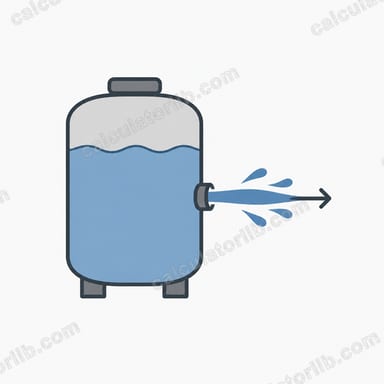
Exit velocity is the speed at which a fluid or an object leaves an opening: water from a tank orifice, a jet from a spray nozzle, or a projectile leaving a barrel. This tool covers three common ways the exit is driven: a gravity head of liquid, a pressure difference across a nozzle, or a known amount of delivered energy acting on a known mass. It is pure physics, so it applies anywhere with no country specific assumptions.
The formulas
For a pressure driven fluid, Bernoulli equation with negligible approach velocity gives
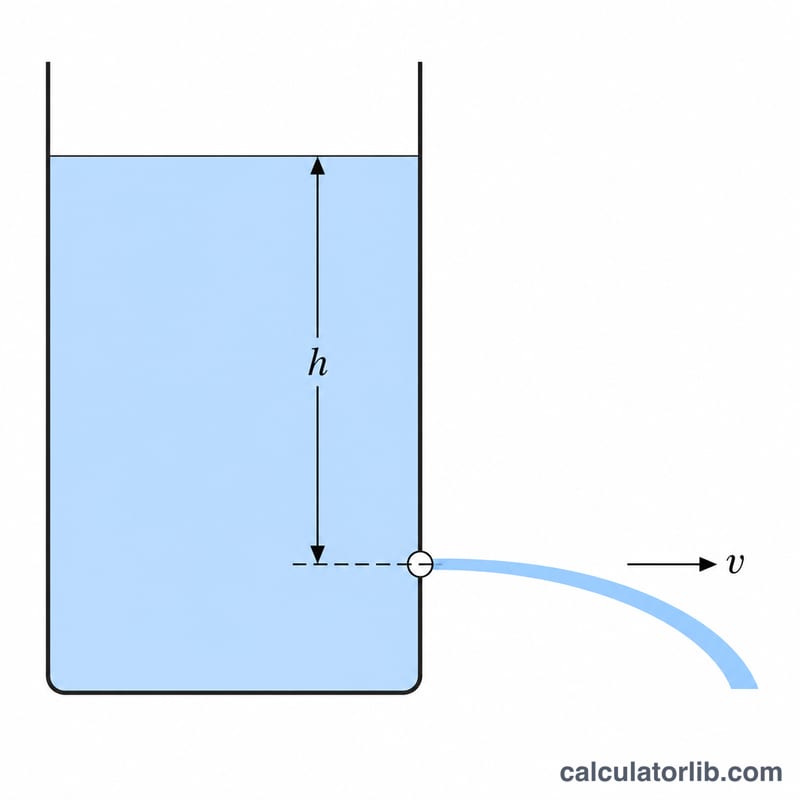
$$v = C_d \sqrt{\frac{2\,\Delta P}{\rho}}$$where \(\Delta P\) = driving pressure difference in pascals, \(\rho\) = fluid density in kg/m³, and \(C_d\) = discharge coefficient (about 0.62 for a sharp edged orifice, 0.95–0.98 for a well shaped nozzle, 1.0 for the ideal case). For a tank open to the atmosphere the same equation reduces to Torricelli law, \(v = C_d\sqrt{2gh}\), with \(g = 9.80665\,\text{m/s}^2\). For an object driven by energy \(E\) over mass \(m\), \(v = \sqrt{2E/m}\). Volumetric flow follows from the opening area, \(Q = vA\) with \(A = \pi d^2/4\).
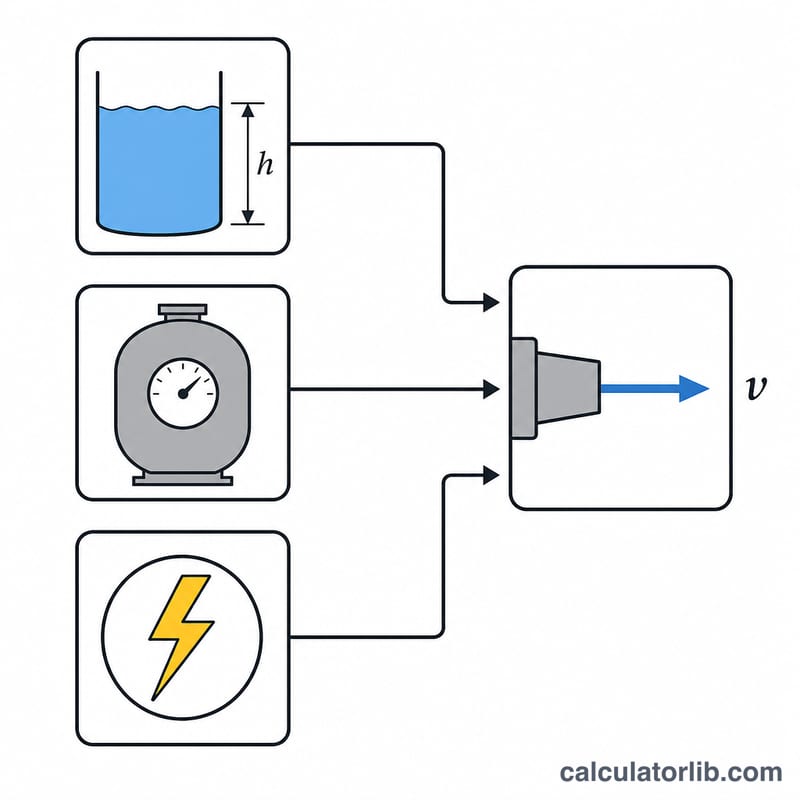
Ideal (frictionless) jet theory with a discharge coefficient. Flow figures assume the jet fills the stated opening; for real sharp-edged orifices the contracted jet area is smaller than the hole area.
Worked example
Water (\(\rho = 1000\,\text{kg/m}^3\)) is pushed through a 10 mm nozzle by a pressure difference of 300 kPa, with \(C_d = 1\):
$$v = \sqrt{\frac{2 \times 300000}{1000}} = \sqrt{600} = 24.49\,\text{m/s}$$$$Q = v \times \frac{\pi (0.01)^2}{4} = 24.49 \times 7.854\times10^{-5} = 1.92\,\text{L/s}$$Discharge Coefficients and Fluid Densities
Two inputs dominate any exit-velocity calculation: the discharge coefficient \(C_d\) of the opening, and (for pressure-driven flow) the density \(\rho\) of the fluid. The ideal (frictionless, full-bore) jet speed from a head \(h\) is \(v_{ideal}=\sqrt{2gh}\); the real jet is slower and narrower, so \(v = C_d\sqrt{2gh}\).
Typical discharge coefficients by opening geometry
| Opening geometry | Typical \(C_d\) | Notes |
|---|---|---|
| Sharp-edged / plain drilled orifice in a thin plate | 0.60 – 0.65 | Strong vena contracta; the classic textbook value is ≈0.62 |
| Square-edged short tube, Borda re-entrant (tube projecting inward) | ≈0.51 | Lowest practical value; flow separates at the re-entrant lip |
| Rounded / bell-mouth entry | ≈0.80 | Rounding suppresses contraction; value rises with radius/diameter ratio |
| Well-contoured converging nozzle | 0.95 – 0.98 | Fire nozzles, hose nozzles, jetting nozzles |
| Ideal (theoretical maximum) | 1.00 | No friction and no contraction — not achievable in practice |
The discharge coefficient is the product of two separate effects:
$$C_d = C_v \cdot C_c$$
- Velocity coefficient \(C_v\) — actual jet speed divided by \(\sqrt{2gh}\); it accounts for friction and turbulence, and is typically 0.95–0.99 even for a sharp orifice.
- Contraction coefficient \(C_c\) — the area of the vena contracta divided by the geometric hole area; about 0.61–0.64 for a sharp-edged orifice and close to 1.0 for a contoured nozzle.
This is why a sharp orifice with an almost ideal jet speed still passes only ~62 % of the ideal flow: the losses are mostly area, not velocity. Published \(C_d\) values are experimental averages and vary with Reynolds number, edge sharpness and plate thickness — treat them as ±5 % engineering estimates, not exact constants. For metered flow, orifice plates are normally sized to a standard such as ISO 5167, which gives its own coefficient correlation rather than a single number.
Fluid densities at 20 °C
| Fluid | Density \(\rho\) (kg/m³) | Reference condition |
|---|---|---|
| Fresh water | 998 | 20 °C, 1 atm |
| Seawater (≈35 g/kg salinity) | 1025 | 20 °C, 1 atm |
| Gasoline / petrol | ≈740 | 20 °C (grade-dependent, ≈720–775) |
| Diesel fuel | ≈840 | 20 °C (grade-dependent, ≈820–860) |
| SAE 30 engine oil | ≈900 | 20 °C |
| Glycerine (glycerol) | 1260 | 20 °C |
| Ethanol (anhydrous) | 789 | 20 °C |
| Air | 1.204 | 20 °C, 101.325 kPa (1 atm) |
Density matters only in the pressure-driven form \(v = C_d\sqrt{2\Delta P/\rho}\); in the gravity form \(v = C_d\sqrt{2gh}\) it cancels out, so a 2 m head of glycerine and a 2 m head of water give the same ideal exit speed (though viscosity will make the real glycerine \(C_d\) lower). Water density falls to about 992 kg/m³ at 40 °C and 958 kg/m³ at 100 °C, so hot-water systems deserve their own value. The air figure applies to incompressible, low-speed flow only: once the pressure ratio across the opening exceeds about 1.9, a gas jet chokes at the local speed of sound and this formula no longer applies.
Exit Velocity Across Common Scenarios
All rows below use fresh water at 20 °C (\(\rho = 998\) kg/m³), \(g = 9.80665\) m/s², and the same two equations — velocity from the driving input, then flow rate from velocity × geometric area:
$$v = C_d\sqrt{2gh} \quad\text{or}\quad v = C_d\sqrt{\frac{2\,\Delta P}{\rho}}, \qquad Q = v \cdot \frac{\pi d^{2}}{4}$$
| Scenario | Driving input | Fluid | Orifice ⌀ | \(C_d\) | v (m/s) | v (ft/s) | Q (L/s) | Q (L/min) |
|---|---|---|---|---|---|---|---|---|
| Water tank, sharp drilled hole | h = 2 m | Water | 10 mm | 0.62 | 3.88 | 12.7 | 0.305 | 18.3 |
| Tank with rounded pipe outlet | h = 5 m | Water | 25 mm | 0.80 | 7.92 | 26.0 | 3.89 | 233 |
| Garden hose nozzle | ΔP = 3 bar | Water | 8 mm | 0.96 | 23.5 | 77.2 | 1.18 | 71.0 |
| Fire hose nozzle | ΔP = 7 bar | Water | 20 mm | 0.97 | 36.3 | 119 | 11.4 | 685 |
| Pressure-washer jet | ΔP = 150 bar | Water | 1.0 mm | 0.95 | 165 | 540 | 0.129 | 7.8 |
| Shallow sump / floor drain | h = 1 m | Water | 50 mm | 0.62 | 2.75 | 9.0 | 5.39 | 323 |
Worked substitution — the 2 m tank row
Velocity, with \(h = 2\) m and \(C_d = 0.62\):
$$v = 0.62 \times \sqrt{2 \times 9.80665 \times 2} = 0.62 \times \sqrt{39.227} = 0.62 \times 6.263 = 3.88\ \text{m/s}$$
Area of a 10 mm hole:
$$A = \frac{\pi (0.010)^{2}}{4} = 7.854 \times 10^{-5}\ \text{m}^{2}$$
Flow rate:
$$Q = 3.88 \times 7.854 \times 10^{-5} = 3.05 \times 10^{-4}\ \text{m}^{3}\text{/s} = 0.305\ \text{L/s} = 18.3\ \text{L/min}$$
What the pattern shows
- Velocity scales with the square root of the driving input. Going from 2 m to 5 m of head (2.5×) raises the ideal speed only 1.58×; quadrupling pressure only doubles speed.
- Flow scales with diameter squared. The 150 bar washer jet is by far the fastest at 165 m/s, yet its 1 mm hole passes less than 8 L/min — under a tenth of the 5 m gravity outlet's flow.
- Geometry is worth more than pressure at low head. The 1 m drain row would rise from 2.75 m/s to about 3.5 m/s just by rounding the entry (\(C_d\) 0.62 → 0.80), a 29 % gain in flow for no extra energy.
These are steady-state, frictionless-pipe estimates for an incompressible liquid. Real installations lose head in the approach pipe, and a draining tank slows continuously as \(h\) falls, so treat the tank rows as the instantaneous rate at that water level, not an average.
Unit Conversions for Velocity, Pressure and Head
Exit-velocity work moves constantly between metric and US customary units, and between pressure and equivalent liquid head. The tables below give exact or high-precision factors.
Velocity
| 1 m/s equals | Value |
|---|---|
| Kilometres per hour | 3.6 km/h (exact) |
| Feet per second | 3.28084 ft/s |
| Miles per hour | 2.23694 mph |
| Knots | 1.94384 kn |
Reversing: 1 ft/s = 0.3048 m/s (exact), 1 mph = 0.44704 m/s (exact), 1 km/h = 0.277778 m/s.
Pressure
| Unit | In kPa | In psi | Equivalent water head |
|---|---|---|---|
| 1 bar | 100 kPa (exact) | 14.5038 psi | 10.197 m |
| 1 psi | 6.89476 kPa | 1 psi | 0.7031 m |
| 1 atm (standard) | 101.325 kPa (exact) | 14.6959 psi | 10.33 m |
| 1 kPa | 1 kPa | 0.145038 psi | 0.10197 m |
Water-head equivalents use \(\rho = 1000\) kg/m³ and \(g = 9.80665\) m/s²; with real 20 °C water at 998 kg/m³ they are about 0.2 % larger.
Head ↔ pressure
The bridge between the two input modes is the hydrostatic relation:
$$\Delta P = \rho\, g\, h \qquad \Longleftrightarrow \qquad h = \frac{\Delta P}{\rho\, g}$$
For water at 1000 kg/m³ this gives 1 m of head ≈ 9.80665 kPa ≈ 0.0980665 bar ≈ 1.422 psi, and 1 m of head is therefore worth about 0.098 bar. Substituting \(\Delta P = \rho g h\) into \(v = C_d\sqrt{2\Delta P/\rho}\) returns \(v = C_d\sqrt{2gh}\) — the two forms are the same equation. Note that head equivalence is fluid-specific: 1 m of diesel (840 kg/m³) is only about 8.24 kPa, and 1 m of mercury is 133.3 kPa.
Flow rate
| 1 m³/s equals | Value |
|---|---|
| Litres per second | 1000 L/s (exact) |
| Litres per minute | 60 000 L/min (exact) |
| US gallons per minute | ≈15 850 US gpm |
| Cubic metres per hour | 3600 m³/h (exact) |
Smaller steps: 1 L/s = 60 L/min = 15.85 US gpm = 3.6 m³/h. Gallons are not universal — 1 US gallon = 3.78541 L, while 1 imperial (UK) gallon = 4.54609 L, so 1 L/s = 13.20 imperial gpm. Always state which gallon a flow figure uses.
Area
Because \(Q = vA\), the area unit must match the velocity unit:
- 1 mm² = 1 × 10⁻⁶ m²
- 1 cm² = 1 × 10⁻⁴ m²
- 1 in² = 645.16 mm² = 6.4516 × 10⁻⁴ m² (exact)
For a circular opening of diameter \(d\) in millimetres, the area in square metres is:
$$A = \frac{\pi d^{2}}{4} \times 10^{-6}$$
So a 12 mm hole gives \(A = \pi(12)^2/4 \times 10^{-6} = 1.131 \times 10^{-4}\) m². A jet at 5 m/s through it carries \(Q = 5 \times 1.131 \times 10^{-4} = 5.65 \times 10^{-4}\) m³/s = 0.565 L/s = 33.9 L/min = 8.96 US gpm.
FAQ
Does the exit velocity depend on the fluid density? Under a gravity head, no — Torricelli law contains no density term. Under a pressure difference, yes: a denser fluid exits more slowly for the same pressure.
What discharge coefficient should I use? Use 0.60–0.65 for a plain drilled hole, 0.80 for a rounded entry, and 0.95–0.98 for a converging nozzle. Use 1.0 only to see the ideal theoretical maximum.
Is this valid for gases? Only for small pressure ratios where the gas behaves as nearly incompressible. Above roughly a 2:1 pressure ratio the flow chokes at sonic speed and a compressible flow model is required.