What this calculator does
Stocking density is the number of animals kept per unit of space. Too many animals in too little space drives stress, aggression, poor growth, ammonia spikes in aquaria and disease in livestock pens. This calculator turns the dimensions of a tank, pond, coop, run or pen into a hard number: how many animals that space can carry, how many you already have, and how much room is left. It works for aquarium fish, poultry, rabbits, reptiles and any livestock for which you have a per-animal space guideline. The tool is unit-consistent and species-neutral, so it applies anywhere.
How to use it
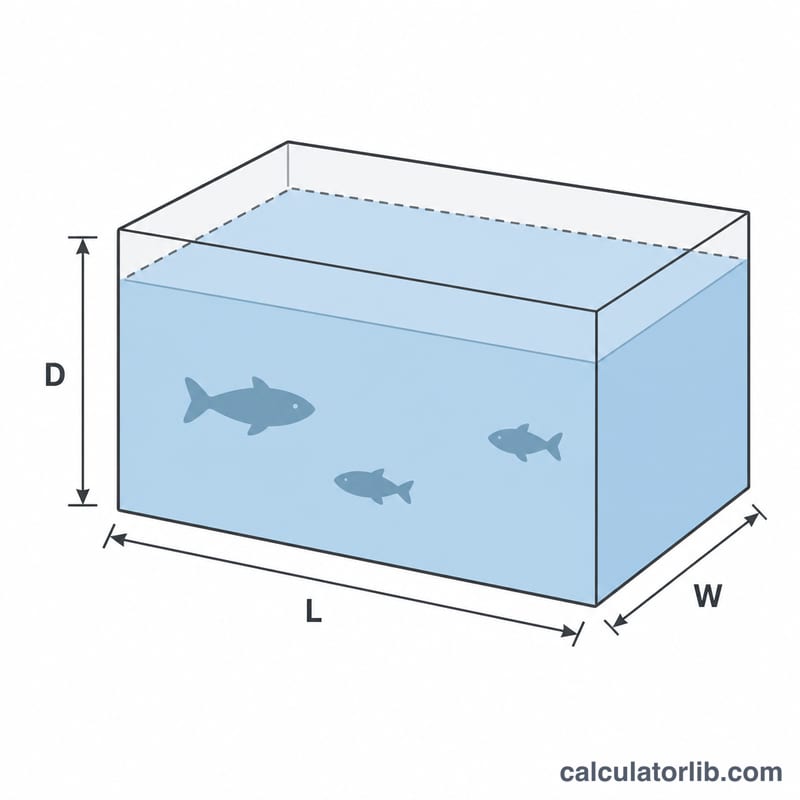
Enter the internal length and width of the enclosure in metres. For a dry enclosure leave water depth at 0; for an aquarium or pond enter the actual water depth. Then supply your welfare guideline: floor space per animal in square metres, water volume per fish in litres, or both. If you supply both, the calculator applies the stricter of the two limits. Finally enter how many animals are already stocked to see the current density and remaining capacity.
The formula explained
Usable area is \(A = L \times W\) and water volume is \(V = A \times D \times 1000\) litres, where \(L\), \(W\) and \(D\) are in metres. With \(a\) = square metres required per animal and \(v\) = litres required per fish, the safe maximum is
$$N_{\max} = \left\lfloor \min\left( \frac{A}{a}, \frac{V}{v} \right) \right\rfloor$$The floor function is used because a partial animal is not a stocking option. Current density is simply \(N_{\text{current}} / A\).
Worked example
A chicken run measures 4 m by 3 m, with no water, and your welfare standard allows 0.5 m² per bird. Eight hens are already in it.
$$A = 4 \times 3 = 12\,\text{m}^2 \qquad N_{\max} = \left\lfloor \frac{12}{0.5} \right\rfloor = 24$$Current density is \(8 / 12 = 0.67\) birds per m², the run is at \(8/24 \times 100 = 33.3\%\) of capacity, and 16 more birds could be added.
Standard Space Requirements per Animal
The table below collects widely published per-animal allowances so you have a defensible number to type into the space per animal or volume per fish field. Each figure is tied to the document that issues it. Several are European Union law and apply only in the EU (and, in modified form, in the UK, which retained equivalent rules); others are national guidance or hobby consensus with no legal force anywhere. Allowances vary by country, by animal age, and by housing type, and your own national welfare code always overrides this table.
| Species / class | Space per animal | Unit | Source / standard | Notes |
|---|---|---|---|---|
| Laying hens — barn / non-cage indoor | 9 birds per m² (≈ 0.111 m² per bird) | m² usable area | EU Council Directive 1999/74/EC, Art. 4 | Counts usable area only, not the total shed footprint. Same article also requires ≥15 cm perch per hen and ≥1 nest per 7 hens. |
| Laying hens — free-range outdoor run | 4 m² per hen (max 2,500 hens per hectare) | m² of ground | EU Council Directive 1999/74/EC (free-range conditions) | This is the outdoor range, in addition to the indoor allowance above. |
| Laying hens — enriched cage | 750 cm² per hen, of which 600 cm² usable | cm² per hen | EU Council Directive 1999/74/EC, Art. 6 | Enriched cages remain lawful in some EU states and are banned in others under national law. |
| Broilers — standard density | ≤ 33 kg live weight per m² | kg/m² | EU Directive 2007/43/EC, Art. 3(2) | Expressed as biomass, not head count; convert with expected slaughter weight. |
| Broilers — higher tier (extra conditions) | ≤ 39 kg live weight per m² | kg/m² | EU Directive 2007/43/EC, Art. 3(3) + Annex II | Requires documentation, house climate limits and notification of the competent authority. |
| Broilers — derogation tier | ≤ 42 kg live weight per m² | kg/m² | EU Directive 2007/43/EC, Art. 3(5) + Annex V | Only where the holding has a sustained record of low mortality and good welfare-outcome scores. |
| Rabbits — pet pair (companion keeping) | 6 m² floor (3 m × 2 m, ≥1 m high) for two bonded rabbits | m² per pair | RSPCA and Rabbit Welfare Association & Fund guidance (UK) | Guidance, not statute. The enclosure must include both shelter and permanently attached run. |
| Rabbits — commercial does and growers | Scheme-specific; no single EU figure | m² per doe / per grower | National codes and farm-assurance scheme standards (e.g. Red Tractor, RSPCA Assured) | There is no EU species-specific rabbit directive. Read the current version of the scheme standard you are audited against; figures are revised periodically. |
| Lizards — ground-dwelling | Enclosure ≥ 5 × SVL long and ≥ 2.5 × SVL wide (≈ 12.5 × SVL² floor area) | multiple of snout–vent length | German BMEL Gutachten über Mindestanforderungen an die Haltung von Reptilien (Germany) | Minimum for one adult; commonly cited uplift of roughly 10–20% of the base area per additional animal. |
| Snakes — terrestrial species | Enclosure length ≥ 1.0 × total length, width ≥ 0.5 × total length | multiple of total body length | German BMEL reptile minimum-keeping guidance (Germany) | Older "two-thirds of body length" rules of thumb are now widely regarded as too small; the animal should be able to stretch out fully. |
| Aquarium fish — small community (<5 cm adult) | 2–4 L per fish | litres per fish | Hobby consensus — no statutory figure | Shoaling species need a minimum group size regardless of litres. |
| Aquarium fish — medium (5–10 cm adult) | 8–15 L per fish | litres per fish | Hobby consensus — no statutory figure | Assumes mature filtration and routine water changes. |
| Aquarium fish — large (10–20 cm adult) | 40–80 L per fish | litres per fish | Hobby consensus — no statutory figure | Territorial or messy species (large cichlids, goldfish) sit at or above the top of the band. |
The aquarium bands are keeper convention, not regulation; the old "1 cm of fish per litre" shortcut ignores body mass, which scales roughly with the cube of length, so it badly under-sizes tanks for deep-bodied or large fish. For poultry, note that the EU broiler limits are stated in kilograms per m², so a head-count tool needs the allowance converted first: at 39 kg/m² and a 2.2 kg target weight, the per-bird area is \( 2.2 \div 39 \approx 0.056\ \text{m}^2 \).
Practical Stocking Recommendations
The points below are general husbandry and planning practice for turning a calculated ceiling into a workable stocking plan. This is general information, not veterinary or professional advice — for a specific holding, species or health problem, consult a veterinarian or your national welfare authority.
- Always round down. A result of 25.8 means 25 animals, never 26. The calculator applies the floor function for exactly this reason; do not reverse it by "rounding to the nearest".
- Size for adult dimensions, not today's animal. Juvenile fish and growing poultry reach their adult footprint within months. Enter the allowance for the adult body length or the target slaughter weight, so the enclosure is not compliant in week 2 and crowded in week 8.
- Deduct fixed obstructions before entering L × W. Feeders, drinkers, nest boxes, brooders and equipment plinths remove usable floor area; in aquaria, substrate, rockwork and hardscape typically displace around 10–15% of the nominal water volume, and heavy aquascaping can displace more. Measure the gross footprint, subtract the obstructions, then enter the net figure. Entering the gross tank volume is the single most common way a stocking plan ends up optimistic.
- Stock to roughly 75–80% of Nmax. Headroom absorbs growth, a broody hen taken out and returned, quarantine animals coming back into the group, or an unplanned addition, without pushing you over the limit. For a house of 12 m × 10 m at 0.25 m² per bird with 2.5 m of headroom and a generous volume allowance of 100 L per bird, the ceiling is \( \min(120/0.25,\ 300000/100) = \min(480,\ 3000) = \) 480 birds; a planning target of 80% is \( 0.80 \times 480 = 384 \) birds.
- Add aquarium stock gradually. Nitrifying bacteria populations expand to match the ammonia supplied to them, and that takes weeks. Adding a few fish at a time and testing ammonia and nitrite between additions lets the biofilter mature in step with the load, rather than lagging behind a single large stocking event.
- Check that the other limiting factors scale too. Space is one constraint among several. Verify feeder and drinker space per animal, perch length per bird, nest-box ratio, ventilation rate per kilogram of live weight, and filter turnover per hour against the same head count. A pen that satisfies the area rule but has one drinker for forty animals will still produce competition and poor outcomes.
- Re-run the calculation whenever anything changes. New hardscape, an extra feeder line, a partition, a species swap or a revision of your welfare code all change either \(A\), \(V\) or the allowance — and therefore the ceiling.
- Record which standard you used. Note the allowance figure and the document it came from alongside your stocking record. Auditors and inspectors assess the code that applies in your country, so being able to show which version you sized against is more useful than the arithmetic itself.
FAQ
Which space guideline should I use? Use the figure from your national welfare code, certification scheme or species care sheet. The calculator does not assume one, because standards differ by species, age and housing type.
Why does my aquarium result differ from the inch-per-gallon rule? That old rule ignores body shape, waste output and filtration. Entering a litres-per-fish figure from a modern species profile gives a far more realistic ceiling.
Should I stock right up to the maximum? No. Treat the result as a ceiling, not a target. Leave headroom for growth, breeding and hot weather, when effective density rises.