
What Is PSA Density?
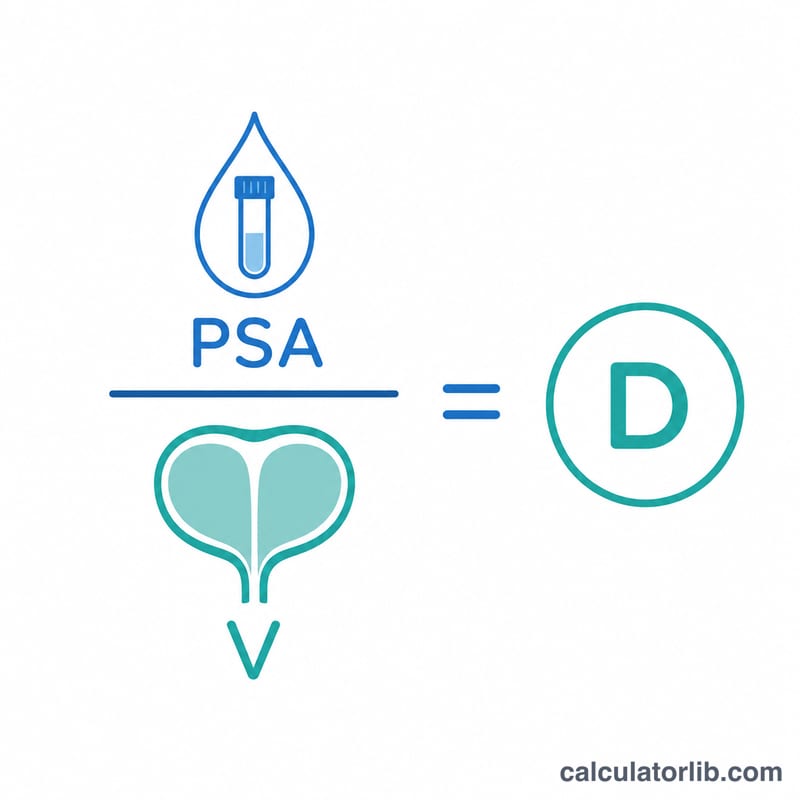
PSA density (PSAD) is a value used in prostate health assessment that normalizes a man's serum prostate-specific antigen (PSA) level to the size of his prostate gland. Because larger prostates naturally produce more PSA, a single PSA number can be misleading. Dividing PSA by prostate volume helps distinguish PSA elevations caused by benign enlargement (BPH) from those that may warrant further investigation. This tool is for general educational purposes and is not a substitute for medical advice.
How to Use This Calculator
Enter your serum PSA level in nanograms per milliliter (ng/mL) — typically from a blood test — and your prostate volume in cubic centimeters (cc, which equals mL), usually measured by transrectal ultrasound (TRUS) or MRI. The calculator divides the two to give the PSA density.
The Formula Explained
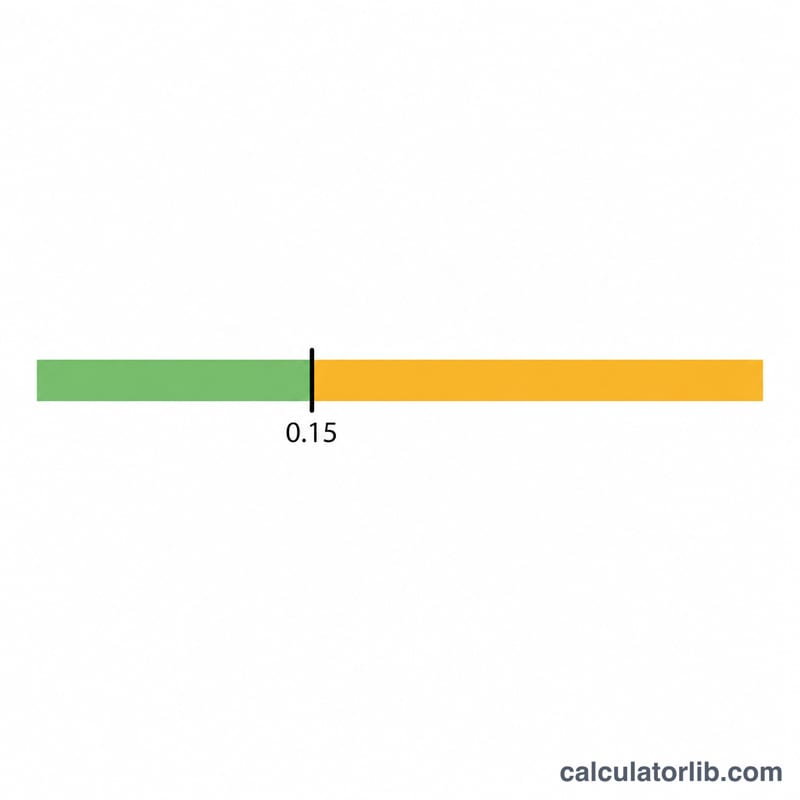
The equation is simply $$\text{PSAD} = \frac{\text{Serum PSA (ng/mL)}}{\text{Prostate Volume (cc)}}$$ A commonly cited reference threshold is \(0.15\) ng/mL per cc: values at or above this level are sometimes used as one factor supporting a recommendation for prostate biopsy, while lower values may favor surveillance. Thresholds vary between clinicians and guidelines.
Worked Example
Suppose a man has a serum PSA of 6 ng/mL and a prostate volume of 50 cc. The PSA density is $$6 \div 50 = 0.12 \text{ ng/mL per cc}.$$ Because \(0.12\) is below \(0.15\), this would generally be considered a lower density despite the moderately raised total PSA, likely reflecting a large gland.
FAQ
Is cc the same as mL? Yes — for prostate volume, \(1\) cc equals \(1\) mL.
What is a "normal" PSA density? Many clinicians use \(0.15\) as a cutoff, but interpretation depends on age, PSA trend, imaging, and other factors. Always discuss results with your doctor.
How is prostate volume measured? Most commonly via ultrasound or MRI using the ellipsoid formula (\(\text{length} \times \text{width} \times \text{height} \times 0.52\)).