
What Is PSA Doubling Time?
PSA doubling time (PSADT) is the estimated time it takes for the prostate-specific antigen level in the blood to double, assuming PSA rises exponentially. It is widely used to assess the pace of prostate-related changes — a shorter doubling time generally indicates faster growth, while a longer doubling time suggests slower change. This calculator is a general mathematical tool; it does not provide medical advice. Always discuss your results with a qualified clinician.
How to Use This Calculator
Enter your first PSA value and the time of that test (in months, often counted from a baseline of 0), then enter a later PSA value and its time in months. The calculator applies the natural-logarithm formula to compute the doubling time in months and also converts it to years. For a meaningful result the second PSA should differ from the first; if PSA is falling, the doubling time concept does not apply.
The Formula Explained
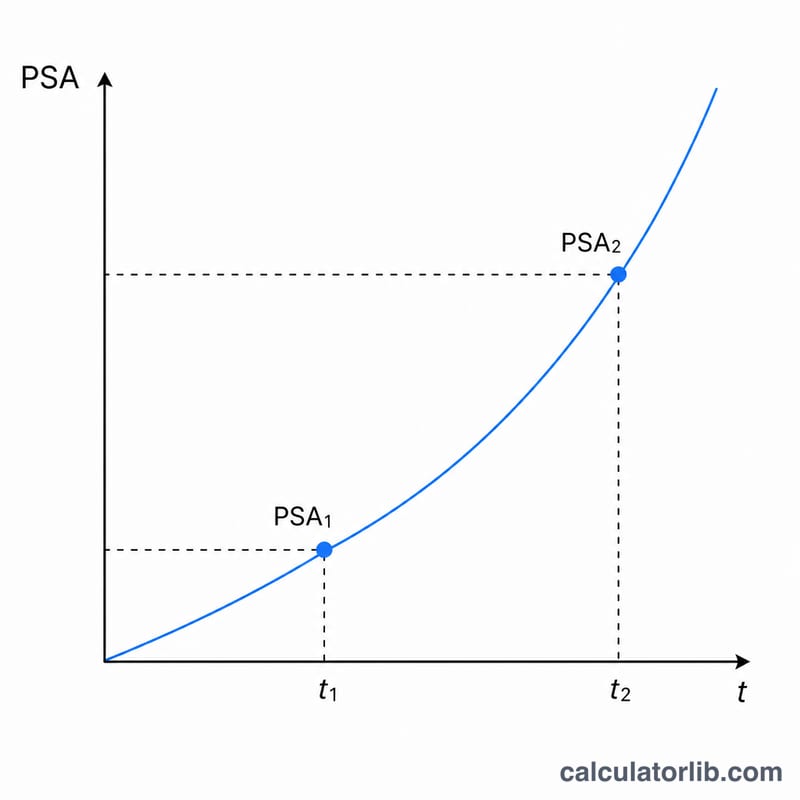
The model assumes \(\text{PSA}(t) = \text{PSA}_1 \cdot e^{k \cdot t}\). Solving for the time to double gives:
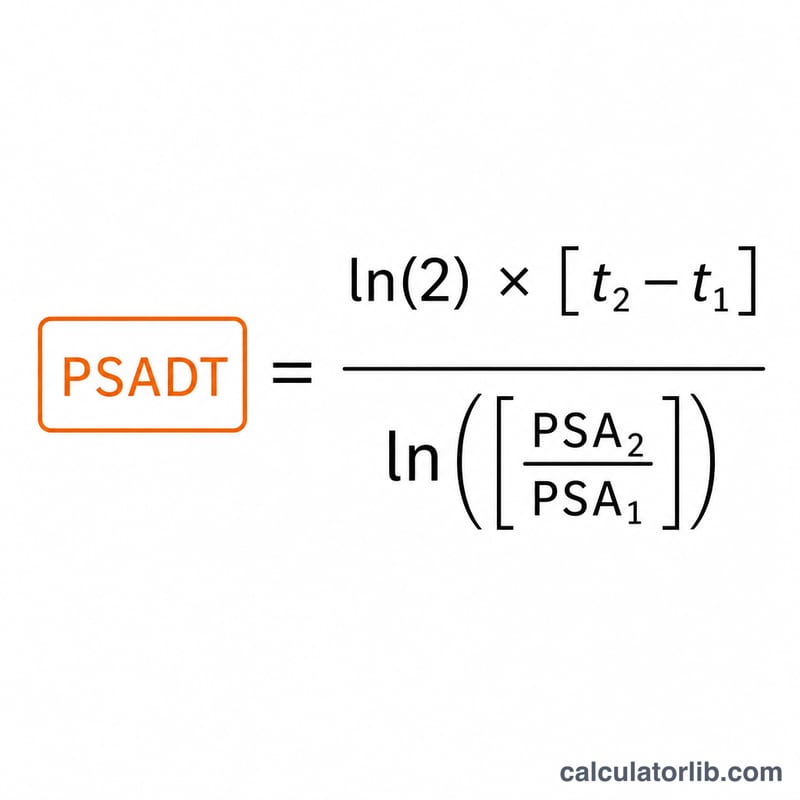
$$\text{PSADT} = \frac{\ln(2)\,\left(t_2 - t_1\right)}{\ln\!\left(\dfrac{\text{PSA}_2}{\text{PSA}_1}\right)}$$Here \(\ln\) is the natural logarithm, \(\ln(2) \approx 0.6931\), \(t\) is time in months, and \(\text{PSA}_1 / \text{PSA}_2\) are the two measured antigen levels.
Worked Example
Suppose PSA rose from 2.0 ng/mL at month 0 to 4.0 ng/mL at month 12. The ratio is \(4.0/2.0 = 2\), so \(\ln(2)/\ln(2) = 1\), and $$\text{PSADT} = 1 \times (12 - 0) = 12 \text{ months}.$$ Because PSA exactly doubled over 12 months, the doubling time is 12 months — confirming the formula.
FAQ
What units should I use for time? Use consistent units; this tool expects months and also reports the equivalent in years.
What if my PSA went down? A decreasing PSA means there is no doubling, so the formula returns 0 — doubling time is undefined in that case.
Is a single pair of readings reliable? Doubling time is more accurate with multiple measurements over time; two points give only a rough estimate.