
What Is the Rule of 72?
The Rule of 72 is a simple mental-math shortcut for estimating how long it takes a sum of money to double in value when it grows at a fixed annual compound rate. Instead of solving a logarithmic equation, you just divide 72 by the annual percentage rate. It works for any compounding quantity — investments, savings accounts, inflation eroding purchasing power, or even population growth.
How to Use This Calculator
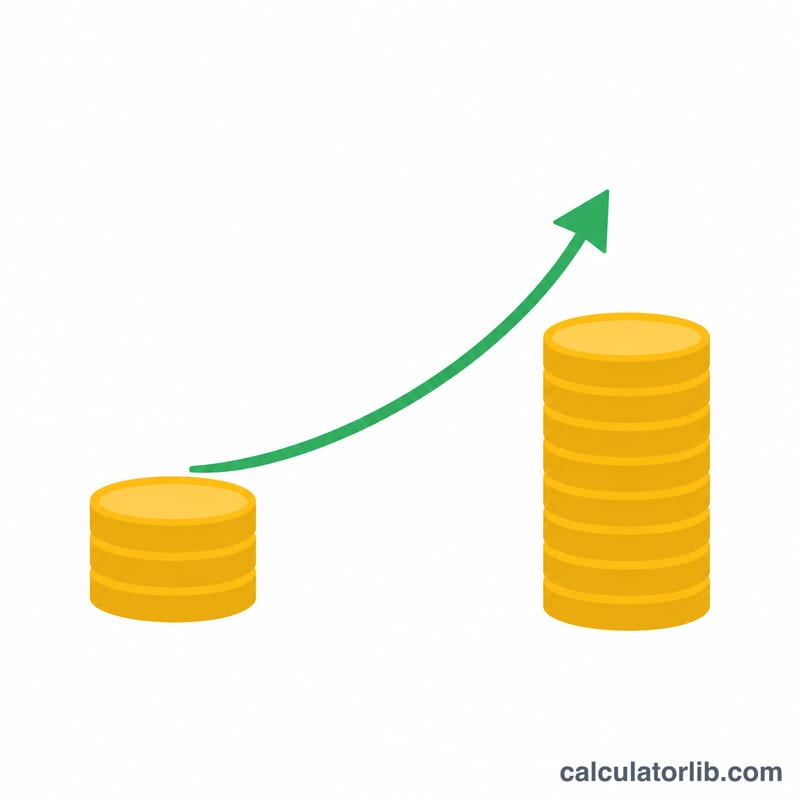
Enter your expected annual interest or growth rate as a percentage (for example, type 8 for 8%). The calculator divides 72 by that rate and returns the approximate doubling time in both years and months. Higher rates double your money faster; lower rates take longer.
The Formula Explained
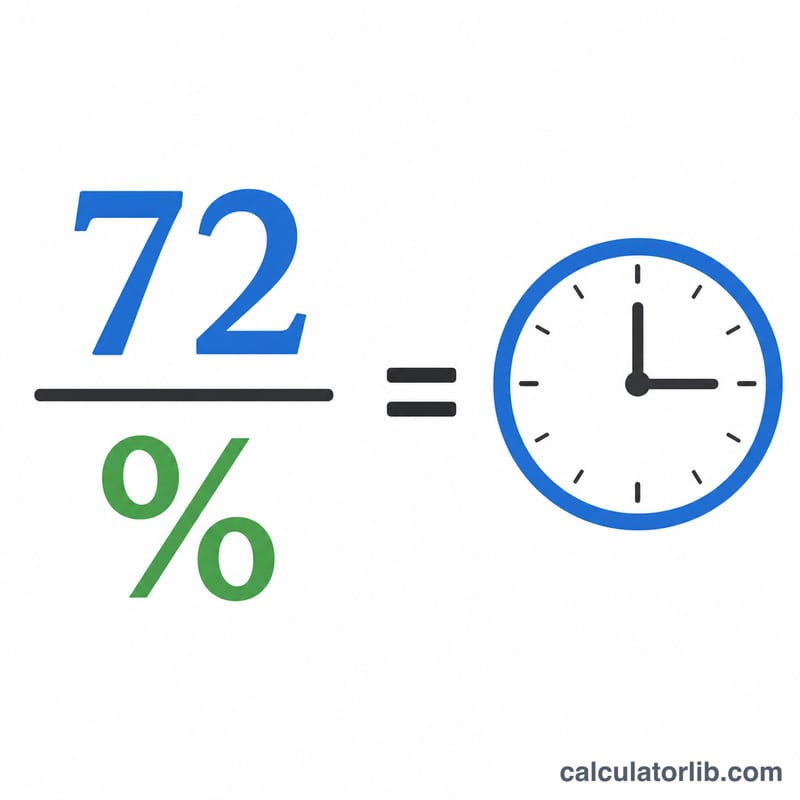
The core equation is $$\text{Years to Double} = \frac{72}{\text{Rate (\%)}}$$ The number 72 is chosen because it is close to the exact value (about 69.3, from \(100 \times \ln 2\)) but is far more divisible — it splits cleanly by 2, 3, 4, 6, 8, 9, and 12 — making the arithmetic easy to do in your head. The approximation is most accurate for rates between roughly 6% and 10%.
Worked Example
Suppose your portfolio earns 8% per year. Doubling time = $$72 \div 8 = 9 \text{ years}$$ That is \(9 \times 12 = 108\) months. So a $10,000 investment compounding at 8% would grow to roughly $20,000 in about nine years.
FAQ
Is the Rule of 72 exact? No — it is an approximation. The precise doubling time uses \(\frac{\ln(2)}{\ln(1+r)}\). At 8% the exact answer is about 9.01 years, so the rule is very close.
When should I use 70 or 69 instead? For continuous compounding or very low rates, the "Rule of 69.3" is more accurate. For everyday estimates, 72 is the best compromise.
Can I use it for inflation? Yes. At 3% inflation, prices double in about \(72 \div 3 = 24\) years, halving your purchasing power.