
What is the Axis of Symmetry?
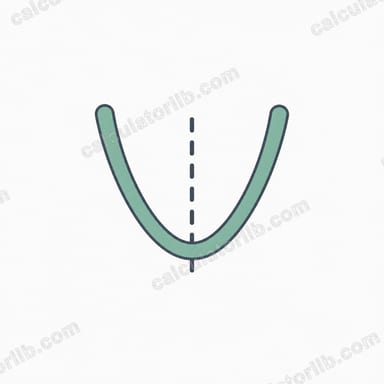
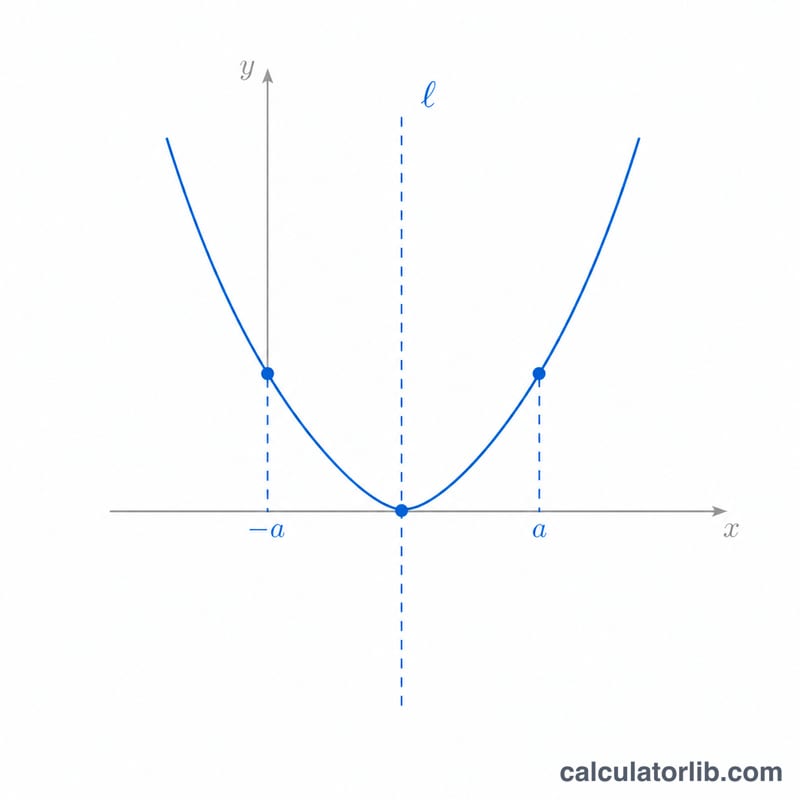
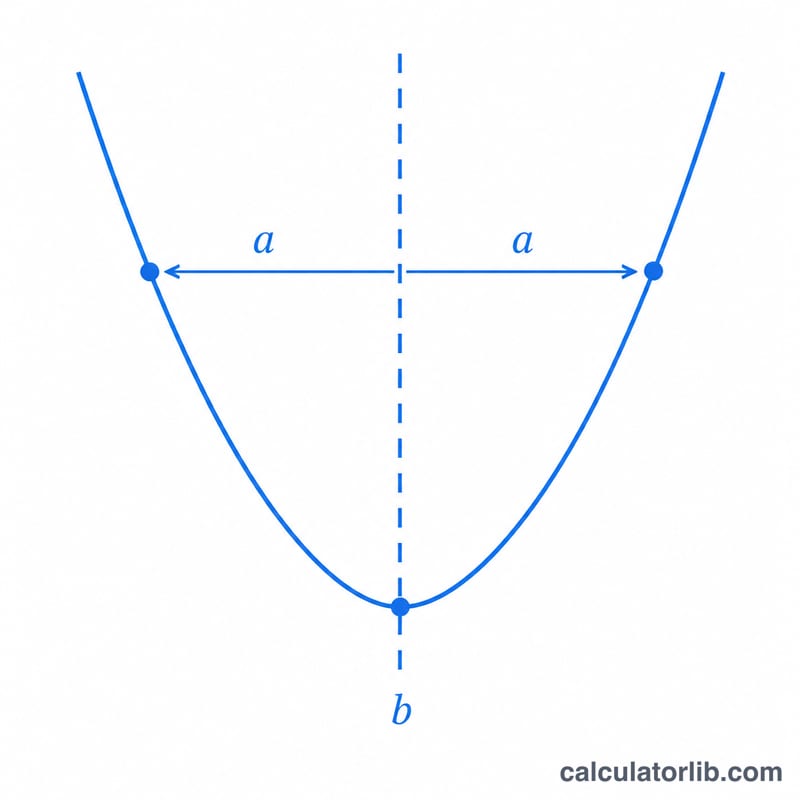
Every parabola described by a quadratic function \(y = ax^2 + bx + c\) has a vertical line that splits it into two mirror-image halves. This line is called the axis of symmetry, and it always passes through the vertex (the turning point) of the parabola. This calculator finds that line — and the vertex — directly from the three coefficients.
How to Use It
Enter the coefficients a, b and c from your equation \(y = ax^2 + bx + c\). The coefficient a must not be zero (otherwise the equation is a straight line). The calculator returns the axis of symmetry as x = a number, plus the full vertex coordinates.
The Formula Explained
The axis of symmetry is found with:
$$x = -\frac{b}{2a}$$
This comes from completing the square on the quadratic: the x-coordinate that minimizes (or maximizes) \(ax^2 + bx + c\) is exactly \(-\frac{b}{2a}\). Substituting that x back into the equation gives the vertex's y-value.
Worked Example
Take \(y = x^2 - 4x + 3\), so \(a = 1\), \(b = -4\), \(c = 3\).
$$x = -\frac{-4}{2 \times 1} = \frac{4}{2} = 2$$ The axis of symmetry is \(x = 2\). The vertex y-value is \(1(2)^2 - 4(2) + 3 = 4 - 8 + 3 = -1\), so the vertex is \((2, -1)\).
FAQ
What if a = 0? Then the equation is linear, not quadratic, and there is no axis of symmetry — the calculator will warn you.
Is the axis of symmetry the same as the vertex? Not exactly: the axis is a vertical line (an equation x = value), while the vertex is the single point on the parabola where that line crosses it.
Does the constant c affect the axis? No. Changing c shifts the parabola up or down but does not move the axis of symmetry, which depends only on a and b.