What Is Free Throw Percentage?
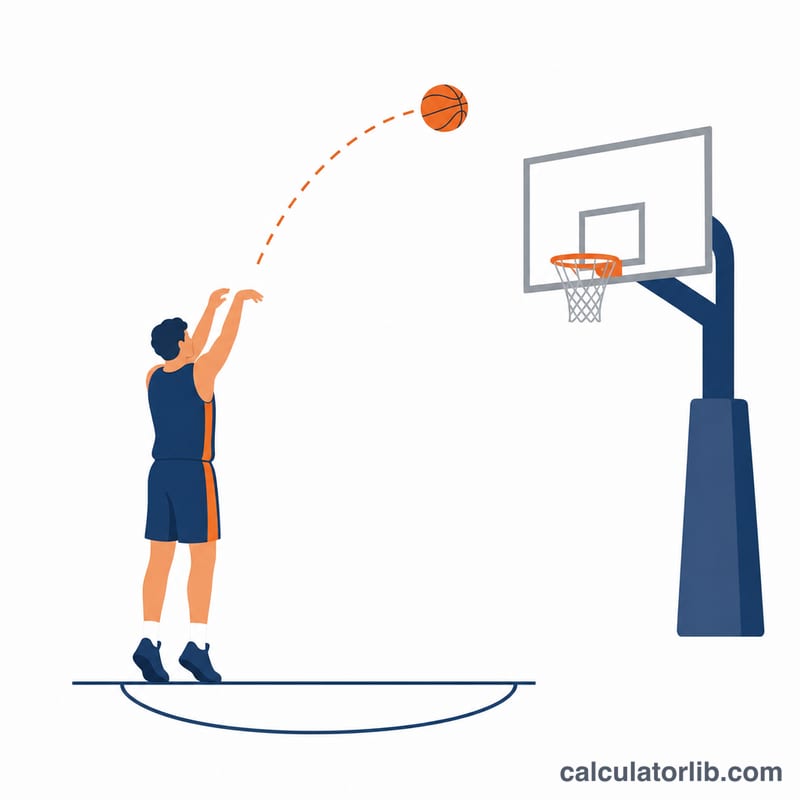
Free throw percentage (FT%) measures how often a basketball player successfully makes their free throws — the uncontested shots awarded after a foul. It is one of the simplest yet most telling efficiency stats in basketball, used at every level from youth leagues to the NBA. A higher FT% means a more reliable scorer when the game slows down and points come straight from the line.
How to Use This Calculator
Enter the number of free throws you made and the number you attempted, then read your percentage instantly. The calculator also shows how many shots you missed. Use it to track a single game, a season total, or to compare players. Attempts must be greater than zero to produce a percentage.
The Formula Explained
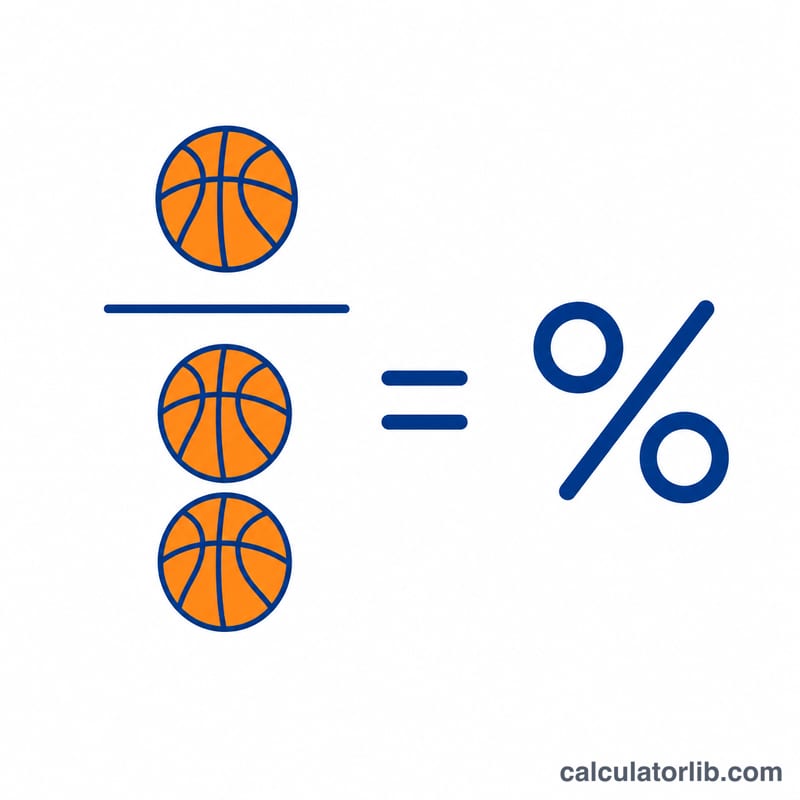
The math is straightforward:
$$\text{FT\%} = \frac{\text{Free Throws Made}}{\text{Free Throws Attempted}} \times 100$$
You divide makes by attempts to get a fraction, then multiply by 100 to express it as a percentage. The result ranges from 0% (missed everything) to 100% (made everything).
Worked Example
Suppose a player goes 8-for-10 from the line. Divide 8 by 10 to get 0.8, then multiply by 100: $$0.8 \times 100 = 80\%$$ The player missed 2 free throws, finishing the game shooting 80% from the stripe — a solid performance.
More Free Throw Percentage Examples
Each example below uses the same formula: \(\text{FT\%} = \frac{\text{Made}}{\text{Attempted}} \times 100\). The results are rounded to one decimal place.
Example 1: A Season Total Across Several Games
A player shoots 5 of 6 in game one, 3 of 7 in game two and 9 of 10 in game three. To get the combined percentage, add up all the makes and all the attempts first, then divide.
- Total made: \(5 + 3 + 9 = 17\)
- Total attempted: \(6 + 7 + 10 = 23\)
- Divide and multiply by 100: $$\text{FT\%} = \frac{17}{23} \times 100 = 0.73913 \times 100 \approx 73.9\%$$
The combined free throw percentage is 73.9%.
Do not average the per-game percentages. The three games come out to 83.3%, 42.9% and 90.0%. Their simple average is \((83.33 + 42.86 + 90.00) \div 3 \approx 72.1\%\), which is wrong. A simple average counts every game the same, even though the 10-attempt game should count for more than the 6-attempt game. Totaling makes and attempts weights each shot equally and gives the true figure of 73.9%.
Example 2: Only a Few Attempts
A player goes 1 for 3 from the line.
$$\text{FT\%} = \frac{1}{3} \times 100 = 0.3333 \times 100 \approx 33.3\%$$
The result is 33.3%. With this few shots, one more attempt changes the number a lot:
- If the next shot goes in: \(\frac{2}{4} \times 100 = 50.0\%\), up 16.7 points.
- If the next shot misses: \(\frac{1}{4} \times 100 = 25.0\%\), down 8.3 points.
A percentage built on only a handful of attempts says very little about how well someone actually shoots. Treat it as provisional until there are many more attempts.
Example 3: A High-Volume Shooter
Over a long season, a player makes 450 of 520 free throws.
$$\text{FT\%} = \frac{450}{520} \times 100 = 0.865384\ldots \times 100 = 86.5384\ldots\%$$
To round to one decimal place, look at the second decimal digit. It is 3, which is less than 5, so you round down to 86.5%. At this volume the number is stable. One more make gives \(\frac{451}{521} \times 100 \approx 86.6\%\), and one more miss gives \(\frac{450}{521} \times 100 \approx 86.4\%\). Each moves the result by only about 0.1 point.
FAQ
What is a good free throw percentage? At the professional level, anything above 80% is considered good, and elite shooters top 90%. For amateurs, 70% is respectable.
Do missed-and-rebounded shots count? No. Only awarded free throw attempts count toward FT%; field goals are tracked separately.
What if I attempted zero free throws? Percentage is undefined with zero attempts, so the calculator returns 0% until you enter at least one attempt.