
What Is the Inflation-Adjusted Rent Calculator?
This tool estimates how much your rent could be in the future if it rises in line with inflation. Using a constant annual inflation rate, it compounds your current monthly rent over the number of years you choose, giving a projected rent, the total dollar increase, and the percentage change. It is useful for tenants budgeting ahead and for landlords forecasting realistic rent adjustments.
How to Use It
Enter your current monthly rent, the expected annual inflation rate as a percentage, and the number of years into the future. The calculator applies compound growth and returns the projected rent along with how much, in dollars and percent, it has grown.
The Formula Explained
The core equation is:
$$\text{New Rent} = \text{Current Rent} \times \left(1 + r\right)^{n}$$
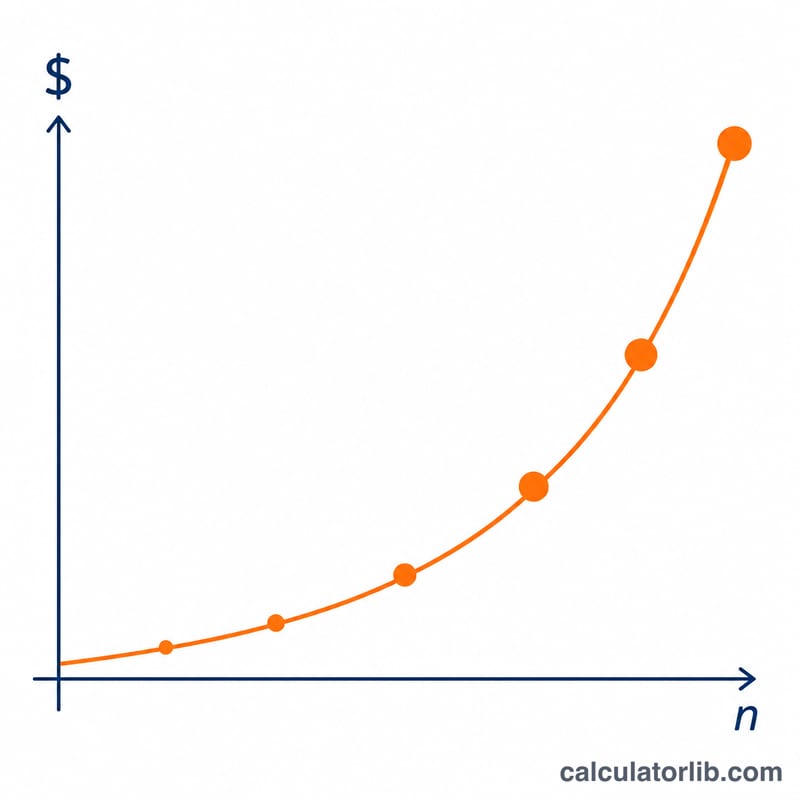
Here \(r\) is the annual inflation rate written as a decimal (3% = 0.03) and \(n\) is the number of years. Because the rate compounds, each year's increase is applied on top of the previous year's adjusted rent — not just on the original amount.
Worked Example
Suppose your rent is $1,500 per month, inflation runs at 3% per year, and you look 5 years ahead. Then $$\text{New Rent} = 1500 \times (1.03)^{5} = 1500 \times 1.159274 \approx \$1{,}738.91$$ That is a total increase of about $238.91, or roughly 15.93% over five years.
FAQ
Does this guarantee my rent will go up by inflation? No. Rent changes depend on your lease, local laws, and market conditions. This is a projection assuming rent tracks the inflation rate you enter.
What inflation rate should I use? A common long-run assumption is 2–3%, but you can use a recent published CPI figure or your own estimate.
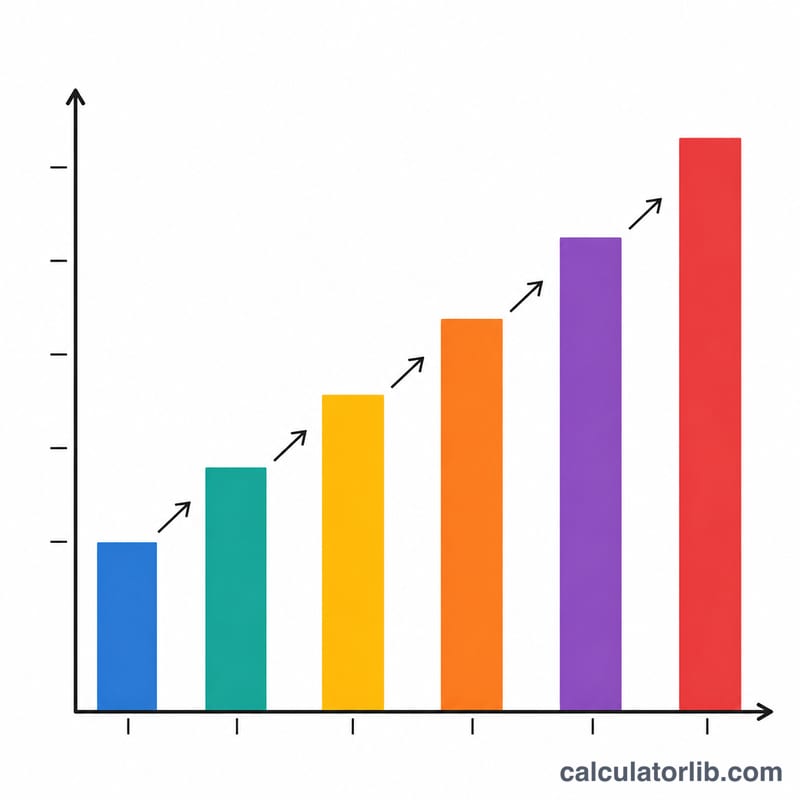
Why use compounding instead of a flat increase? Inflation accumulates year over year, so compounding gives a more realistic long-term projection than adding a fixed amount each year.