
What Is Real vs Nominal Value?
A nominal value is an amount expressed in current (today's) prices, while a real value is that same amount restated in the prices of a chosen base year. Because inflation erodes purchasing power over time, a nominal figure can overstate how much something is truly worth. This calculator "deflates" a nominal amount using a price index — such as the Consumer Price Index (CPI), GDP deflator, or any other index series — so you can compare values across different periods on an equal footing.
How to Use the Calculator
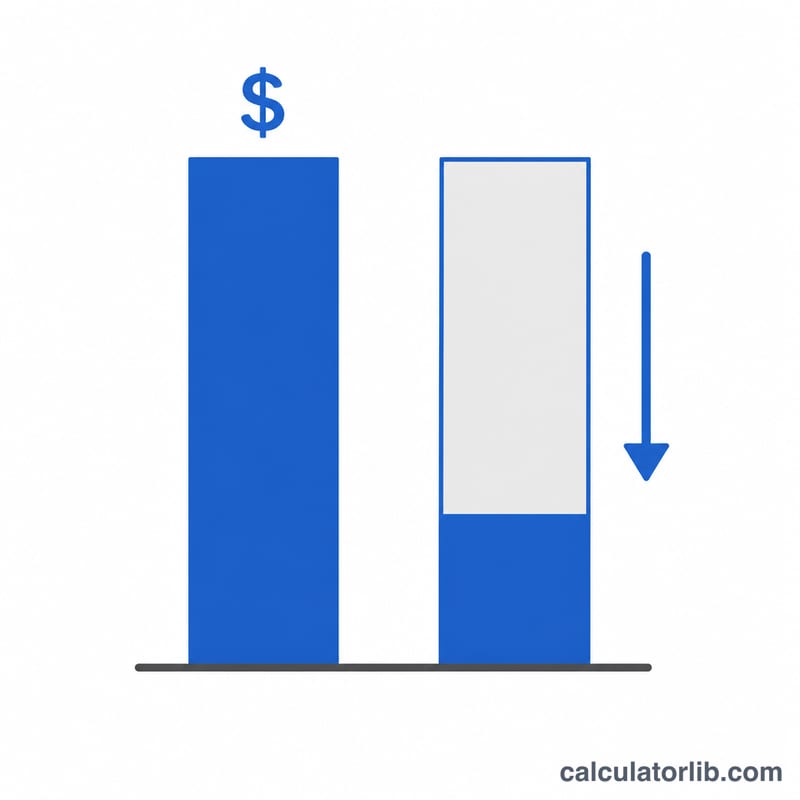
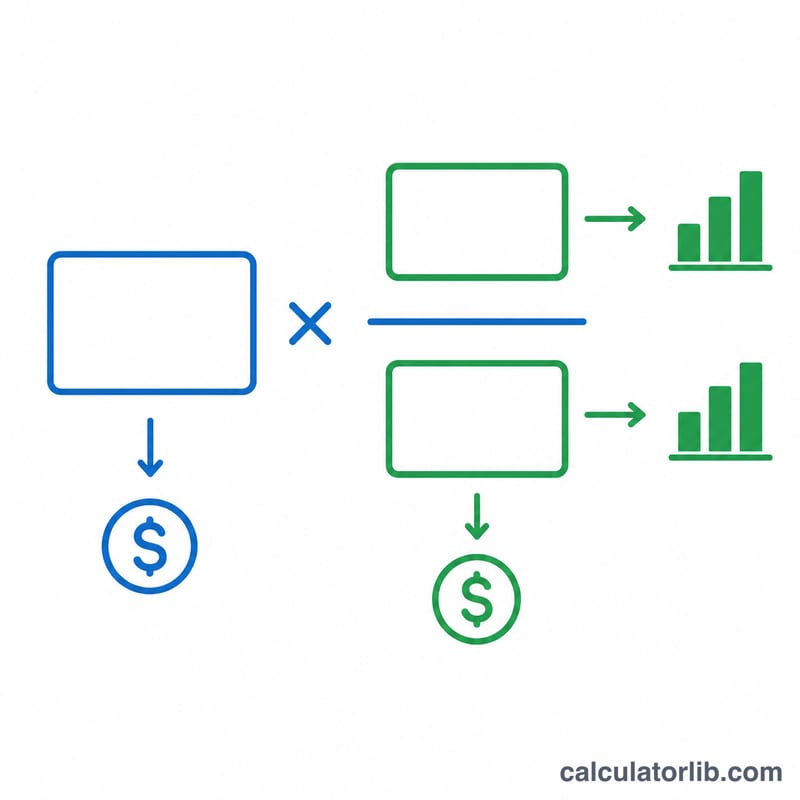
Enter three numbers: the nominal value you want to convert, the base-year price index (the period you want to express results in), and the current price index (the period your nominal value comes from). The tool divides the base index by the current index and multiplies that ratio by the nominal value to give the real value, plus the absolute and percentage difference.
The Formula Explained
The core equation is:
$$\text{Real Value} = \text{Nominal Value} \times \frac{\text{Base Index}}{\text{Current Index}}$$
When the current index is higher than the base index (prices have risen), the ratio is below 1 and the real value is smaller than the nominal value. When the base index is higher, the real value is larger.
Worked Example
Suppose you earned $50,000 in a year when the price index was 120, and you want to express it in base-year prices where the index was 100. $$\text{Real value} = 50{,}000 \times \frac{100}{120} = 50{,}000 \times 0.8333 = \$41{,}666.67$$ So $50,000 in the later year has the purchasing power of about $41,667 in the base year.
FAQ
Which index should I use? Use the index that matches what you're measuring — CPI for consumer purchasing power, the GDP deflator for broad output, or a sector-specific index.
What if both indexes are equal? The ratio is 1, so real value equals nominal value (no inflation adjustment).
Can I go the other way? Yes — to convert a real value back to nominal, simply swap the indexes (multiply by \(\text{current} \div \text{base}\)).