
What this calculator does
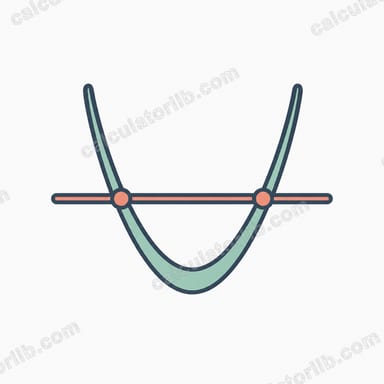
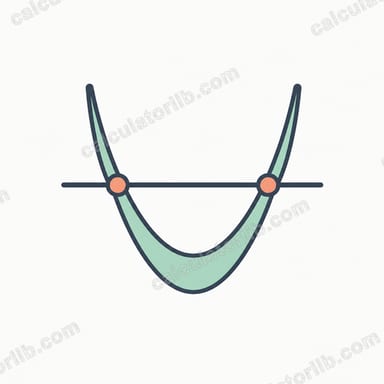
This tool analyzes a quadratic function written in standard form, \(y = ax^2 + bx + c\). It returns the y-intercept (where the parabola crosses the vertical axis) and the x-intercepts (where it crosses the horizontal axis, also called the roots or zeros). It also reports the discriminant and whether any real x-intercepts exist.
How to use it
Enter the three coefficients a, b and c from your equation. For example, in \(y = x^2 - 3x + 2\), you would enter \(a = 1\), \(b = -3\), \(c = 2\). Press calculate to see the intercepts. If \(a = 0\) the equation is linear and the tool solves the single-root case instead.
The formula explained
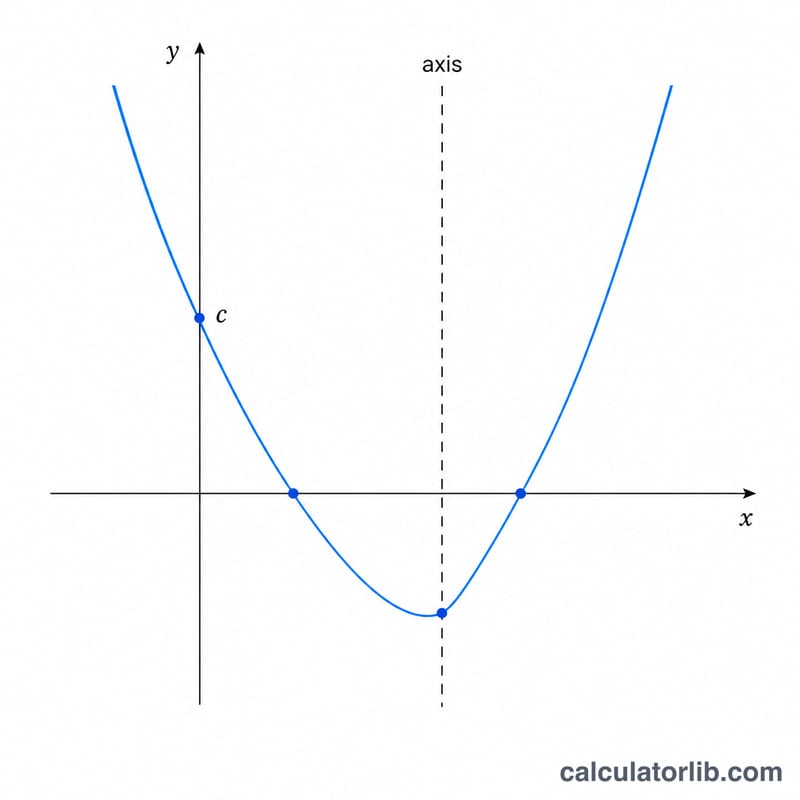
The y-intercept is simply \(f(0)\). Substituting \(x = 0\) leaves only the constant, so the y-intercept is always c — the point \((0, c)\). The x-intercepts come from the quadratic formula. The key part is the discriminant, \(D = b^2 - 4ac\). When \(D > 0\) there are two distinct real roots; when \(D = 0\) there is exactly one (a repeated root, where the parabola touches the axis); when \(D < 0\) there are no real x-intercepts because the parabola never crosses the x-axis.
$$x = -\frac{b}{2a} \qquad y = c$$$$x\text{-intercepts:}\quad x = \frac{-b \pm \sqrt{b^{2} - 4ac}}{2a}$$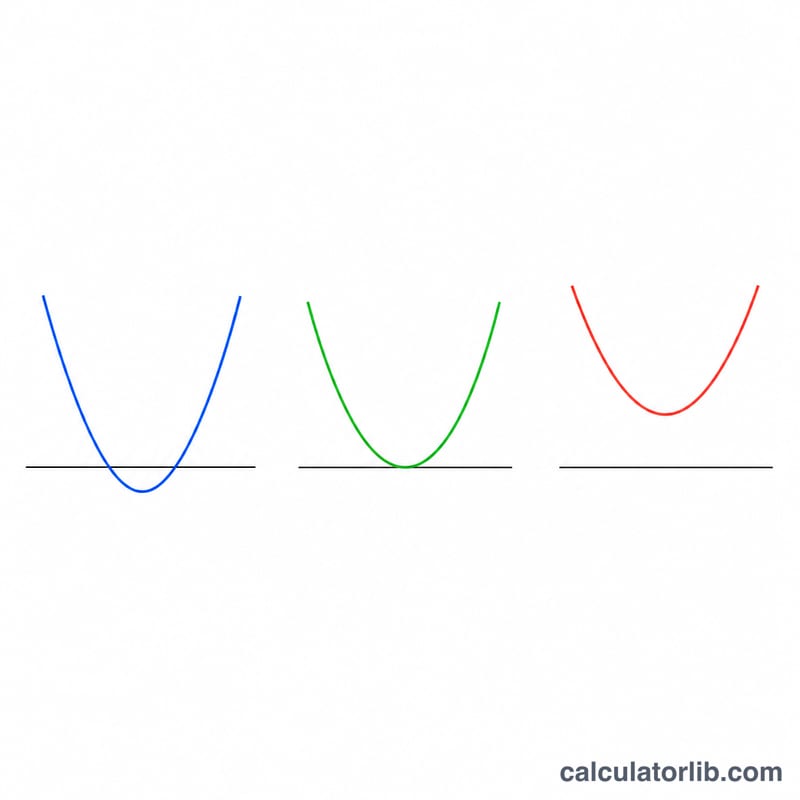
Worked example
For \(y = x^2 - 3x + 2\): the y-intercept is \((0, 2)\). The discriminant is $$(-3)^2 - 4(1)(2) = 9 - 8 = 1,$$ which is positive, so there are two real roots: $$x = \frac{3 \pm 1}{2},$$ giving \(x = 1\) and \(x = 2\). The intercepts are \((1, 0)\) and \((2, 0)\).
FAQ
Why does \(y = x^2 + 1\) have no x-intercepts? Its discriminant is \(0 - 4(1)(1) = -4 < 0\), so the parabola sits entirely above the x-axis and never crosses it.
What is the axis of symmetry? It is the vertical line \(x = -\frac{b}{2a}\), which passes through the vertex and lies midway between the two x-intercepts.
Can a equal zero? If \(a = 0\) the function is no longer quadratic but linear; the calculator still solves \(bx + c = 0\) for its single intercept.