
What is the Y-Intercept Calculator?
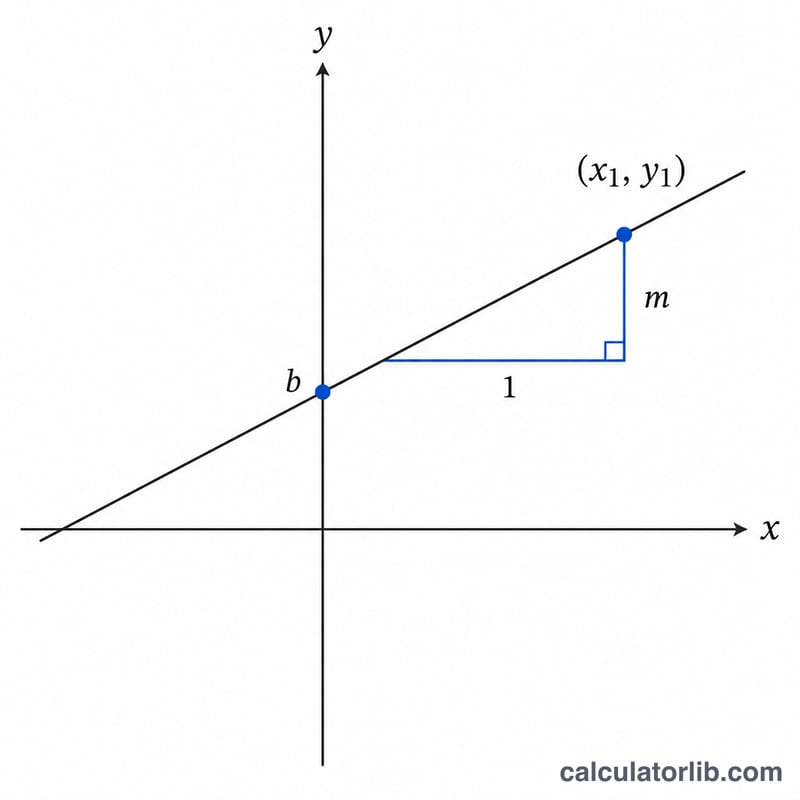
The y-intercept of a straight line is the point where the line crosses the y-axis — that is, the value of y when \(x = 0\). In the slope-intercept form of a line, \(y = mx + b\), the y-intercept is the constant b. This calculator finds b when you know the slope m and the coordinates of any single point (x₁, y₁) on the line.
How to Use It
Enter three values: the slope m, and the x and y coordinates of a known point on the line (x₁ and y₁). The calculator applies the formula and returns the y-intercept along with the complete equation of the line in slope-intercept form.
The Formula Explained
Start from the slope-intercept equation \(y = mx + b\). Since the point (x₁, y₁) lies on the line, it must satisfy the equation: \(y_1 = m \cdot x_1 + b\). Solving for b gives:
$$b = y_1 - m \cdot x_1$$This works for any non-vertical line, because vertical lines have an undefined slope and no single y-intercept formula of this type.
Worked Example
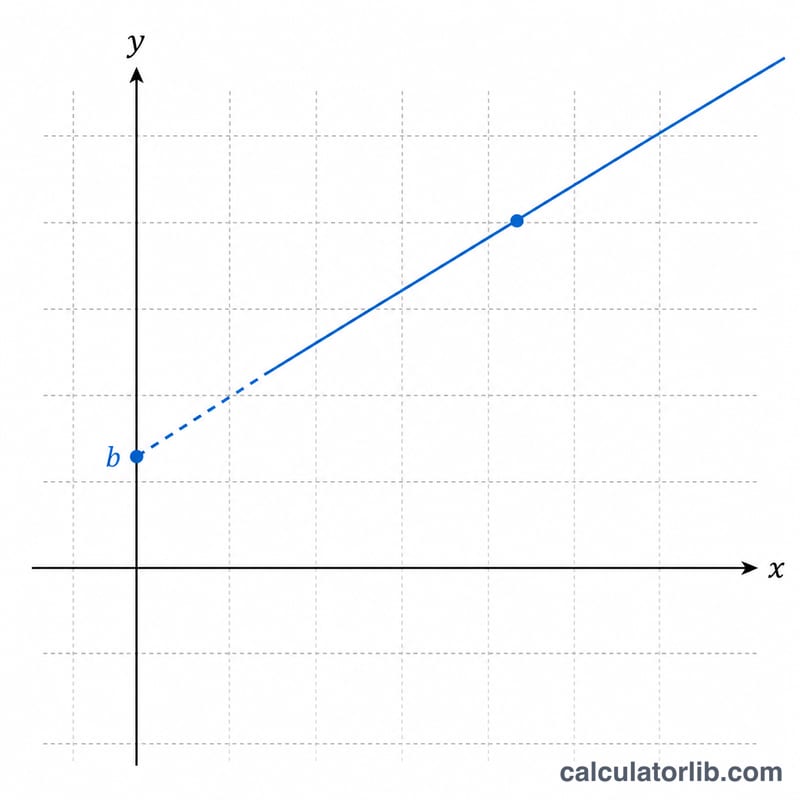
Suppose a line has slope m = 2 and passes through the point (3, 5). Then:
$$b = 5 - (2 \times 3) = 5 - 6 = -1$$So the line is \(y = 2x - 1\), and it crosses the y-axis at (0, −1).
FAQ
What does a y-intercept of 0 mean? The line passes through the origin (0, 0).
Can the slope be negative? Yes. A negative slope simply means the line goes downward from left to right; the formula still applies.
What if I have two points instead of a slope? First compute the slope \(m = (y_2 - y_1)/(x_2 - x_1)\), then use either point with this calculator.