
What Is the X-Intercept?
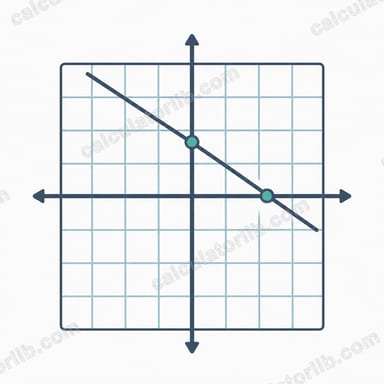
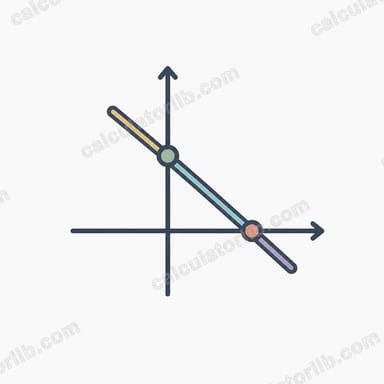
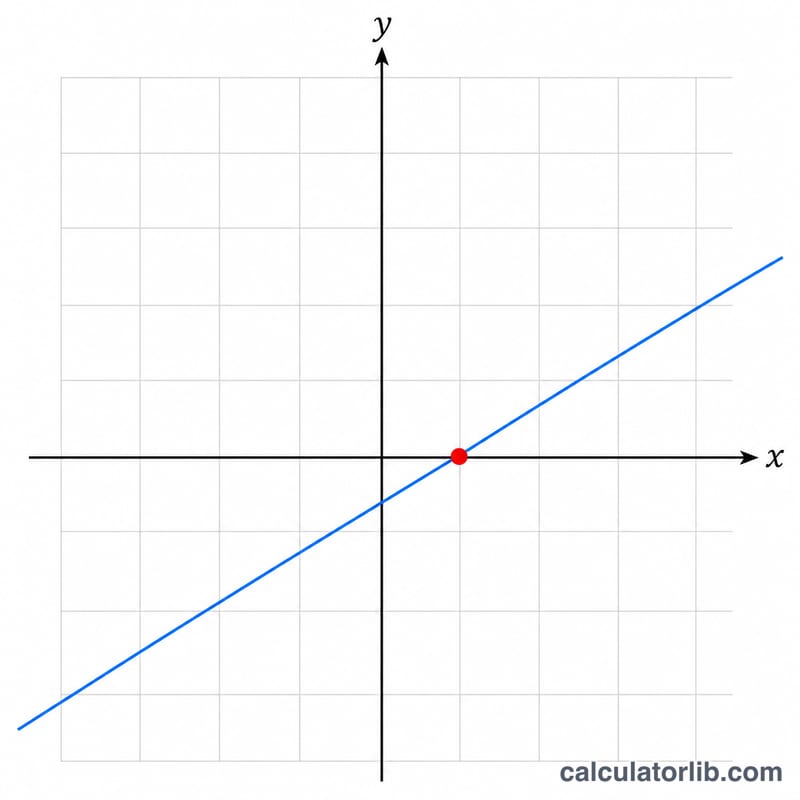
The x-intercept of a line is the point where the line crosses the x-axis. At every point on the x-axis the y-coordinate equals zero, so finding the x-intercept means solving the equation after setting \(y = 0\). This calculator works with any line written in slope-intercept form, \(y = mx + b\), and returns the exact x value where the line meets the horizontal axis.
How to Use It
Enter the slope m and the y-intercept b from your equation \(y = mx + b\). The calculator sets \(y = 0\) and solves for x, giving you both the x value and the full coordinate point \((x, 0)\). Decimals and negative numbers are allowed.
The Formula Explained
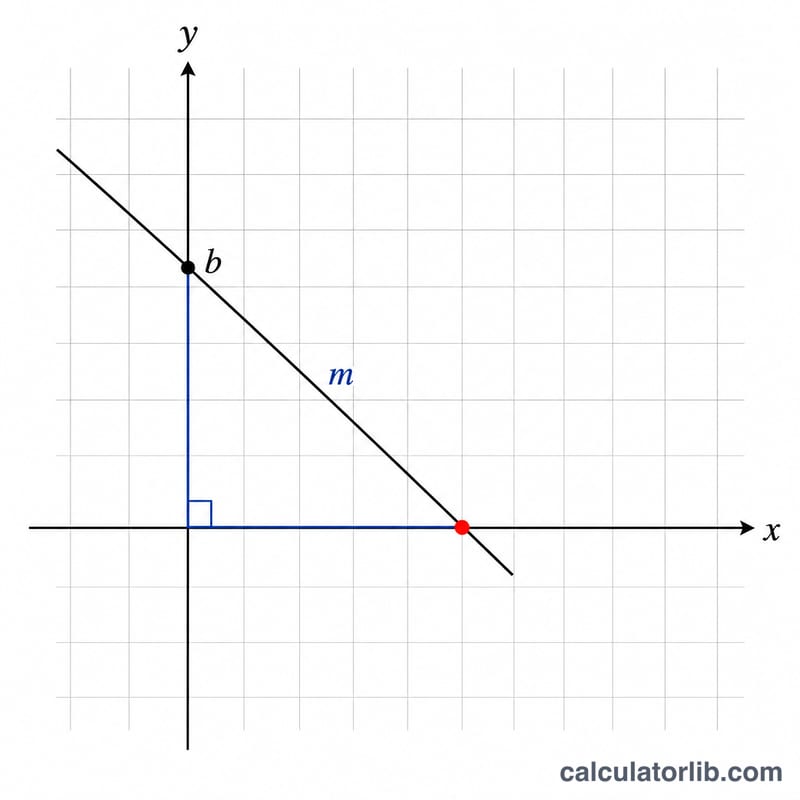
Starting from \(y = mx + b\), substitute \(y = 0\) to get \(0 = mx + b\). Subtract b from both sides: \(-b = mx\). Divide by the slope m:
$$x = -\frac{b}{m}$$This is the x-intercept. The division is only valid when m is not zero — a horizontal line (\(m = 0\)) never crosses the x-axis unless it is the x-axis itself.
Worked Example
Take \(y = 2x - 6\). Here \(m = 2\) and \(b = -6\). The x-intercept is
$$x = -\frac{b}{m} = -\frac{-6}{2} = \frac{6}{2} = 3$$So the line crosses the x-axis at the point \((3, 0)\). You can verify by plugging \(x = 3\) back in: \(y = 2(3) - 6 = 0\). Correct.
FAQ
What if the slope is 0? A line with \(m = 0\) is horizontal (\(y = b\)). It has no x-intercept unless \(b = 0\), in which case the line is the x-axis and meets it everywhere.
How do I find the y-intercept instead? The y-intercept is simply the constant b in \(y = mx + b\) — it is the value of y when \(x = 0\).
Can a line have more than one x-intercept? A straight (non-horizontal) line has exactly one x-intercept. Curves such as parabolas can have zero, one, or two.