
What this calculator does
This Quadratic Function Analyzer takes any quadratic in standard form, f(x) = ax² + bx + c, and instantly returns its complete profile: the vertex, the axis of symmetry, the discriminant, the real roots (x-intercepts), and the y-intercept. It is a universal math tool that works for parabolas in algebra, precalculus, physics projectile problems, and optimization.
How to use it
Enter the three coefficients a, b, and c. The coefficient a must be nonzero for a true quadratic (if a = 0 the equation is linear). Press calculate and read off every key feature of the parabola in one view.
The formulas explained
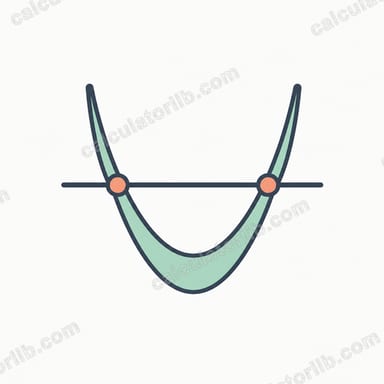
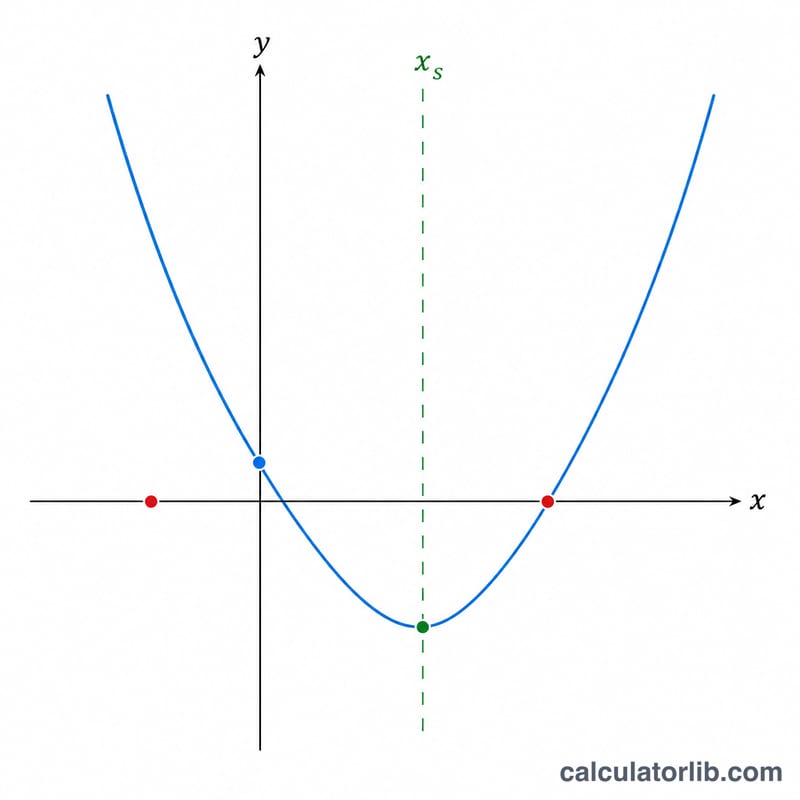
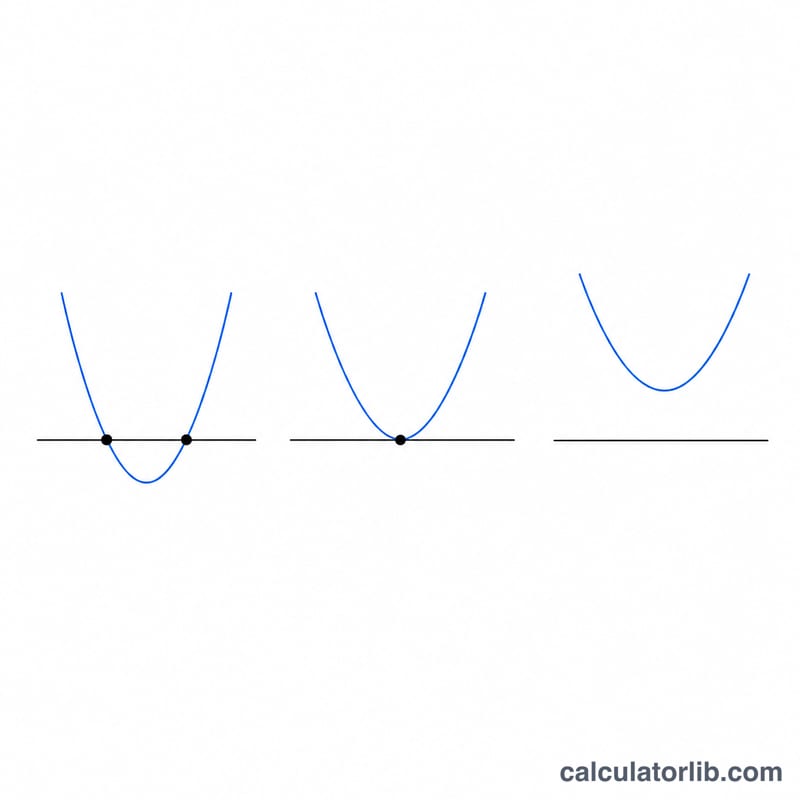
The axis of symmetry and the vertex share the same x-value: $$x = \frac{-b}{2a}$$ Plug that x back into the function to get the vertex y-value. The roots come from the quadratic formula, $$x = \frac{-b \pm \sqrt{b^{2} - 4ac}}{2a}$$ The quantity under the root, \(b^{2} - 4ac\), is the discriminant: if it is positive there are two real roots, if it is zero there is one repeated root, and if it is negative there are no real roots (the parabola never crosses the x-axis). The y-intercept is simply \(c\), since \(f(0) = c\).
Worked example
For \(f(x) = x^{2} - 3x + 2\) (a = 1, b = −3, c = 2): axis $$x = \frac{-(-3)}{2 \cdot 1} = 1.5$$ vertex $$y = 1.5^{2} - 3(1.5) + 2 = -0.25$$ so the vertex is \((1.5, -0.25)\). Discriminant \(= 9 - 8 = 1\), giving roots $$x = \frac{3 \pm 1}{2} = 2 \text{ and } 1$$ The y-intercept is \((0, 2)\).
FAQ
What if a = 0? The expression becomes linear (bx + c) and has at most one root; there is no parabola or vertex.
What does a negative discriminant mean? The parabola does not touch the x-axis, so there are no real roots — only complex ones.
Does the vertex x always equal the axis of symmetry? Yes. The axis of symmetry is the vertical line through the vertex, \(x = \frac{-b}{2a}\).