
What Is the Midpoint Formula?
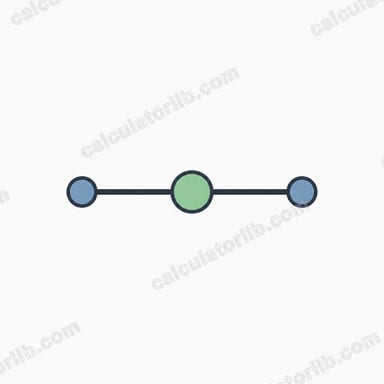
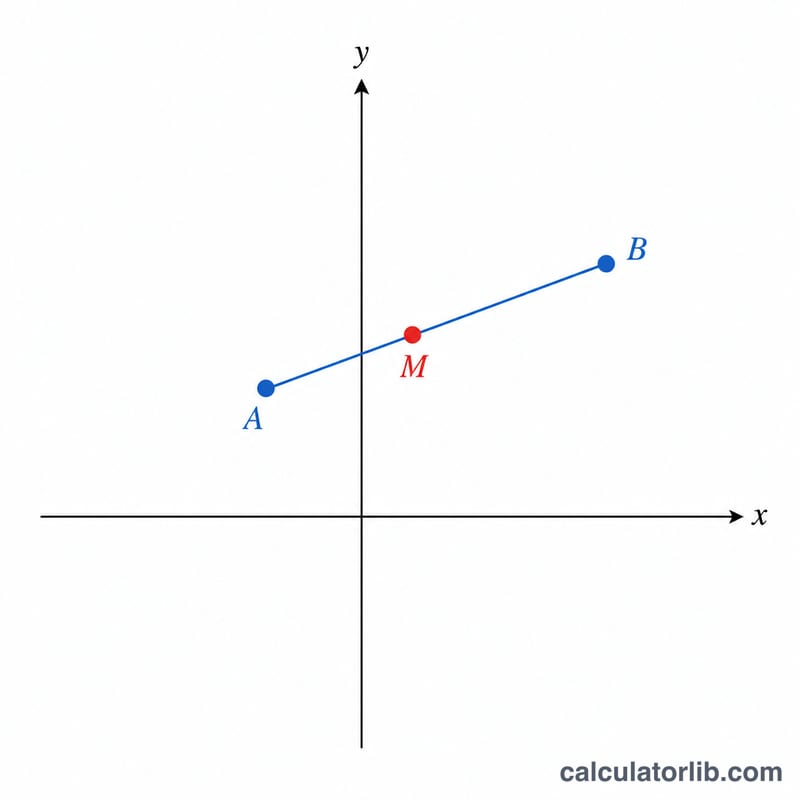
The midpoint formula finds the exact center point of a line segment connecting two points on a coordinate plane. Given two endpoints, the midpoint is simply the average of their x-coordinates and the average of their y-coordinates. It is a core concept in coordinate geometry, used in math classes, engineering, computer graphics, and mapping.
How to Use This Calculator
Enter the coordinates of your first point as x₁ and y₁, and the coordinates of your second point as x₂ and y₂. The calculator instantly returns the midpoint M as an ordered pair (Mx, My). Inputs can be positive, negative, or decimal numbers.
The Formula Explained
For two points \((x_1, y_1)\) and \((x_2, y_2)\), the midpoint is:
$$M = \left( \frac{x_1 + x_2}{2},\ \frac{y_1 + y_2}{2} \right)$$
Each coordinate of the midpoint is just the arithmetic mean of the matching coordinates of the endpoints. Because averaging is symmetric, the order of the two points does not matter — you get the same midpoint either way.
Worked Example
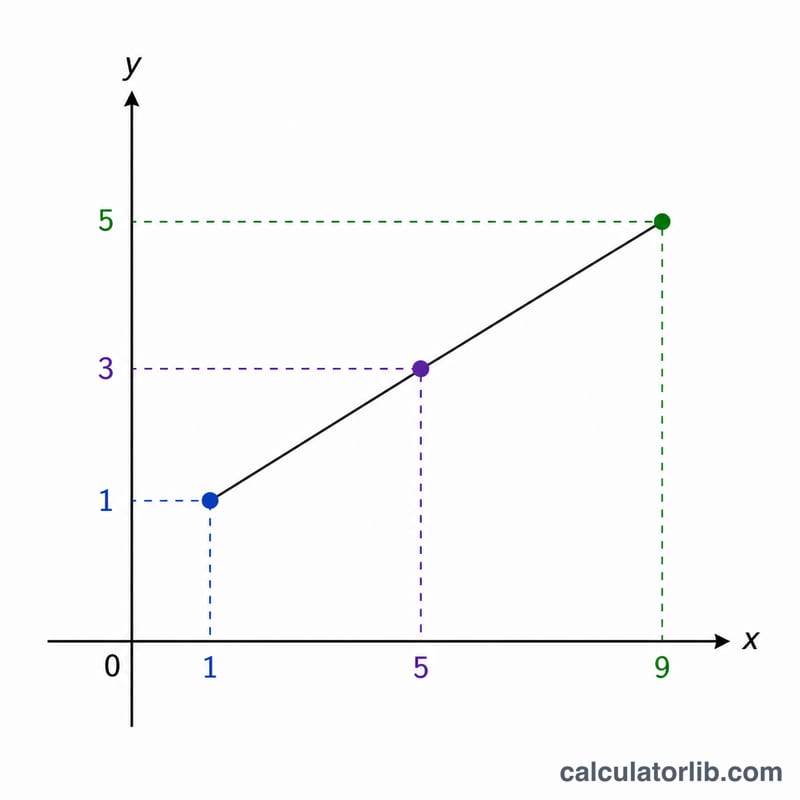
Find the midpoint between (2, 3) and (8, 7). The x-coordinate is \((2 + 8) / 2 = 10 / 2 = 5\). The y-coordinate is \((3 + 7) / 2 = 10 / 2 = 5\). So the midpoint is (5, 5).
FAQ
Does the order of the points matter? No. Since you are averaging, swapping point 1 and point 2 gives the identical midpoint.
Can I use negative or decimal coordinates? Yes. The formula works for any real numbers, including negatives and fractions.
How is this different from the distance formula? The midpoint formula gives the center point of a segment, while the distance formula gives its length. They are related but answer different questions.