
What is the Lung Nodule Doubling Time Calculator?
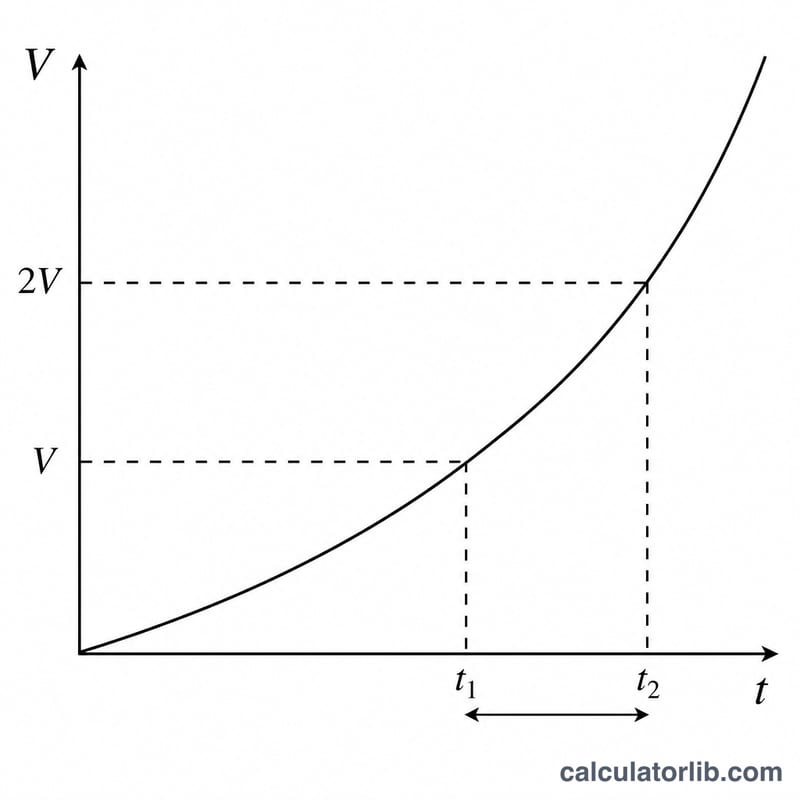
This tool estimates the volume doubling time (VDT) of a pulmonary (lung) nodule from two measurements taken on separate CT scans. VDT is widely used in nodule follow-up and lung cancer screening to help characterize whether a nodule is growing fast, slow, or remaining stable. This calculator is for educational purposes only and is not a substitute for radiology interpretation or clinical judgment.
How to use it
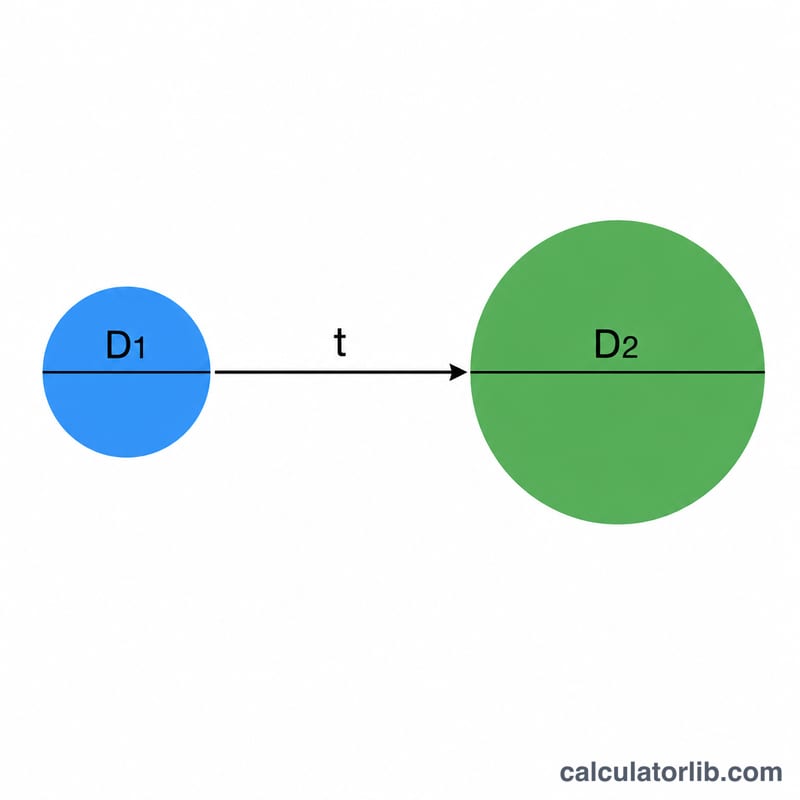
Enter the nodule's diameter on the first scan (D1), its diameter on the later scan (D2), and the time interval between the two scans in days. The result is the estimated number of days for the nodule's volume to double. A larger VDT means slower growth; a shorter VDT means faster growth.
The formula explained
Because a nodule's volume scales with the cube of its diameter (assuming a sphere), the volume ratio is (D2/D1)³. The doubling time follows from exponential growth:
$$\text{VDT} = \frac{\text{Time (days)} \cdot \ln(2)}{3 \cdot \ln\!\left(\dfrac{\text{D2 (mm)}}{\text{D1 (mm)}}\right)}$$
The factor of 3 converts the diameter ratio into a volume ratio. If D2 equals D1 there is no measurable growth and doubling time is undefined.
Worked example
A nodule measures 8 mm and grows to 10 mm over 180 days. The diameter ratio is \(10/8 = 1.25\), and \(\ln(1.25) \approx 0.22314\). $$\text{VDT} = \frac{180 \times 0.69315}{3 \times 0.22314} = \frac{124.767}{0.66943} \approx 186.4 \text{ days}$$ The volume ratio is \(1.25^3 \approx 1.953\), a roughly 95% increase in volume.
FAQ
What VDT suggests malignancy? As a general teaching guide, many solid malignant nodules have VDTs of roughly 20–400 days; very short (<20 days, likely infection/inflammation) or very long VDTs (>~600 days) are less typical of aggressive cancer. Always defer to a clinician.
Can I use the same units? Yes — D1 and D2 just need the same length unit; only their ratio matters. Time is reported in whatever unit you enter (here, days).
Why use volume instead of diameter? Volume changes much more dramatically than diameter for the same growth, making subtle growth easier to detect and standardize.