
What is the Cell Doubling Time Calculator?
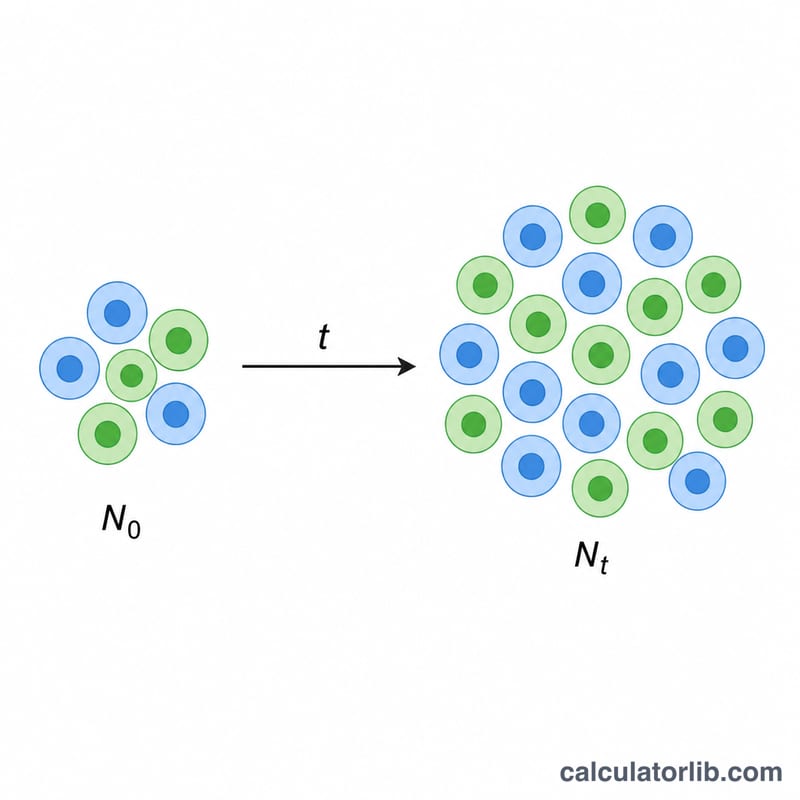
The doubling time is the time it takes for a population of cells (or any exponentially growing quantity) to double in number. It is a fundamental metric in cell biology, microbiology, and tissue culture used to characterize how quickly a cell line proliferates. This calculator derives the doubling time directly from two measured cell counts and the time that elapsed between them.
How to use it
Enter the initial cell count (N₀) measured at the start, the final cell count (Nₜ) measured later, and the elapsed time (t) between the two measurements. The result is reported in the same time units you entered for t — if you enter t in hours, the doubling time is in hours. The calculator also reports how many doublings occurred and the exponential growth rate per time unit.
The formula explained
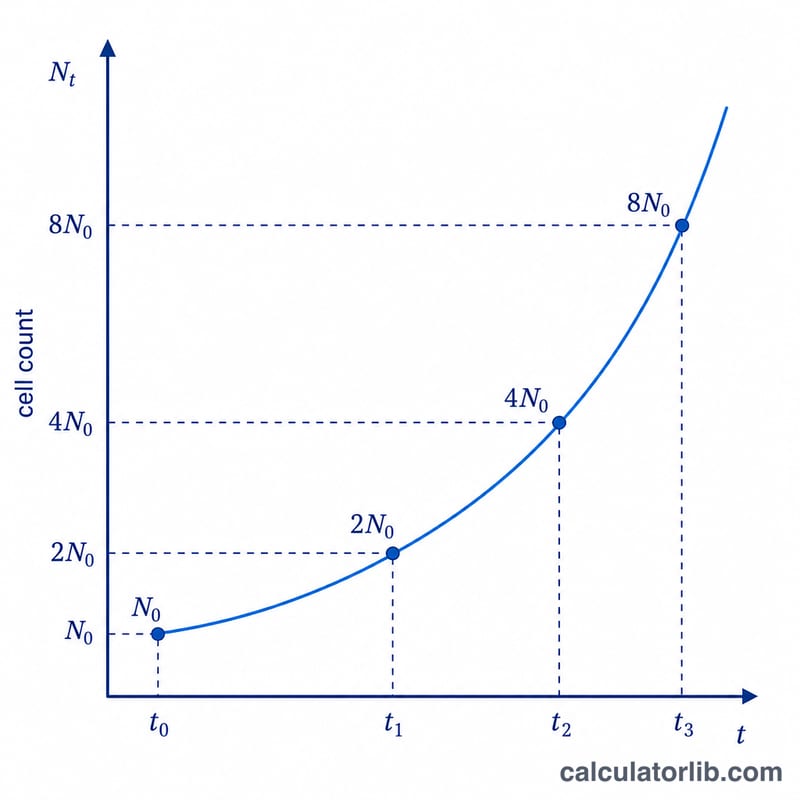
Exponential growth follows \(N_t = N_0 \cdot 2^{t/T_d}\). Solving for \(T_d\) gives:
$$T_d = \frac{t \cdot \ln 2}{\ln\left(\frac{N_t}{N_0}\right)}$$
The ratio \(N_t/N_0\) must be greater than 1 (the population must have grown) for a meaningful result. The number of doublings is simply \(\log_2\left(\frac{N_t}{N_0}\right)\), and the continuous growth rate is \(\ln(N_t/N_0)/t\).
Worked example
Suppose you seed 10,000 cells and measure 40,000 cells after 24 hours. The ratio is \(40{,}000/10{,}000 = 4\). Then $$T_d = \frac{24 \cdot \ln 2}{\ln 4} = \frac{24 \cdot 0.6931}{1.3863} = 12 \text{ hours}.$$ The population doubled \(\log_2(4) = 2\) times.
FAQ
What units should I use? Any consistent unit for time — the answer comes out in the same unit. Hours are most common for mammalian cells.
Why must Nₜ be greater than N₀? The logarithm of a ratio ≤ 1 is zero or negative, which doesn't represent growth and would make the formula undefined or meaningless.
Does this account for cell death? No — it assumes net exponential growth. The result reflects the apparent (net) doubling time over the interval.