
What Is Log Reduction?
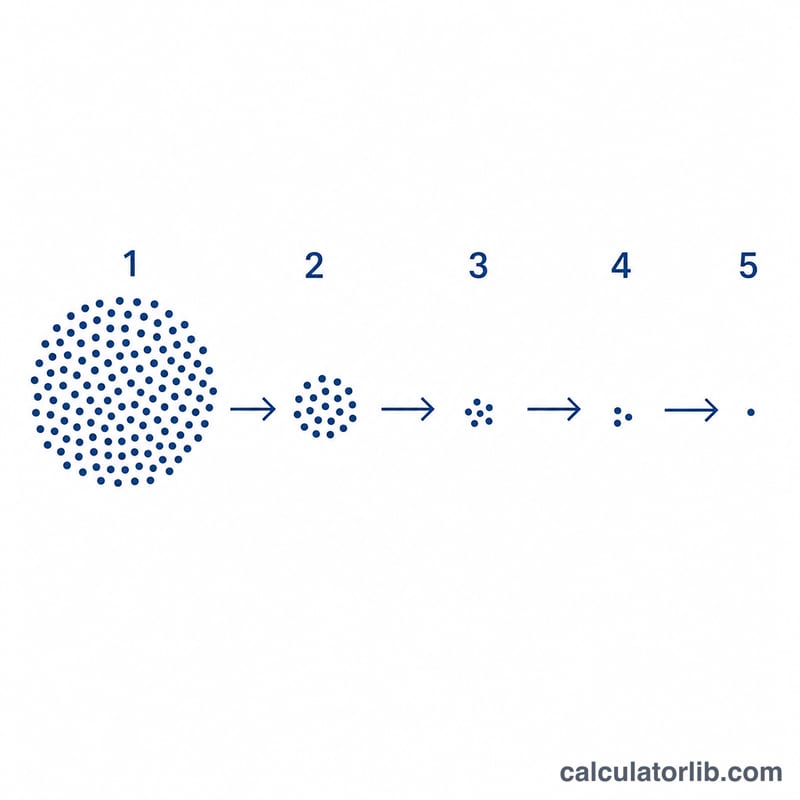
Log reduction (also called the Log Reduction Value, or LRV) measures how effectively a process — such as disinfection, sterilization, filtration, or pasteurization — reduces the number of viable microorganisms. It is expressed on a base-10 logarithmic scale, so each whole-number increase represents a tenfold drop in microbial count. A 1-log reduction removes 90% of organisms, a 2-log reduction removes 99%, a 3-log reduction removes 99.9%, and so on.
How to Use This Calculator
Enter the initial count (the microbial concentration before treatment, e.g. in CFU/mL) and the final count (the concentration after treatment). The calculator returns the log reduction value, the equivalent percent reduction, and the surviving fraction. Both counts must be positive numbers for a valid log value.
The Formula Explained
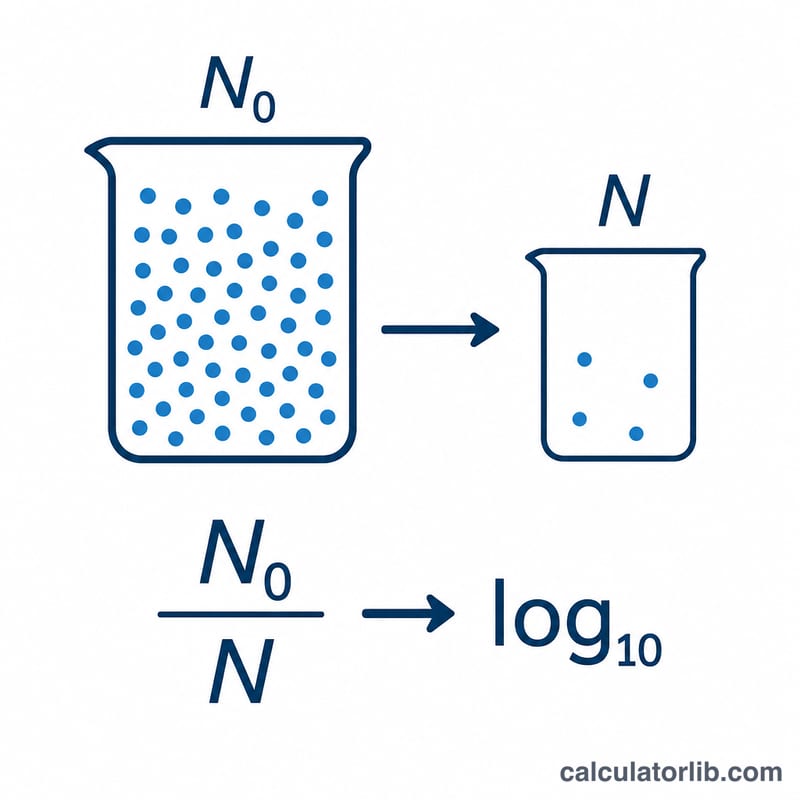
The log reduction is the base-10 logarithm of the ratio between the starting and ending populations:
$$\text{LRV} = \log_{10}\left(\frac{N_0}{N}\right)$$
where \(N_0\) is the initial count and \(N\) is the final count. The percent reduction is calculated separately as $$\%\,\text{Reduction} = \left(1 - \frac{N}{N_0}\right)\times 100$$ which tells you the proportion of organisms eliminated.
Worked Example
Suppose a disinfectant reduces a bacterial population from 1,000,000 CFU/mL to 100 CFU/mL. The ratio is \(1{,}000{,}000 \div 100 = 10{,}000\), and \(\log_{10}(10{,}000) = 4\). So the treatment achieves a 4-log reduction. The percent reduction is $$\left(1 - \frac{100}{1{,}000{,}000}\right)\times 100 = 99.99\%$$ with a surviving fraction of 0.01%.
FAQ
What is a good log reduction? It depends on the application. Hand sanitizers often target a 3-log (99.9%) reduction, while sterilization processes may require a 6-log (99.9999%) reduction.
Can the final count be zero? Mathematically \(\log_{10}(N_0/0)\) is undefined (infinite). Use the detection limit of your assay as the final count instead.
How does percent reduction relate to log reduction? 1 log = 90%, 2 log = 99%, 3 log = 99.9%, 4 log = 99.99% — each additional log adds one more "9".