
What this calculator works out
You give it a target balance and a date, and it tells you three ways to get there: how much to put away every month, how much to put away every year, or how much extra cash you would need in the account today to never contribute again. Your current savings are assumed to keep growing at the same return, so the calculator only sizes the gap that growth alone will not close.
Use it when you already have a target in mind — from an advisor, a rule of thumb, or another calculator — and need to turn it into a contribution you can set up as a standing transfer.
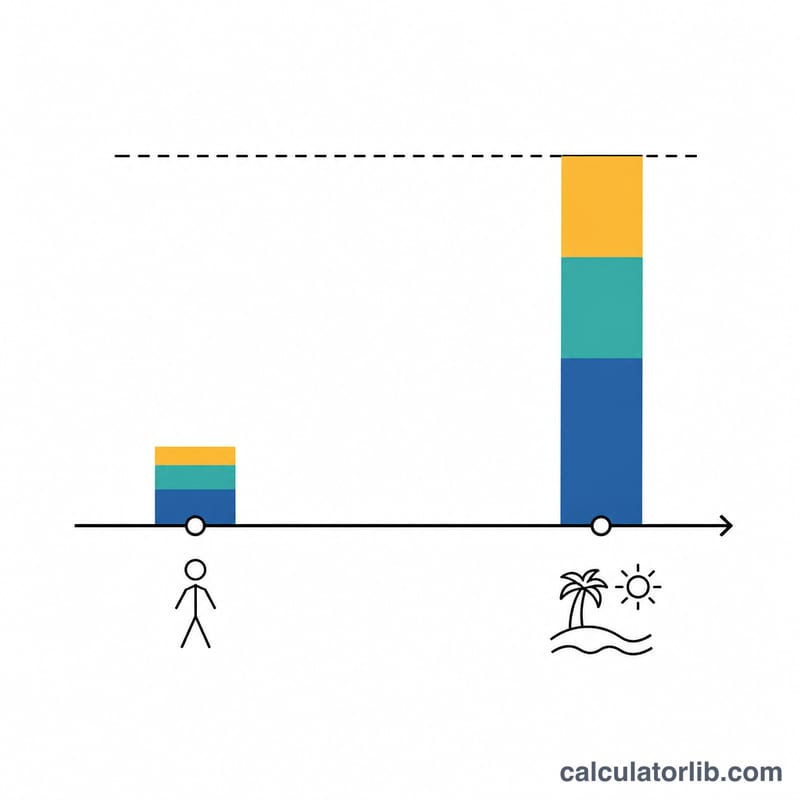
The five inputs, and what to put in them
All five fields are always read, and none of them has an upper limit.
| Input | Where the value comes from | Sensible range |
|---|---|---|
| Your age now | Your actual age. Fractions are accepted, so 35.5 is a legal entry. | 18–70 |
| Your planned retirement age | The age you intend to stop contributing. Must be strictly greater than your current age. | 55–75 |
| Amount needed at the retirement age | Your target balance on the day you retire — in future dollars, not today's. Commas are fine. | $250,000–$3,000,000 |
| Your retirement savings now | The combined balance of the accounts earmarked for retirement. Negative values are accepted if you are in the hole. | $0–$1,000,000 |
| Average investment return | The effective annual return you expect on the whole pot, before inflation. Negative values are accepted. | 3%–10% |
There is no inflation field, no fee field and no contribution-escalation field, so the answer is in nominal dollars at a flat contribution. If you want an inflation-adjusted result, subtract your inflation assumption from the return before typing it in.
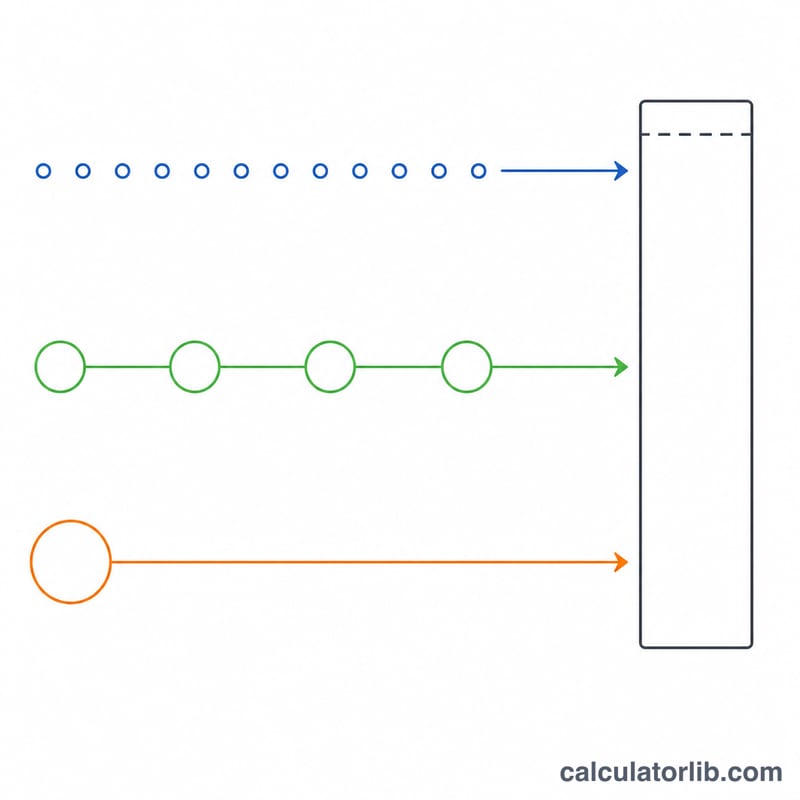
The formula
With \(A_0\) = age now, \(A_r\) = retirement age, \(R\) = return in percent, \(PV\) = savings now and \(FV\) = amount needed:
$$n = A_r - A_0, \qquad r = \frac{R}{100}, \qquad g = (1+r)^n, \qquad i = (1+r)^{1/12} - 1$$\(n\) is the horizon in years (never rounded), \(g\) is total growth over that horizon, and \(i\) is the monthly rate — the twelfth root of the annual rate, not \(r/12\). Your existing balance grows to \(PV\times g\) on its own, so the amount contributions must supply is
$$\text{need} = FV - PV \times g$$ $$\text{Monthly} = \frac{ \text{need}}{(g-1)/i}, \qquad \text{Yearly} = \frac{ \text{need}}{(g-1)/r}, \qquad \text{Lump sum today} = \frac{FV}{g} - PV$$Contributions are assumed to land at the end of each month or year. Each plan also reports a total principal and total interest:
$$\text{Principal} = PV + \text{contribution} \times \text{number of payments}, \qquad \text{Interest} = FV - \text{Principal}$$Worked example
Age now 30, retiring at 65, target $750,000, current savings $50,000, return 7%. So \(n = 35\), \(r = 0.07\), and 420 monthly payments.
$$g = 1.07^{35} = 10.676581, \qquad i = 1.07^{1/12} - 1 = 0.005654145$$ $$PV \times g = \$50{,}000 \times 10.676581 = \$533{,}829.07$$ $$\text{need} = \$750{,}000 - \$533{,}829.07 = \$216{,}170.93$$ $$\text{Monthly} = \frac{\$216{,}170.93}{(10.676581-1)/0.005654145} = \frac{\$216{,}170.93}{1711.4136} = \$126.31$$ $$\text{Yearly} = \frac{\$216{,}170.93}{(10.676581-1)/0.07} = \frac{\$216{,}170.93}{138.2369} = \$1{,}563.77$$ $$\text{Lump sum today} = \frac{\$750{,}000}{10.676581} - \$50{,}000 = \$70{,}247.20 - \$50{,}000 = \$20{,}247.20$$The monthly plan's principal is \(\$50{,}000 + \$126.3113 \times 420 = \$103{,}051\), leaving \(\$750{,}000 - \$103{,}051 = \$646{,}949\) of interest. Note that $126.31 a month and $1,563.77 a year are not the same plan — twelve payments of $126.31 is $1,515.72, less than the yearly figure, because monthly money spends longer in the market.
Rules that surprise people
The return is an effective annual rate, and the monthly rate is its twelfth root. Most calculators divide the annual rate by 12; this one uses \((1+r)^{1/12}-1\), which is slightly smaller and therefore demands a slightly larger contribution. On the default scenario the difference is $362.74 versus $351.05 a month — about 3% — and it widens with the horizon. Type the compounded return you actually expect, not a nominal one.
Total Principal includes the money you already have. It is not the sum of the contributions the plan tells you to make. On the default scenario the monthly plan shows $169,292 of principal, but the contributions themselves are only $139,292 — the other $30,000 is the opening balance. Subtract your current savings from that row before treating it as "what I will pay in."
The table is computed from the unrounded contribution. The payment is rounded to the cent for display only, so multiplying the number on screen by the number of payments will miss the principal row by a dollar or two. The table is right; your recomputation of it will be slightly off.
Above a certain balance the table vanishes entirely. If the extra lump sum needed today comes out at one dollar or less, you get a paragraph instead of three plans — telling you to just leave your savings alone and what they will grow to. The trigger is not "savings ≥ goal": on the defaults it fires at $92,973.44 against a $600,000 goal, i.e. with 15% of the target in hand, because growth covers the rest.
A zero return still works, and so does a negative one. At 0% the contribution is simply the shortfall spread evenly: the default scenario becomes $1,484.38 a month, exactly \(\$570{,}000 / 384\). At a negative return the required contributions exceed the goal, so the interest row goes negative — at −3% on the defaults, principal $950,288 and interest −$350,288. That is arithmetic, not an error: the negative number is the money the market takes off you.
Retirement age is echoed exactly as typed; the goal is not. Enter 67.5 and the plan headings read "until 67.5". The target amount, by contrast, is displayed rounded to whole dollars while the arithmetic keeps every cent — a goal of $600,000.75 displays as $600,001 but produces a yearly contribution one cent higher than a $600,001 goal would.
Zero is allowed; equal ages are not. An age of 0 or a goal of 0 is accepted despite the wording asking for a positive number. But a retirement age equal to your current age is rejected outright with "You are at retirement age already" — the horizon must be strictly positive. If several fields are wrong, you get every complaint at once, not just the first.
How the Required Contribution Changes Across Scenarios
The required level contribution follows the calculator's formula \(M = \dfrac{i\,(A - S g)}{g - 1}\), with \(g = (1+r)^{n}\) and the effective monthly rate \(i = (1+r)^{1/12} - 1\). The table below fixes the retirement target at \(A = 1{,}000{,}000\) and current savings at \(S = 50{,}000\), then varies the horizon \(n\) (years to retirement) against the assumed annual return \(r\). Each cell is the required monthly contribution.
| Years to retirement (n) | 4% return | 6% return | 8% return |
|---|---|---|---|
| 10 | $6,312 | $5,604 | $4,952 |
| 20 | $2,447 | $1,852 | $1,348 |
| 30 | $1,223 | $731 | $353 |
| 35 | $892 | $448 | $122 |
Two structural effects are visible. First, time dominates: at 6%, stretching the horizon from 10 to 30 years cuts the required monthly amount by roughly 87%, because \(g\) grows exponentially in \(n\) while the payment scales with \(1/(g-1)\). Second, the return assumption matters far more over long horizons than short ones — at \(n = 10\) the 4%-to-8% spread changes the payment by about 22%, but at \(n = 35\) it changes it by roughly 86%.
Holding the return at 6% and varying current savings
Existing savings enter only through the term \(S g\), the future value of what you already hold. It reduces the gap \(A - S g\) directly, so its impact is leveraged by the same growth factor. Below, \(A = 1{,}000{,}000\), \(r = 6\%\) and \(n = 20\) (for example, age 45 to 65).
| Current savings (S) | Future value of that balance (S·g) | Remaining gap (A − S·g) | Monthly contribution |
|---|---|---|---|
| $0 | $0 | $1,000,000 | $2,205 |
| $50,000 | $160,357 | $839,643 | $1,852 |
| $200,000 | $641,427 | $358,573 | $791 |
At 6% over 20 years \(g = 3.2071\), so every $1 of current savings removes $3.21 from the amount your future contributions must generate. Push the same $200,000 out to \(n = 30\) and \(S g \approx 1{,}148{,}700\) — larger than the target itself, which makes \(A - S g\) negative and the required contribution zero or below.
Every figure above is nominal (not inflation-adjusted) and is computed with the monthly rate \(i = (1+r)^{1/12} - 1\), exactly as the calculator does — not \(r/12\). Amounts are shown with a dollar sign for readability, but the arithmetic is currency-neutral: the same numbers apply to any currency unit. Figures are rounded to the nearest unit.
What Your Result Actually Tells You
The output is a single level nominal contribution: the same amount deposited every period from now until the retirement age you entered, sized so that it plus the grown value of your current savings equals your target on the retirement date. It is stated in future currency units, not in today's purchasing power. If prices rise 2.5% a year for 30 years, a $1,000,000 balance then buys what about $477,000 buys today (\(1{,}000{,}000 / 1.025^{30}\)). To plan in real terms, either enter an inflated target or enter a real (inflation-adjusted) return in place of the nominal one — but do not mix the two.
Why the monthly plan is never more than one twelfth of the yearly plan. Twelve monthly deposits are made throughout the year, so early ones compound for extra months; one annual deposit does not. The yearly amount therefore has to be larger than twelve times the monthly amount to reach the same target. The ratio is \(\dfrac{r}{12\,\bigl((1+r)^{1/12} - 1\bigr)}\) — about 1.027 at \(r = 6\%\), so a $731/month plan corresponds to roughly $9,017 a year, not $8,778. Seeing a monthly figure above one twelfth of the yearly figure would indicate an input or reading error, not a real option.
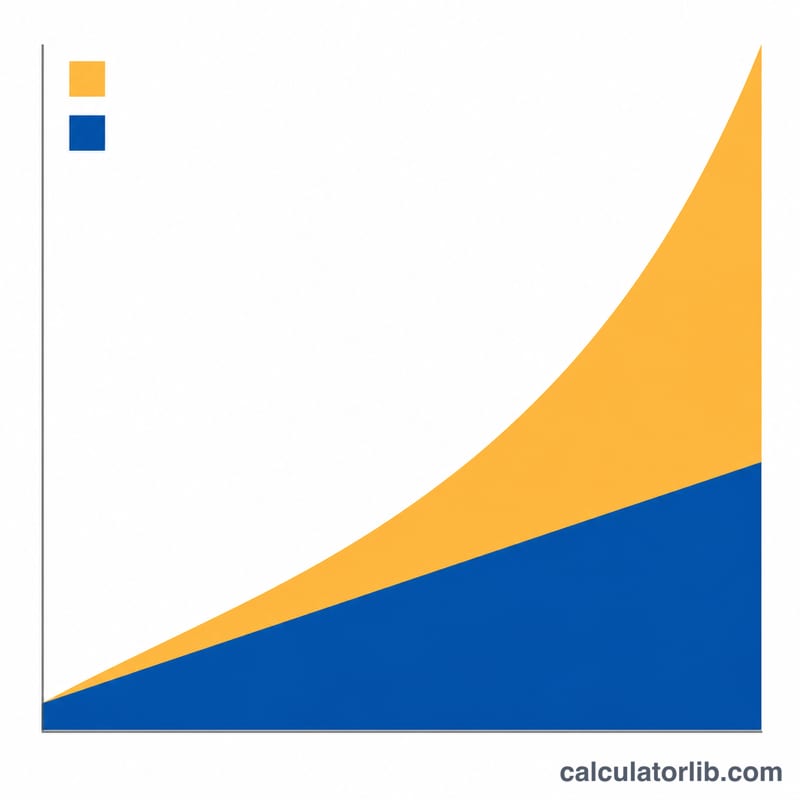
Principal versus interest. Principal is simply the sum of money you put in — your current savings plus every scheduled deposit. Interest is the residual: target minus principal, i.e. the portion of the final balance produced by compound growth at the assumed rate. A long horizon pushes the interest share up sharply; over short horizons most of the target has to come out of your own pocket. Comparing the three plans (monthly, yearly, lump sum) shows the same target reached with different principal totals, because a lump sum today has the longest time to compound and therefore requires the least principal.
A zero or negative "Additional Amount Needed". This means \(S g \ge A\): at the return you assumed, your existing balance alone grows to at least the target by the retirement date, so no further contributions are mathematically required by this model. It is a statement about the arithmetic under a fixed assumed return, nothing more.
What the assumed return is and is not. \(r\) is treated as a constant, identical in every year. Real portfolios deliver a sequence of varying returns, and the order in which good and bad years arrive changes the outcome even when the average is unchanged (sequence-of-returns risk) — this model contains no such effect, no volatility, and no probability distribution. It is a deterministic projection, not a forecast or a guarantee.
Excluded from the calculation. Investment fees and fund expenses, account and advice charges, taxes of any kind, employer matching contributions, and statutory contribution limits are all outside the model. Contribution ceilings and tax treatment are country-specific — for example US 401(k) and IRA annual limits, or UK pension annual and lifetime allowance rules — and this calculator applies none of them; check the rules of your own country and account type. Salary increases, career breaks, and future changes to the contribution amount are also not modelled: the payment is assumed level for the entire horizon.
This section explains what the numbers mean; it is general information about the calculation and not financial or tax advice. For decisions about your own retirement plan, consult a qualified professional familiar with the rules where you live.
Key Terms and Variables
| Term / symbol | Meaning |
|---|---|
| Present value, PV (\(S\)) | Retirement savings you already hold today — the "Retirement Savings Now" input. It is the starting balance that compounds over the whole horizon. |
| Future value, FV (\(A\)) | The "Amount Needed at Retirement" — the balance you want on the retirement date, expressed in future (nominal) currency units. |
| Horizon (\(n\)) | Years remaining, \(n = A_r - A_0\), where \(A_r\) is the planned retirement age and \(A_0\) the current age. It is used unrounded, so a horizon of 29.5 years is treated as 29.5, not 30. |
| Annual return (\(r\)) | The assumed nominal annual rate as a decimal, \(r = R/100\) where \(R\) is the percentage entered. Assumed constant in every year. |
| Growth factor (\(g\)) | \(g = (1+r)^{n}\) — the multiple by which one unit of money grows over the full horizon. At 6% for 30 years, \(g = 5.7435\). |
| Effective monthly rate (\(i\)) | \(i = (1+r)^{1/12} - 1\): the monthly rate whose twelve-fold compounding reproduces \(r\) exactly, since \((1+i)^{12} = 1+r\). |
| Nominal vs real | Nominal amounts are face values in future currency; real amounts are restated in today's purchasing power by dividing by \((1+\pi)^{n}\) for inflation rate \(\pi\). This calculator works entirely in nominal terms. |
| Level contribution (annuity) | A fixed payment made at equal intervals for the whole horizon. Its accumulated value is \(M\,\dfrac{(1+i)^{12n} - 1}{i}\), which the formula inverts to solve for \(M\). |
| Principal | The total of your own money: current savings plus the sum of all scheduled deposits. It contains no growth. |
| Interest / growth | Final balance minus principal — the part of the target produced by compounding rather than by deposits. |
| Compound interest | Growth applied to previously accumulated growth as well as to principal, which is why balances follow \((1+r)^{n}\) rather than \(1 + rn\). |
Why \(i\) is not \(r/12\)
Dividing the annual rate by twelve overstates growth, because the twelve resulting monthly periods each compound. At \(r = 6\%\), \(r/12 = 0.005\) and \((1.005)^{12} = 1.0617\) — an effective 6.17% a year, not 6%. The correct monthly equivalent is \(i = 1.06^{1/12} - 1 = 0.0048676\), or about 0.48676% per month, which compounds back to exactly 6.00%. Using \(r/12\) would understate the required contribution by roughly 3–4% over a 30-year horizon at this rate. The calculator uses the \(i\) definition throughout, so its monthly figures are internally consistent with the annual and lump-sum plans.
FAQ
Is the target in today's dollars or future dollars?
Future dollars — the balance you want on the day you retire. There is no inflation input, so if your target came from a "what I need per year in today's money" exercise, inflate it yourself first, or enter a real (inflation-adjusted) return and treat every output as today's money.
Why is saving yearly more expensive than twelve monthly payments?
Because the money arrives later. Contributions are assumed to land at the end of each period, so a year-end deposit earns nothing during the year that produced it, while January's deposit compounds for eleven extra months. In the worked example the yearly plan costs $48.05 a year more than twelve monthly payments.
Can I enter a negative current balance?
Yes. If your retirement accounts are net negative, enter the negative figure — the calculator will simply size the contributions larger to make up the hole as well as the goal.
What does "Additional Amount Needed" actually mean?
It is the one-time deposit you would have to make today, on top of your current savings, so that growth alone reaches the goal with no further contributions. Its "Total Principal" is your current savings plus that deposit — every dollar after that is investment return.
Does it account for fees or taxes?
No. Net your fee drag out of the return first — a 7% gross return with a 0.5% expense ratio goes in as 6.5% — and remember a pre-tax balance is worth less than a Roth balance of the same size.