
What this calculator does
The Retirement Savings Duration Calculator estimates how many years and months a nest egg will last while you draw it down in retirement. It runs a month-by-month simulation that adds your monthly income (such as a pension or social security), subtracts your monthly living expenses, and credits interest at the end of each month. This is a universal time-value-of-money model and applies to any currency, though the inputs here use US dollars and the example references social security as a typical income source.
How to use it
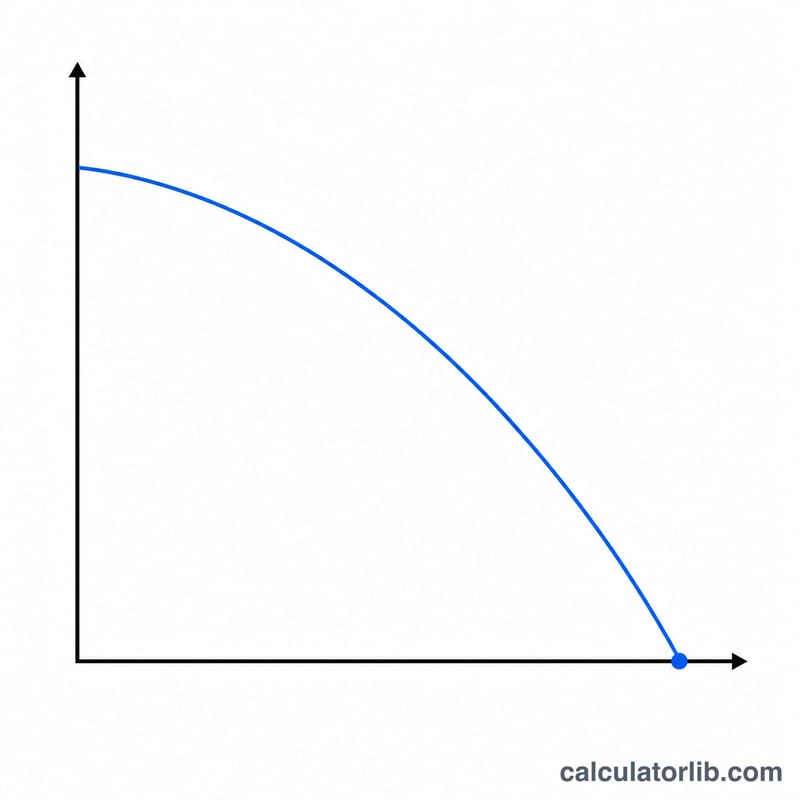
Enter your current account balance, the stated annual interest rate (compounded monthly), the money you receive each month, and the money you spend each month. The calculator finds the net monthly drawdown (expenses minus income) and simulates the account until it reaches zero, then reports the result as years and months.
The formula explained
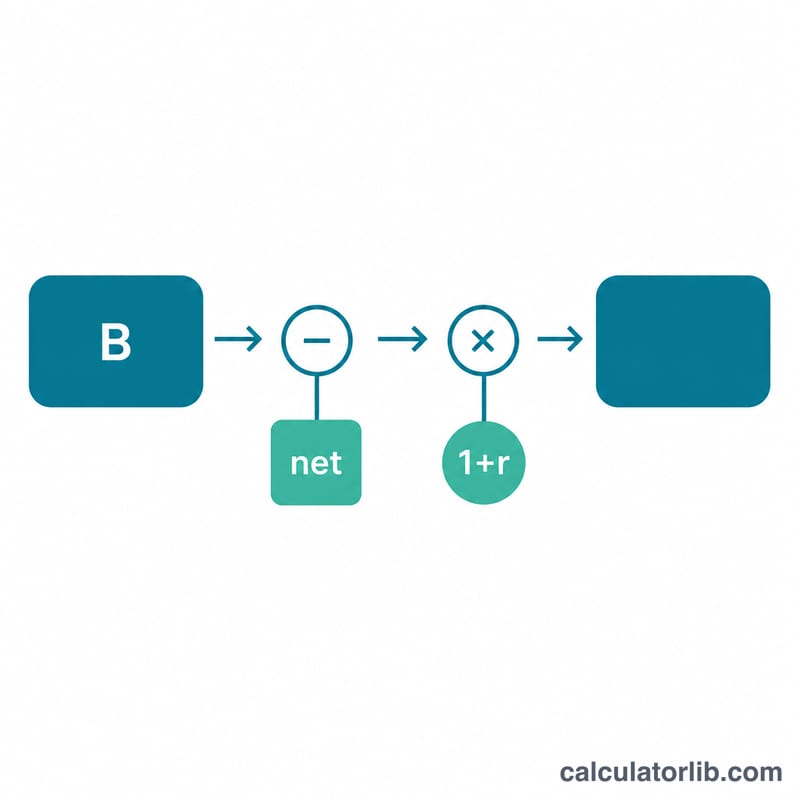
The monthly rate is \(r = (\text{annual rate} / 100) / 12\). Each month the balance updates as $$B = (B - \text{net}) \times (1 + r),$$ where \(\text{net} = \text{monthly expenses} - \text{monthly income}\). Because the withdrawal happens first and interest is credited afterward, interest is earned on the post-withdrawal balance. If income is greater than or equal to expenses, the balance never falls and the savings last indefinitely. If the interest earned each month is enough to fully fund the net withdrawal (when the starting balance is at or above \(\text{net} \times (1 + r) / r\)), the savings also never run out.
Worked example
Starting with $75,000 at 2.75% annual interest, $1,800 monthly income and $2,400 monthly expenses, the net drawdown is $600 per month and \(r \approx 0.00229\). Interest partly offsets the withdrawal, so the balance falls slowly. The simulation survives about 147 whole months before depletion, which is 12 Years and 3 Months.
FAQ
Does it account for inflation? No. It assumes fixed monthly income and expenses. To approximate inflation, increase your expense figure.
What if my income exceeds my expenses? Your balance grows or stays flat, so the calculator reports that your savings should last indefinitely.
How is interest applied? Interest is credited at the end of each month, on the balance remaining after that month's deposit and withdrawal.