What Is a Christmas Club?
A Christmas Club is a short-term savings plan, usually offered by banks and credit unions, that helps you set money aside throughout the year so you have a lump sum ready for holiday spending. You make small, regular deposits—typically weekly—and the account pays out near the end of the year. This calculator shows exactly how much you will have at payout based on your deposit amount, the number of weeks you save, and any interest the account earns.
How to Use the Calculator
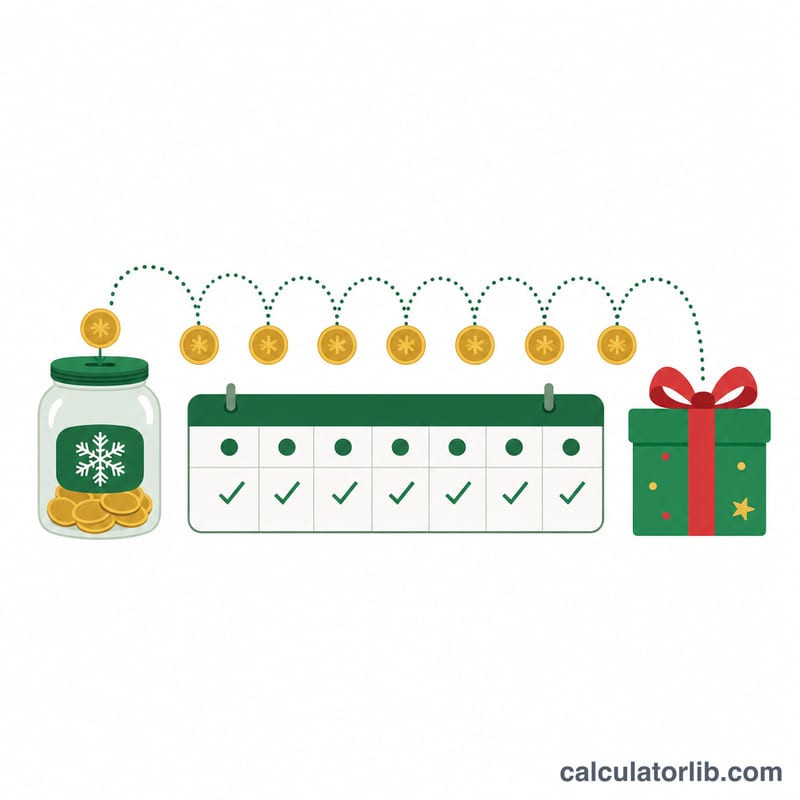
Enter your weekly deposit (the amount you plan to set aside each week), the number of weeks you will save (often 50 or 52 to cover a full year), and an optional annual interest rate if your account pays interest. The calculator returns your total payout, the total you personally deposited (principal), and any interest earned.
The Formula Explained
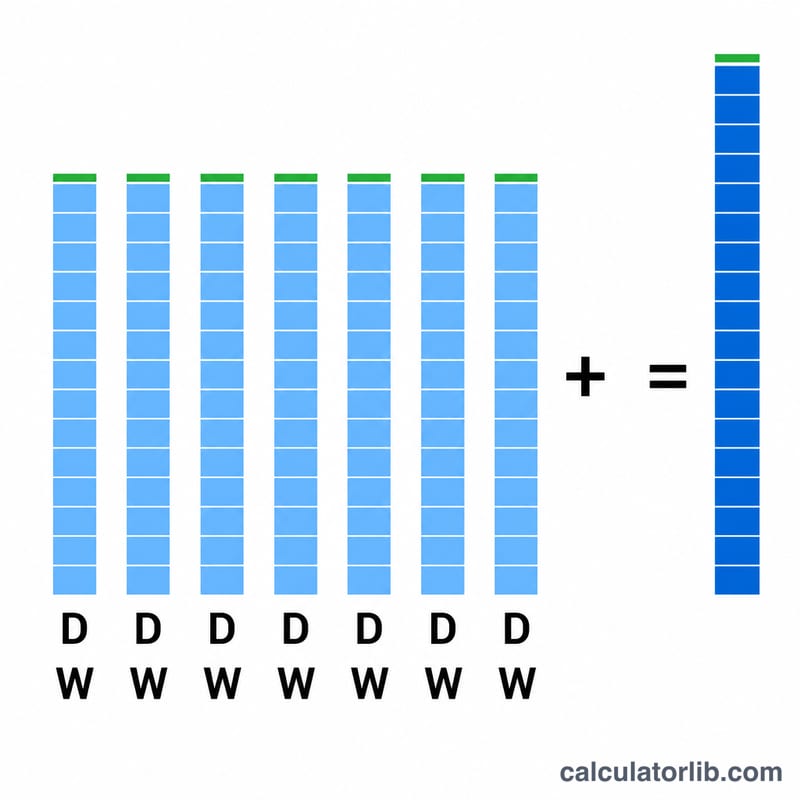
With no interest, the math is simple: \( \text{Total} = \text{Weekly Deposit} \times \text{Weeks} \). When the account pays interest, each deposit earns interest only for the weeks remaining until payout. The calculator applies the weekly rate (annual rate ÷ 52) and compounds each deposit individually, then sums them. This mirrors how a real interest-bearing savings account treats deposits made at different times.
$$\begin{gathered} \text{Total} = \sum_{n=1}^{N} D \,(1+r)^{n} \\[1.5em] \text{where}\quad \left\{ \begin{aligned} D &= \text{Weekly Deposit} \\ N &= \text{Number of Weeks} \\ r &= \dfrac{\text{Annual Rate (\%)}}{100 \times 52} \end{aligned} \right. \end{gathered}$$
Worked Example
Suppose you deposit $25 per week for 52 weeks with no interest. Your total is $$25 \times 52 = 1{,}300$$ $1,300, all of it principal. If the same plan earned 2% annual interest, each deposit would compound at roughly 0.0385% per week, adding a small amount of interest on top of the $1,300.
Central bank policy rates today
The latest official policy rates of major central banks, updated automatically — the benchmark that bank deposit and loan rates follow.
- Federal Reserve · United States
- 3.75–4.00%
- As of
- 2026-11-13
- Change in 1 year
- 0 pp
Latest change Up +25 bp Federal Reserve changed its rate on 2026-09-17: from 3.50–3.75% to 3.75–4.00%.
| Central bank | Policy rate | As of | Change in 1 year |
|---|---|---|---|
| Banco Central do Brasil (Selic) · Brazil | 13.75% | 2026-11-16 | −1.25 pp |
| Banco de México · Mexico | 6.25% | 2026-11-10 | −1.00 pp |
| Federal Reserve · United States | 3.75–4.00% | 2026-11-13 | 0 pp |
| ECB | 2.50% | 2026-11-16 | +0.50 pp |
| Sveriges Riksbank · Sweden | 2.00% | 2026-11-16 | +0.25 pp |
| Saudi Central Bank (SAMA) · Saudi Arabia | 4.50% | 2026-10-29 | 0 pp |
| Reserve Bank of Australia · Australia | 4.60% | 2026-10-31 | +1.00 pp |
| Central Bank of the Republic of Türkiye · Türkiye | 36.00% | 2026-11-06 | −3.50 pp |
| Bank of Russia · Russia | 14.00% | 2026-11-10 | −2.50 pp |
| People’s Bank of China · China | 3.00% | 2026-11-10 | 0 pp |
| Bank of Canada · Canada | 2.50% | 2026-11-13 | +0.25 pp |
| Reserve Bank of India · India | 5.50% | 2026-10-19 | 0 pp |
| Bank of England · United Kingdom | 4.00% | 2026-11-16 | 0 pp |
| Bank of Japan · Japan | 1.25% | 2026-11-10 | +0.75 pp |
| Bank of Korea · South Korea | 3.00% | 2026-11-02 | +0.50 pp |
Federal Reserve: key rates and overnight market rates
The rates that frame monetary policy and the overnight market rate they steer, each with the date of its latest published value.
| Rate | Level | As of | Change in 1 year |
|---|---|---|---|
| Federal funds target range | 3.75–4.00% | 2026-11-13 | 0 pp |
| Effective federal funds rate (EFFR) | 3.88% | 2026-11-13 | 0 pp |
| Secured Overnight Financing Rate (SOFR) | 3.90% | 2026-11-13 | −0.10 pp |
Each rate keeps the date of its own latest published value; overnight market rates are published on the next business day.
Latest figure: 2026-11-13 Data last updated 2026-11-16 · current
Source: Banco Central do Brasil ODbL; Bank for International Settlements (BIS) Terms of permitted use of BIS statistics; Federal Reserve Bank of New York New York Fed Terms of Use; Board of Governors of the Federal Reserve System Public domain (U.S. government work); European Central Bank ECB reuse policy; Sveriges Riksbank Riksbank open data terms; The World Bank Group CC BY 4.0; Reserve Bank of Australia 2026 RBA copyright terms (Cash Rate); Bank of Canada Bank of Canada terms of use; Bank of England Open Government Licence v3.0
The one-year change is computed by CalculatorLib from these data. The EFFR and SOFR are subject to the Terms of Use posted at newyorkfed.org. The New York Fed is not responsible for publication of the EFFR and SOFR by CalculatorLib, does not sanction or endorse any particular republication, and has no liability for your use.
Source details and methodology
- Banco Central do Brasil
- Bank for International Settlements (BIS) — Central bank policy rates
- Federal Reserve Bank of New York — Reference rates (EFFR, SOFR)
- Board of Governors of the Federal Reserve System
- European Central Bank
- Sveriges Riksbank
- The World Bank Group — World Development Indicators (FR.INR.LEND, FR.INR.RINR)
- Reserve Bank of Australia 2026
- Bank of Canada
- Bank of England
FAQ
Do Christmas Clubs pay interest? Some do and some don't—rates are usually modest. Leave the rate at 0 if your account pays none.
Can I withdraw early? Many Christmas Clubs restrict early withdrawals or charge a fee, since the goal is to keep you saving until the holidays.
How many weeks should I use? Most clubs run about 50–52 weeks, but you can model any horizon up to a full year.