What is a DPS calculator?
DPS (damage per second) is the standard yardstick for comparing weapons, spells and builds in RPGs, shooters, MOBAs and MMOs. A weapon that hits for 900 every three seconds is weaker in sustained combat than one that hits for 200 four times a second, and raw tooltip damage hides that. This calculator folds hit damage, attack speed, critical hit chance, critical multiplier and accuracy into one comparable number, then converts it into damage per minute and a time-to-kill estimate.
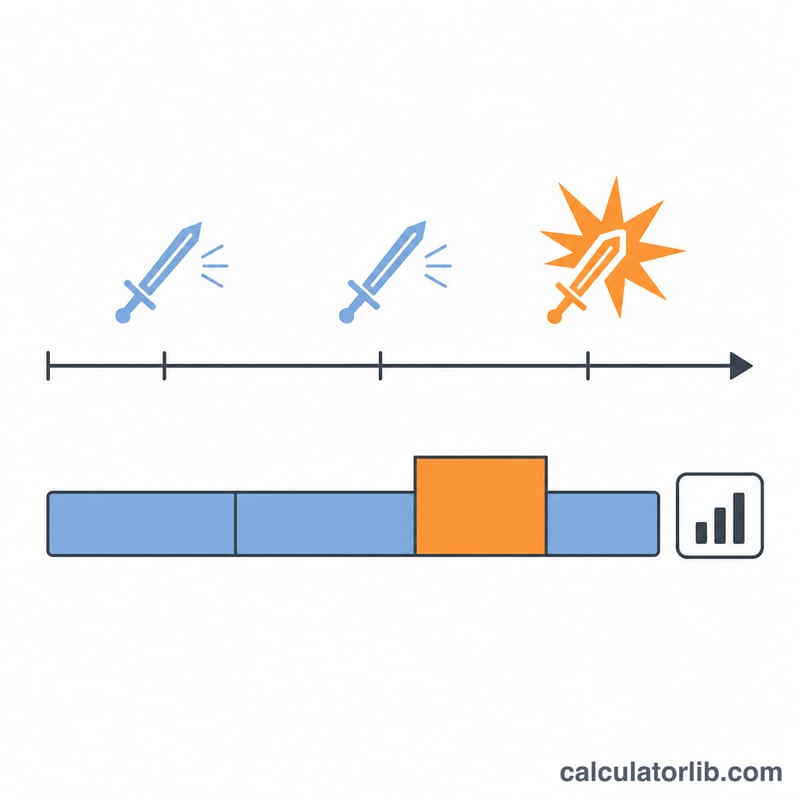
The formula explained
Average damage per swing is the base hit scaled by how often you crit and by how often you actually connect. Multiplying by attack speed gives sustained damage per second:
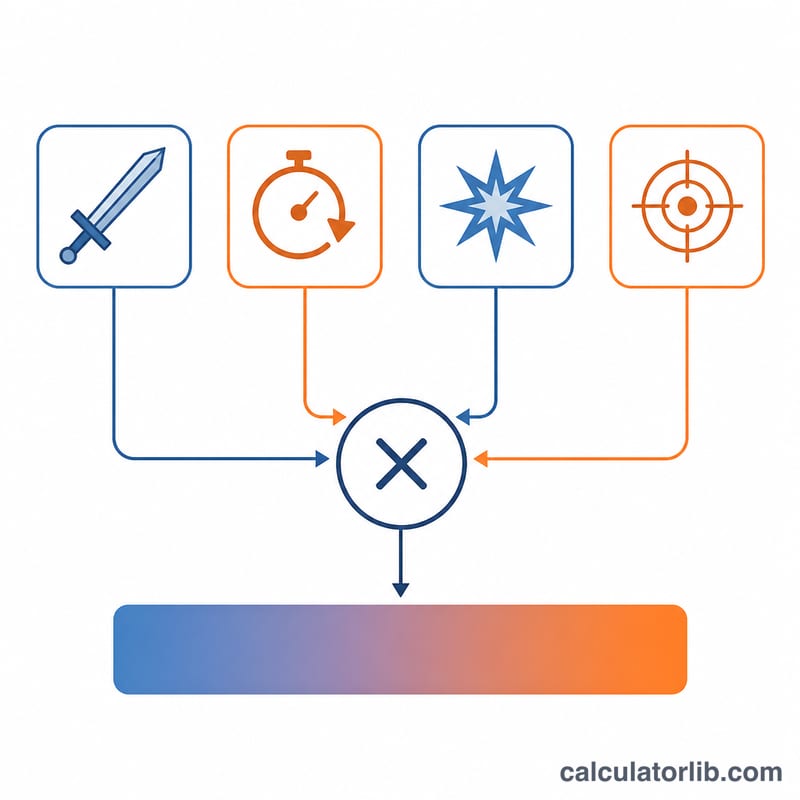
$$\text{DPS} = D \times S \times H \times \left(1 + C \times (M - 1)\right)$$Where \(D\) = damage per non-critical hit, \(S\) = attacks per second, \(H\) = hit chance as a decimal, \(C\) = critical hit chance as a decimal and \(M\) = critical damage multiplier. The bracketed term \(1 + C \times (M-1)\) is the average crit bonus: at 25% crit chance and a 2x multiplier it equals \(1.25\), meaning crits add 25% to your expected damage.
Worked example
A bow hits for 250, swings 1.5 times per second, crits 40% of the time for 2.5x, and lands 90% of its shots against an evasive target:
$$\text{avg hit} = 250 \times (1 + 0.4 \times 1.5) \times 0.9 = 360$$$$\text{DPS} = 360 \times 1.5 = 540$$Against a 5,000 HP boss the time to kill is
$$\text{TTK} = \frac{5000}{540} \approx 9.26\ \text{s}$$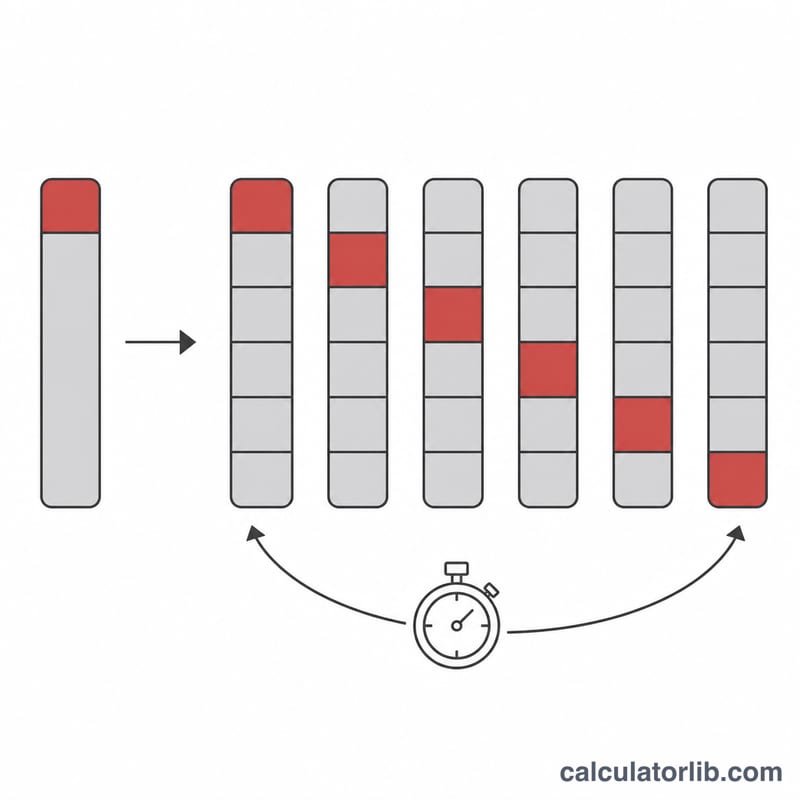
DPS Across Common Build Scenarios
The table below compares four contrasting weapon archetypes using the same model the calculator applies:
$$\text{DPS} = D \times S \times H \times \bigl(1 + C\,(M-1)\bigr)$$where \(D\) is damage per hit, \(S\) is attacks per second, \(H\) is hit chance as a decimal, \(C\) is crit chance as a decimal and \(M\) is the crit multiplier. The average hit column is the crit-adjusted damage of a hit that lands, \(D \times (1 + C(M-1))\); damage per minute is \(\text{DPS} \times 60\) and time to kill is \(\text{TTK} = \text{HP} / \text{DPS}\) against a 5,000 HP target.
These stat lines are illustrative examples only. They are not taken from any specific game and do not correspond to any real weapon in any title — every game defines damage, attack speed and critical hits differently.
| Build / weapon archetype | D (dmg per hit) | S (attacks/s) | C (crit chance) | M (crit mult.) | H (hit chance) | Average hit | DPS | DPM | TTK vs 5,000 HP |
|---|---|---|---|---|---|---|---|---|---|
| Slow heavy hitter (two-handed / sniper) | 900 | 0.33 | 10% | 2.0× | 95% | 990.0 | 310.37 | 18,622 | 16.11 s |
| Fast light weapon (dagger / SMG) | 200 | 4.0 | 15% | 1.5× | 95% | 215.0 | 817.00 | 49,020 | 6.12 s |
| Crit-stacked build (assassin / precision) | 300 | 1.5 | 60% | 3.0× | 90% | 660.0 | 891.00 | 53,460 | 5.61 s |
| High damage, low accuracy (heavy pistol / cannon) | 500 | 1.0 | 20% | 2.0× | 60% | 600.0 | 360.00 | 21,600 | 13.89 s |
Check of the crit-stacked row: the crit factor is \(1 + 0.60\,(3.0 - 1) = 2.2\), so the average hit is \(300 \times 2.2 = 660\), and \(660 \times 1.5 \times 0.90 = 891.0\) DPS. Over a minute that is \(891.0 \times 60 = 53{,}460\) damage, and \(5000 / 891.0 = 5.61\) seconds to kill.
Two patterns stand out. First, the fast light weapon out-damages the slow heavy hitter by more than 2.6× despite dealing less than a quarter of the damage per swing — attack speed multiplies the whole expression. Second, hit chance scales DPS strictly linearly: the high-damage/low-accuracy weapon loses 40% of its output purely to missed attacks, so 10 points of accuracy are worth more than 10 points of damage on that build. This model assumes sustained, uninterrupted attacks against a single target with no armour, resistance, damage-over-time or falloff mechanics.
More Worked Examples
All three examples use the same formula, \(\text{DPS} = D \times S \times H \times (1 + C(M-1))\), with every substitution written out. The values are illustrative and not drawn from any particular game.
1. Automatic weapon: converting fire rate into effective attacks per second
A theoretical fire rate ignores reloading. To get a sustained value, divide the rounds in one magazine by the time to fire that magazine plus the reload time:
$$S_{\text{eff}} = \frac{\text{shots per magazine}}{\text{magazine duration} + \text{reload time}}$$Take a rifle firing 600 rounds per minute (10 shots per second) with a 30-round magazine and a 2.0 s reload. Each shot deals 35 damage, crit chance is 10% at a 2.0× multiplier, and hit chance is 85%.
Magazine duration: \(30 \div 10 = 3.0\) s. Effective attack speed:
$$S_{\text{eff}} = \frac{30}{3.0 + 2.0} = \frac{30}{5.0} = 6.0\ \text{attacks/s}$$Crit factor and average hit:
$$1 + 0.10\,(2.0 - 1) = 1.10 \qquad\Rightarrow\qquad 35 \times 1.10 = 38.5$$Sustained DPS:
$$\text{DPS} = 38.5 \times 6.0 \times 0.85 = 196.35$$So the rifle sustains 196.35 DPS, or \(196.35 \times 60 = 11{,}781\) damage per minute. Against a 2,000 HP target, \(\text{TTK} = 2000 / 196.35 = 10.19\) s. Using the raw 10 shots/s instead would have given 327.25 DPS — a 67% overstatement, because reloading consumes 40% of the cycle.
2. Spell with a fixed cast time and a high crit multiplier
For an ability with a hard cast time, the attack speed is simply the reciprocal: \(S = 1 / t_{\text{cast}}\). Consider a nuke with a 1.6 s cast, 850 base damage, 25% crit chance, a 2.5× crit multiplier, and 100% hit chance (spells in many systems cannot miss).
$$S = \frac{1}{1.6} = 0.625\ \text{casts/s}$$$$1 + 0.25\,(2.5 - 1) = 1 + 0.375 = 1.375 \qquad\Rightarrow\qquad 850 \times 1.375 = 1{,}168.75$$$$\text{DPS} = 1{,}168.75 \times 0.625 \times 1.00 = 730.47$$The spell averages 730.47 DPS and \(730.47 \times 60 = 43{,}828\) damage per minute. Against a 12,000 HP boss, \(\text{TTK} = 12000 / 730.47 = 16.43\) s, i.e. about 11 casts. Note the leverage of the 2.5× multiplier: at a plain 2.0× the crit factor would be 1.25 instead of 1.375, dropping DPS to 664.06 — a 9% loss from the multiplier alone.
3. Low accuracy, high damage — how hit chance scales output
A heavy cannon deals 1,200 damage at 0.8 attacks per second with 15% crit at 2.0×, but only 55% hit chance.
$$1 + 0.15\,(2.0 - 1) = 1.15 \qquad\Rightarrow\qquad 1{,}200 \times 1.15 = 1{,}380$$$$\text{DPS} = 1{,}380 \times 0.8 \times 0.55 = 607.20$$That is 607.20 DPS and \(607.20 \times 60 = 36{,}432\) damage per minute; against an 8,000 HP target, \(\text{TTK} = 8000 / 607.20 = 13.18\) s.
Because \(H\) appears as a plain multiplier, DPS is directly proportional to it. Raising hit chance to 85% with the same weapon gives:
$$\text{DPS} = 1{,}380 \times 0.8 \times 0.85 = 938.40$$That is a factor of \(0.85 / 0.55 = 1.545\), a 54.5% gain, and TTK falls to \(8000 / 938.40 = 8.53\) s. In practice this means accuracy and damage scale identically in this model — 10% more hit chance is worth exactly as much as 10% more damage per hit, so the cheaper of the two upgrades wins. Remember that real games layer on mechanics this formula does not model (armour, resistances, damage-over-time, headshot zones, ammo economy and movement), so treat the output as a comparison tool between builds rather than an absolute prediction.
FAQ
Should I stack crit chance or attack speed? Compare marginal gains: attack speed scales DPS linearly, while crit chance scales it by \(M-1\) per point. With a 2x multiplier, one point of crit chance is worth half a point of raw damage, so high multipliers make crit chance far stronger.
Does this include reloads or cooldowns? No. It models uninterrupted attacking. To account for downtime, reduce the attack speed to your real average, for example 0.8 attacks per second instead of a theoretical 1.0.
What about armour and resistances? Enter post-mitigation damage as the damage per hit if you want DPS against a specific target, or raw damage for a build-versus-build comparison.