What this calculator does
Pool water balance is simple arithmetic once you know two things: how much water you are treating, and how far the reading has to move. This tool combines both into a single dose. Pick the product you actually have on the shelf (liquid chlorine, cal-hypo, dichlor, sodium bicarbonate, muriatic acid, soda ash, calcium chloride or stabilizer), enter your pool volume in gallons or liters, then the current and target reading from your test kit. The result is given in fluid ounces or ounces by weight, plus gallons/pounds and a metric equivalent so you can measure with whatever you have.
The formula
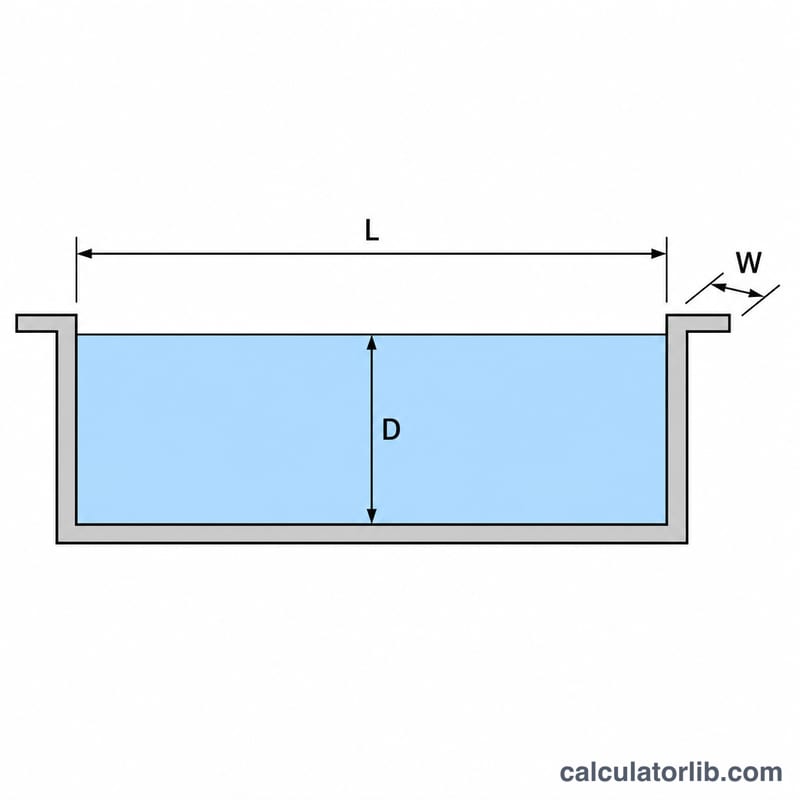
Every product has a dose factor \(F\): the amount needed per 10,000 US gallons to move the reading by one unit (1 ppm, or 1.0 pH unit for acid and soda ash). The dose is then simply proportional to volume and to the gap you need to close:
$$D = F \times \Delta L \times \frac{V}{10000}$$where \(D\) = dose, \(\Delta L\) = level change required, and \(V\) = pool volume in US gallons. Liters are converted first with \(V = L \times 0.264172\). For liquid chlorine at 12.5%, one gallon (128 fl oz) raises 10,000 gallons by 12.5 ppm, so \(F = 128/12.5 = 10.24\) fl oz per ppm.
Worked example
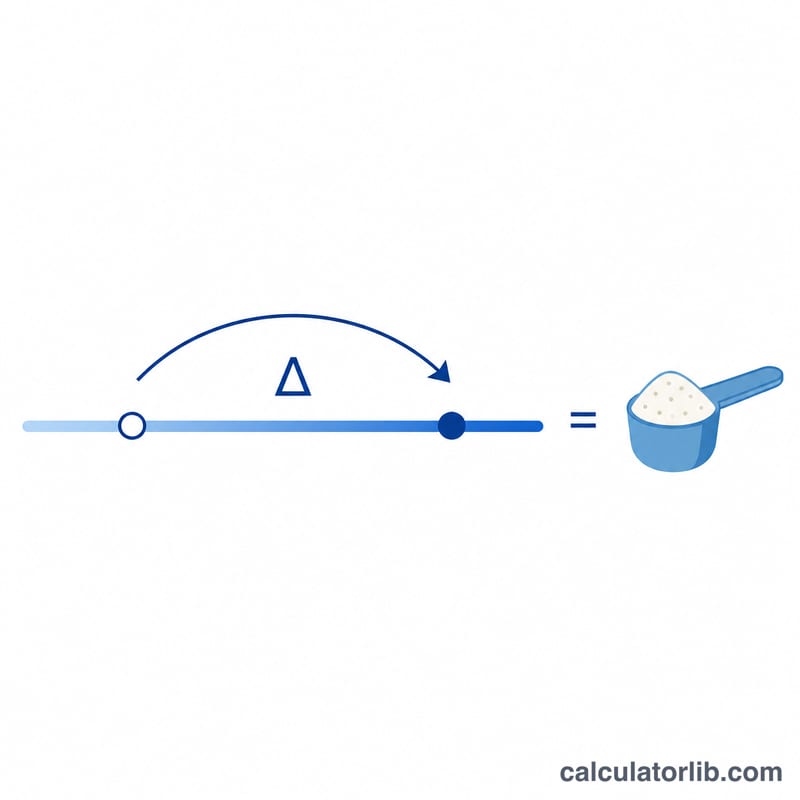
A 20,000 gallon pool tests at 1 ppm free chlorine and you want 3 ppm using 12.5% liquid chlorine:
$$D = 10.24 \times 2 \times \frac{20000}{10000} = 40.96\,\text{fl oz}$$That is about 0.32 gallons, or roughly five cups of liquid chlorine.
Recommended Pool Water Ranges
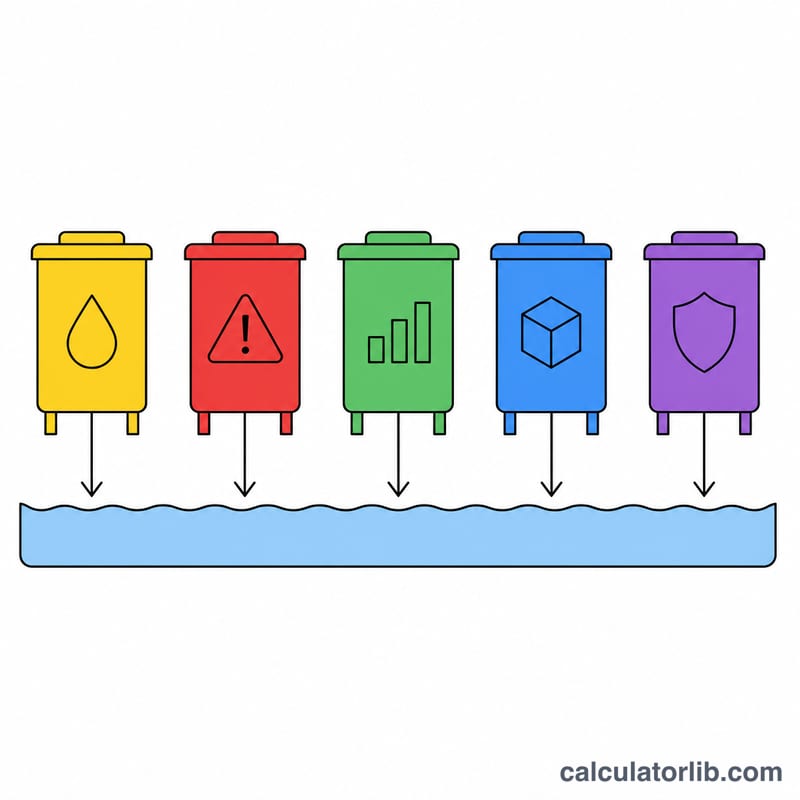
The targets below are the ones published for United States practice: ANSI/APSP/PHTA-11 (water quality in public pools and spas) and the CDC's Model Aquatic Health Code (MAHC), which US states and counties adopt in whole or in part. Other countries set different numbers — Germany's DIN 19643 calls for free chlorine of only about 0.3–0.6 mg/L in continuously treated public pools, and the WHO guidance and various EN standards differ again. Check the rules that apply where your pool is, and follow your local health authority for any commercial or public pool.
| Parameter | Acceptable range | Ideal target | Notes |
|---|---|---|---|
| Free chlorine (FC) | 1–3 ppm; 2–4 ppm when cyanuric acid is present | 2–4 ppm | MAHC sets a minimum of 1 ppm in pools (2 ppm where CYA is used) and 3 ppm in spas/hot tubs |
| Combined chlorine (chloramines) | < 0.5 ppm | 0 ppm | The "chlorine smell" and eye sting; cleared by breakpoint chlorination or oxidiser |
| pH | 7.2–7.8 | 7.4–7.6 | Below 7.2 is corrosive to metals and grout; above 7.8 chlorine loses most of its kill speed |
| Total alkalinity (TA) | 80–120 ppm | 90–110 ppm | 60–80 ppm suits pools run on liquid chlorine or a salt chlorine generator, where pH drifts up |
| Calcium hardness (CH) | 200–400 ppm | 250–350 ppm plaster/concrete; 175–225 ppm vinyl and fiberglass | Vinyl and fiberglass have no cement to protect, so they tolerate softer water |
| Cyanuric acid (CYA) | 30–50 ppm outdoor | 30–50 ppm outdoor; 0–20 ppm indoor | MAHC caps CYA at 90 ppm; indoor pools get no UV benefit from stabilizer |
| Salt (for a salt chlorine generator) | 2,700–3,400 ppm | Per cell manufacturer, commonly ≈3,200 ppm | Always use the number in your generator's manual — cells differ |
The FC-to-CYA relationship
Cyanuric acid shields chlorine from UV but also binds most of it, so a fixed "1–3 ppm" target means different sanitising power at different stabilizer levels. A widely used hobbyist rule of thumb (popularised by Trouble Free Pool, not part of ANSI/APSP/PHTA-11) is to hold free chlorine at roughly 7.5% of the CYA reading in a manually dosed pool:
$$FC_{\text{target}} \approx 0.075 \times CYA$$At CYA 40 ppm that is about 3 ppm FC; at CYA 80 ppm it is about 6 ppm. Salt-generator pools are usually run nearer 5% of CYA. If your CYA has crept to 100 ppm from tablet or dichlor use, the practical fix is dilution — partial drain and refill — because there is no routine chemical that removes it.
Balance indices
pH, TA, CH and temperature together determine whether water is scaling or corrosive; the Langelier Saturation Index is the usual summary, and a value near 0 (roughly −0.3 to +0.3) is the goal. Adjust in the order TA → pH → CH, since each earlier step moves the later readings.
This is general water-chemistry information, not professional advice. Test results vary with test-kit type and sample handling, and commercial or public pools are subject to legal requirements that override any general range.
FAQ
How accurate are the pH doses? pH is buffered by alkalinity, so acid and soda ash doses are estimates based on a total alkalinity near 100 ppm. Add about three quarters of the calculated amount, circulate, then retest.
Can I lower chlorine, alkalinity or stabilizer? Not with a dose. Those come down mainly by dilution (partial drain and refill) or, for chlorine, by waiting or using a neutralizer.
How do I find my pool volume? For a rectangular pool, length × width × average depth in feet × 7.48 gives US gallons. A 32 × 16 ft pool averaging 5 ft deep holds about 19,150 gallons.