What this calculator works out
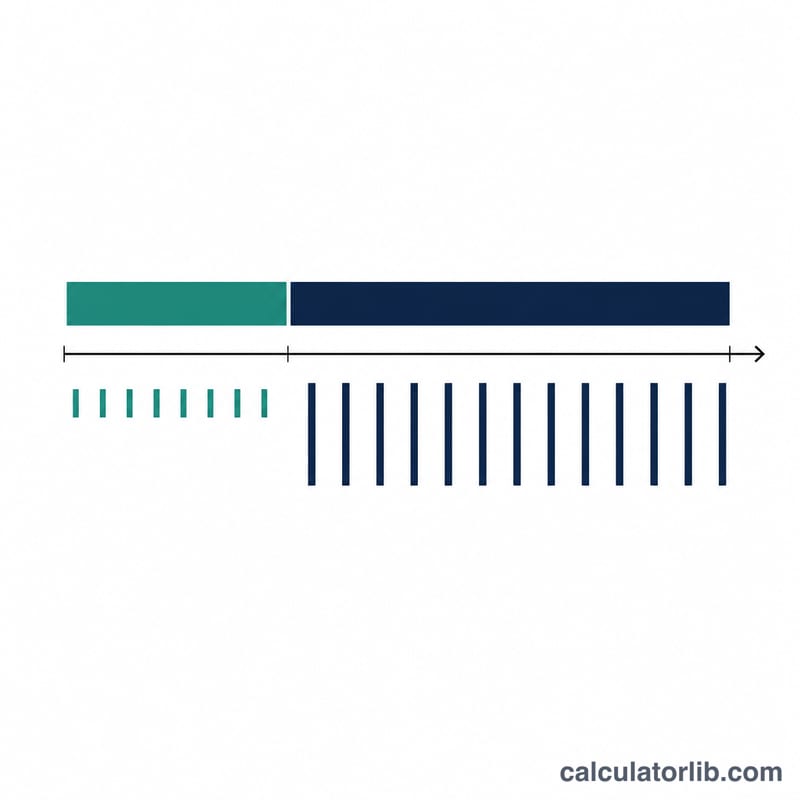
A home equity line of credit is two loans wearing one name. During the draw period you can borrow against the line and you pay interest only; when the draw period ends the balance converts to a fixed repayment period with a level principal-and-interest payment. This calculator gives you both monthly payments, the total of every payment you will make, the total interest, and — if you add closing costs and an annual fee — the full cost of the loan and its APR, plus a year-by-year amortization schedule.
You need it at exactly two moments: when you are comparing HELOC offers and want to know what the payment becomes after the draw period ends, and when you are budgeting for that jump, which on a typical line is more than double what you were paying.
How to read each input
The calculator assumes you draw the entire line on day one and hold that balance for the whole draw period. That is the worst realistic case, and it is what makes the answer comparable between lenders.
| Input | Where the number comes from | Sensible range |
|---|---|---|
| Loan amount | The credit limit on the offer, or the amount you actually intend to draw. Commas and a dollar sign are fine. | $10,000 – $500,000 |
| Interest rate | The quoted rate. Most HELOCs are variable (prime plus a margin), so this is a snapshot, not a promise. Zero is accepted. | 0% – 15% |
| Draw period | From the offer — the window in which you can borrow and pay interest only. | 5 – 10 years; fractions like 2.99 are allowed |
| Repayment period | From the offer — how long you have to clear the balance after the draw ends. | 10 – 20 years, must be above zero |
| Closing costs | Appraisal, title, origination. Enter a dollar figure or a percentage of the loan amount. Many lenders waive these. | $0 – 5% of the line |
| Annual fee | The line-maintenance fee, charged during the draw period only. | $0 – $100/year |
Closing costs and the annual fee are only used if you tick Include closing costs and fees. Leave it clear and whatever sits in those boxes is ignored entirely.
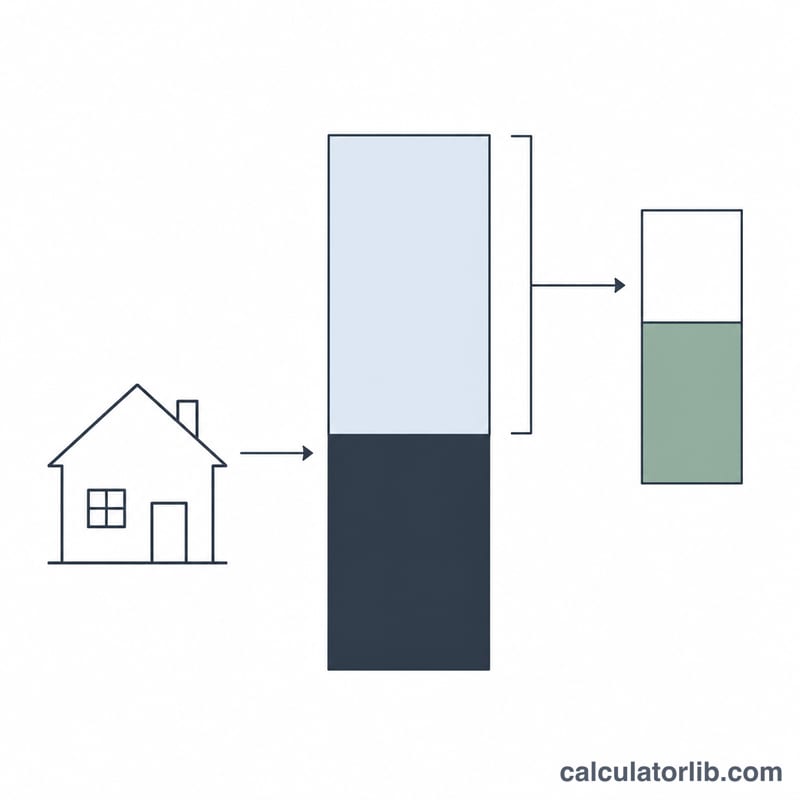
The formula
Let \(P\) = loan amount, \(r\) = annual interest rate as a percent, \(d\) = draw period in years and \(t\) = repayment period in years. The monthly rate is \(i = r/1200\), the draw runs \(m = 12d\) months and repayment runs \(n = 12t\) months.
The draw payment is interest only; the repayment payment is a standard level annuity on the full balance:
$$A_{\text{draw}} = P \times i \qquad\qquad A_{\text{repay}} = \frac{P \times i}{1 - (1+i)^{-n}}$$Everything else follows from those two, using the unrounded payments:
$$\text{Total paid} = A_{\text{draw}} \times m + A_{\text{repay}} \times n$$ $$\text{Total interest} = \text{Total paid} - P$$ $$\text{Cost of loan} = \text{Total interest} + C + F \times d$$where \(C\) is the closing cost (\(C = P \times c/100\) if you enter it as a percentage) and \(F\) is the annual fee. At a 0% rate the repayment payment is simply \(P/n\).
A worked example
A $75,000 line at 7.5%, a 5-year draw, a 15-year repayment, $2,500 of closing costs paid upfront and a $75 annual fee. So \(i = 0.075/12 = 0.00625\), \(m = 60\) and \(n = 180\).
The interest-only payment during the draw:
$$A_{\text{draw}} = 75{,}000 \times 0.00625 = \$468.75$$The payment once repayment starts:
$$A_{\text{repay}} = \frac{75{,}000 \times 0.00625}{1 - (1.00625)^{-180}} = \frac{468.75}{0.674209} = \$695.26$$Total of 240 payments, built from the unrounded figures:
$$468.75 \times 60 + 695.25927 \times 180 = 28{,}125 + 125{,}146.67 = \$153{,}271.67$$ $$\text{Total interest} = 153{,}271.67 - 75{,}000 = \$78{,}271.67$$The fee runs for the five draw years only, so total annual fees are \(75 \times 5 = \$375.00\), and:
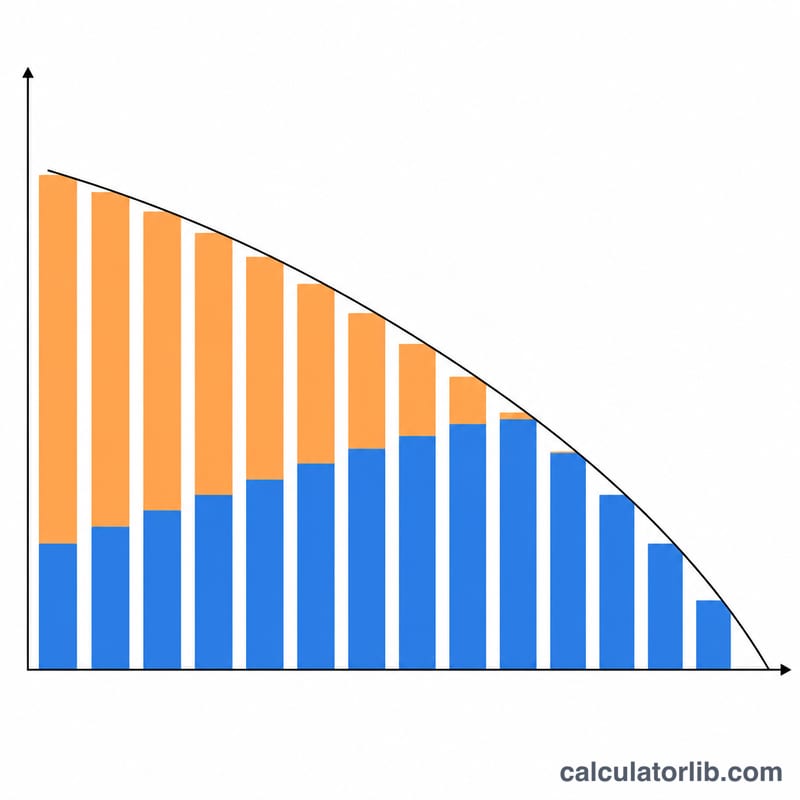
$$\text{Cost of loan} = 78{,}271.67 + 2{,}500 + 375 = \$81{,}146.67$$The APR on this loan comes out at 8.130%. In the annual schedule, years 1–5 each show $5,625.00 of interest, $0.00 of principal and a flat $75,000 balance; year 6 is the first with principal in it — $5,529.59 interest, $2,813.52 principal, ending balance $72,186.48.
The rules that surprise people
The costs box is off by default, and it gates everything. Closing costs and an annual fee are pre-filled, but until you tick the box they change nothing — no cost of loan, no APR, and no effect on the totals. On a $125,000 line at 9.75% with a 7-year draw, $9,000 of costs and a $900 fee, ticking the box adds $15,300 of cost and an APR line; the payments and the $297,835.04 total are identical either way.
"Total of N payments" includes your principal. It is every dollar that leaves your account, not a cost figure. Interest is that number minus the loan amount — $153,271.67 versus $78,271.67 in the example above.
"Deducted from loan" does not lower your payments. Choosing it adds a Cash received line ($72,500 in the example) and nothing else. Both payments, the total, the cost of loan and the APR are computed on the full $75,000. If the $2,500 were genuinely netted out and amortized, the repayment payment would be lower — so the payment you see is the conservative one, and it is the one the lender will bill.
The annual fee stops when the draw stops. It is charged as fee × draw years, prorated continuously — half a year of a $100 fee is $50.00, and a 2.99-year draw with a $250 fee gives $747.50, not $750. Set the draw period to zero and the line still appears, reading $0.00.
Part years are kept, not rounded to whole months. A 2.99-year draw bills 35.88 months of interest. On a $50,000 line at 8% with a 15-year repayment, that is a $97,968.69 total against $98,008.69 for a flat 3-year draw — a $40 difference — and year 3 of the schedule shows $3,960.00 of interest rather than $4,000.00. Amortization still begins on the next whole month.
Which lines appear is itself a rule. A separate Closing costs line only shows when you enter the cost as a percentage — enter 4% of $50,000 and you see $2,000.00 spelled out; enter $2,000 directly and you do not, though every other number is the same. Cost of loan and APR only appear when at least one of the two costs is above zero, and the APR is dropped entirely at a 0% rate.
Zero is a valid entry in three places. The interest rate, the draw period and both cost fields all accept 0. Only the loan amount and the repayment period have to be above zero.
Questions people ask
Why does my payment jump so much after the draw period?
Because during the draw you were paying interest and nothing else. In the example the balance is still the full $75,000 on the day repayment begins, and it now has to be cleared in 15 years — the payment goes from $468.75 to $695.26, a 48% rise. On shorter repayment terms the jump is far steeper.
Should I tick the closing-costs box?
Tick it if you want the APR, which is the only figure here that folds fees into a single comparable rate. Leave it clear if you are only comparing payments. Many HELOCs genuinely have no closing costs and no annual fee, in which case the two views are identical anyway.
Why is the APR higher than my interest rate?
The APR spreads the closing costs and the annual fees over the loan, so it is always at or above the note rate when either is present. In the worked example, $2,500 plus $375 of fees turns a 7.5% rate into an 8.130% APR. Treat it as a like-for-like comparison number between offers, not as a figure to quote back to a lender.
My rate is variable — is this still useful?
Yes, as a scenario tool. Run it at today's rate, then again two or three points higher to see what the repayment payment becomes in a worse rate environment. That second number is the one worth budgeting against.
Can I model paying the line down during the draw period?
Not directly — the calculator assumes the full balance is outstanding for the whole draw. To approximate paying it down, lower the loan amount to the balance you expect to carry into the repayment period; the draw payment will then be understated but the repayment payment will be right.
HELOC Terms Defined
A home equity line of credit (HELOC) is a revolving loan secured by a lien on your home. The product structure described below — a draw phase followed by a repayment phase, with a variable rate tied to a published index — is the standard form used in the United States and Canada; product rules, disclosures and terminology differ in other countries. The definitions match how each quantity is used by this calculator.
- Credit limit vs. drawn balance
- The credit limit is the maximum you may borrow on the line. The drawn balance is what you have actually taken out and owe. Interest accrues only on the drawn balance, not the limit. This calculator's loan amount is the drawn balance, and it assumes that balance is outstanding for the whole term.
- Draw period
- The opening phase (commonly 5 or 10 years in US lines) during which you may borrow, repay and re-borrow up to the limit. Most lenders require only an interest payment during this phase.
- Repayment period
- The phase after the draw ends (commonly 10, 15 or 20 years). Further draws are closed and the outstanding balance is amortized with level principal-and-interest payments.
- Interest-only payment
- A payment equal to one month's accrued interest on the balance: \(I = P \times \dfrac{r_{\text{annual}}}{12}\). It retires no principal, so the balance does not fall.
- Level P&I payment
- The fixed monthly amount that fully amortizes the balance over the repayment period: \(M = P \cdot \dfrac{r}{1-(1+r)^{-n}}\), with \(r\) the monthly rate and \(n\) the number of repayment months.
- Index
- The published benchmark a variable-rate line floats on. In the US this is usually the prime rate; other markets use their own reference rates.
- Prime rate
- In the US, a benchmark published by banks (commonly quoted as the Wall Street Journal prime rate) that moves with the Federal Reserve's target rate. It is a US-specific reference, not an international one.
- Margin
- The fixed percentage the lender adds to the index. It is set at origination and normally does not change over the life of the line.
- Fully-indexed rate
- Index + margin — the rate actually charged. If prime is 7.50% and the margin is 0.50%, the fully-indexed rate is 8.00%. This calculator treats the entered rate as fixed for the whole term.
- Periodic and lifetime rate caps
- A periodic cap limits how much the rate may move in a single adjustment; a lifetime cap sets the maximum rate for the life of the line. US lenders are required to disclose a lifetime cap on variable-rate home equity plans.
- APR vs. nominal (note) rate
- The nominal rate is the interest rate used to accrue interest. The APR is a disclosed cost measure that also folds in prepaid finance charges such as closing costs and certain fees, expressed as an annual percentage. When there are no such charges, APR equals the nominal rate.
- Closing costs
- One-time origination charges: appraisal or valuation, title search and title insurance, recording, credit report and any origination or application fee. This calculator lets you enter them as a currency amount or as a percentage of the loan amount, and either pay them up front or add them to the balance.
- Annual / maintenance fee
- A recurring yearly charge some lenders levy simply for keeping the line open, regardless of whether you draw on it.
- Combined loan-to-value (CLTV)
- All liens on the property divided by its appraised value. On a $400,000 home with a $240,000 first mortgage and a $60,000 line, CLTV is \((240{,}000+60{,}000)/400{,}000 = 75\%\). Lenders cap CLTV as an underwriting limit; the cap varies by lender and country.
- Balloon payment
- A single large sum due at the end of the term. Some HELOCs have no amortizing repayment phase at all and instead require the entire balance at draw-end. This calculator models the amortizing structure, so no balloon arises.
- Cost of loan
- As used by this calculator: everything you pay beyond the principal borrowed — all interest paid across both phases, plus closing costs and all annual fees. It is the total price of using the money, not just the interest.
How the Payment Shift Changes Across Offers
All six scenarios below use the same $50,000 drawn on day one and a rate held fixed for the whole term — the calculator's own assumptions. Closing costs and annual fees are excluded here so the payment structure is visible on its own; adding them raises the APR and the cost of loan but not the payments shown. Real variable-rate lines will drift from these figures as the index moves.
| Drawn | Rate | Draw yrs | Repay yrs | Interest-only payment | Repayment P&I | Payment multiple | Total interest | Total of payments |
|---|---|---|---|---|---|---|---|---|
| $50,000 | 6% | 10 | 20 | $250.00 | $358.22 | 1.43× | $65,972.80 | $115,972.80 |
| $50,000 | 6% | 10 | 10 | $250.00 | $555.10 | 2.22× | $46,612.00 | $96,612.00 |
| $50,000 | 8% | 10 | 15 | $333.33 | $477.83 | 1.43× | $76,009.40 | $126,009.40 |
| $50,000 | 8% | 5 | 10 | $333.33 | $606.64 | 1.82× | $42,796.80 | $92,796.80 |
| $50,000 | 10% | 5 | 10 | $416.67 | $660.76 | 1.59× | $54,291.20 | $104,291.20 |
| $50,000 | 10% | 10 | 20 | $416.67 | $482.51 | 1.16× | $115,802.40 | $165,802.40 |
Totals are computed from the rounded monthly payments (interest-only payment × draw months + P&I payment × repayment months), so they may differ by a few cents from unrounded figures. Two patterns stand out. First, a longer draw period raises total interest without changing either payment — rows 1 and 6 pay ten full years of interest that retires nothing. Second, the jump at conversion is largest when the rate is low and the repayment term is short: at 6% over 10 years the payment more than doubles, while at 10% over 20 years it rises only 16%.
What Your Numbers Actually Tell You
The interest-only payment
This is pure carrying cost. It equals one month of accrued interest, \(P \times r_{\text{annual}}/12\), and applies nothing to principal. The direct consequence: your balance on the last day of the draw period is identical to the amount drawn. A $50,000 balance carried at 8% for a ten-year draw costs $40,000 in interest and still stands at $50,000 when the repayment phase begins.
The repayment payment
The repayment figure is an ordinary fully-amortizing payment computed over the repayment term only — the draw years give it no head start. That is why a line with a 10-year draw and a 10-year repayment amortizes $50,000 in ten years, not twenty, and why extending the repayment term lowers the payment while increasing total interest.
The payment multiple
The ratio of repayment payment to interest-only payment simplifies to a quantity that does not depend on the balance at all:
$$\frac{M}{I} = \frac{ \dfrac{r}{1-(1+r)^{-n}} }{ r } = \frac{1}{1-(1+r)^{-n}}$$It is governed entirely by the monthly rate \(r\) and the number of repayment months \(n\). Across the common splits in the table above the multiple runs from roughly 1.2× to 2.2×; it climbs toward and past 2× when the repayment term is short and the rate is low, and compresses toward 1× when the term is long and the rate is high. Doubling the drawn amount doubles both payments and leaves the multiple unchanged.
APR vs. the rate you entered
APR here is the disclosure-style cost measure defined in the United States by the Truth in Lending Act and its implementing rule, Regulation Z. It restates the cash flows — the amount you actually receive after prepaid charges, against the payments you actually make — as a single annualized rate. Because closing costs and fees are money spent to obtain the credit, folding them in always produces a rate at or above the note rate. Two results follow mechanically: a line with no closing costs and no annual fee shows an APR equal to the entered rate, and the same note rate with $1,500 of costs shows a higher APR, with the gap widening as the term over which those costs are spread gets shorter. Note that US disclosure rules for home equity lines have their own conventions for which charges enter the APR; lenders outside the US disclose comparable measures under different names and rules, so an APR from this calculator is a comparison tool, not a substitute for a lender's own disclosure.
Total interest and cost of loan
The total interest shown is a maximum-case figure. The model assumes the full amount is drawn on day one and stays outstanding for every month of the draw period, which is the most expensive way a line can behave. A real HELOC lets you draw in stages and repay principal during the draw phase; either behaviour reduces interest below the figure shown. The cost of loan adds closing costs and every annual fee to that interest, so it is the broadest total the calculator reports.
The fixed-rate assumption
Most HELOCs carry a variable rate equal to an index plus a margin. This model holds the rate constant, so its schedule is a snapshot at one rate rather than a forecast. If the index rises, both the interest-only payment and the eventual repayment payment rise with it, bounded by the plan's lifetime cap; if it falls, they fall. Running the calculator at several rates — including a rate at or near the lifetime cap disclosed in your agreement — shows the range your payment could occupy.
This section explains what the outputs mean; it is general information, not financial advice. Loan terms, disclosure rules and underwriting limits vary by lender and by country, and a licensed professional can address your specific situation.