
What Is a Coupon Payment?
A coupon payment is the periodic interest a bond issuer pays to the bondholder. It is fixed for most conventional bonds and is based on the bond's face (par) value and its stated annual coupon rate. Because many bonds pay interest more than once a year, the annual coupon is divided by the number of payments per year to get the amount you actually receive each period.
How to Use This Calculator
Enter the bond's face value (commonly $1,000), the annual coupon rate as a percentage, and how often coupons are paid — annually, semi-annually, quarterly, or monthly. The calculator returns the cash you receive each period along with the total annual coupon.
The Formula Explained
The core equation is:
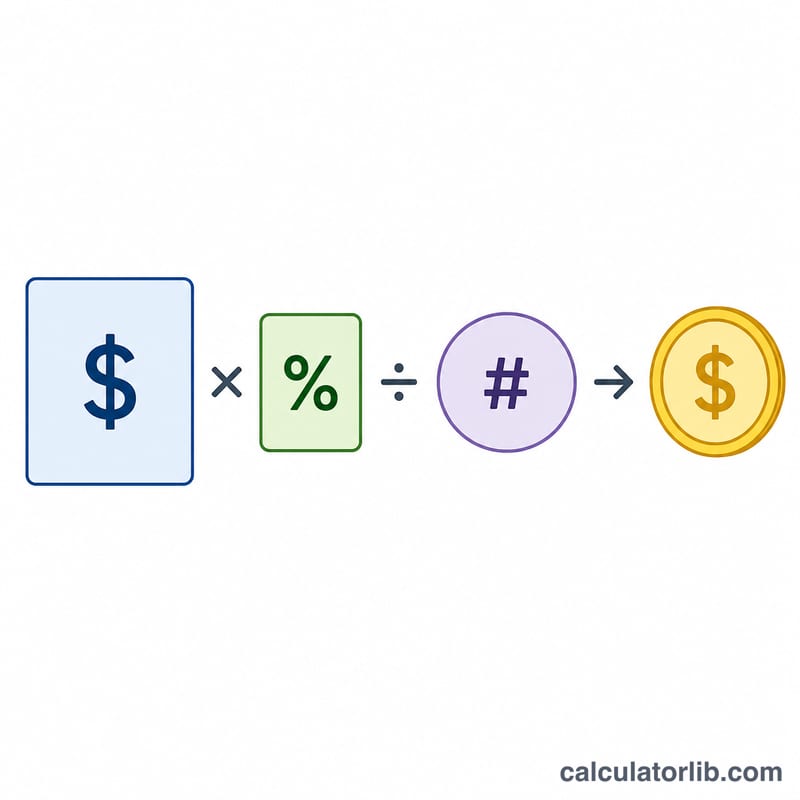
$$C = \frac{\text{Face Value} \times \dfrac{\text{Coupon Rate (\%)}}{100}}{\text{Payments per Year}}$$The coupon rate is converted from a percentage to a decimal (\(5\%\) becomes \(0.05\)). Multiplying by face value gives the total annual coupon, and dividing by the payment frequency spreads that interest across each period.
Worked Example
Suppose a bond has a $1,000 face value, a 5% annual coupon rate, and pays semi-annually (twice per year). The annual coupon is \(1{,}000 \times 0.05 = \$50\). Divided by 2 payments, each coupon payment is $25. So the holder receives $25 every six months.
FAQ
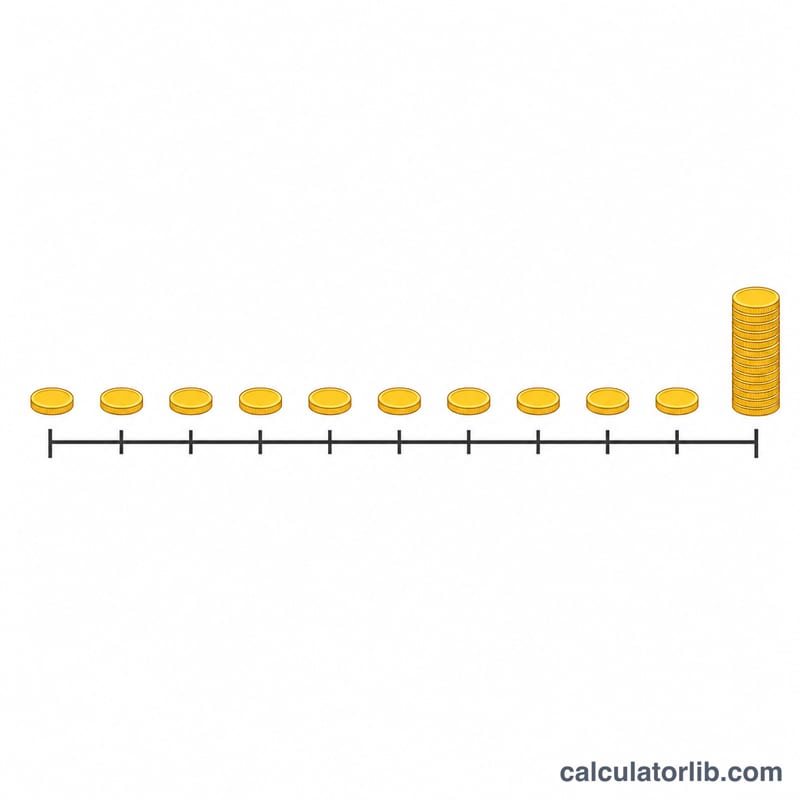
Does the coupon payment change with market price? No. Coupon payments are based on face value and the fixed coupon rate, not the bond's current market price. The yield to maturity changes with price, but the cash coupon stays the same.
What's the difference between coupon rate and yield? The coupon rate determines the fixed cash payment, while yield reflects the return relative to what you paid for the bond. They are equal only when the bond trades exactly at par.
What if my bond is a zero-coupon bond? Zero-coupon bonds pay no periodic interest (coupon rate of \(0\%\)), so the coupon payment is $0. They instead return value through being issued at a discount to face value.