What Is a Down Payment Calculator?
A down payment is the portion of a purchase price you pay upfront in cash, with the remainder typically financed through a loan. This calculator instantly converts a down payment percentage into a dollar amount and shows the loan balance you would still need to finance. It works for homes, cars, equipment, or any major purchase.
How to Use It
Enter the total purchase price and the down payment percentage you plan to put down. The calculator displays your down payment in dollars along with the remaining loan amount. Try a few percentages — such as 5%, 10%, and 20% — to compare how much cash you need versus how much you will borrow.
The Formula Explained
The math is simple but useful. The down payment equals the price multiplied by the percentage divided by 100:
$$\text{down\_payment} = \text{price} \times \frac{\text{pct}}{100}$$
The loan amount is whatever is left over:
$$\text{loan\_amount} = \text{price} - \text{down\_payment}$$
A larger down payment lowers your loan balance, which usually means smaller monthly payments and less interest paid over the life of the loan.
Worked Example
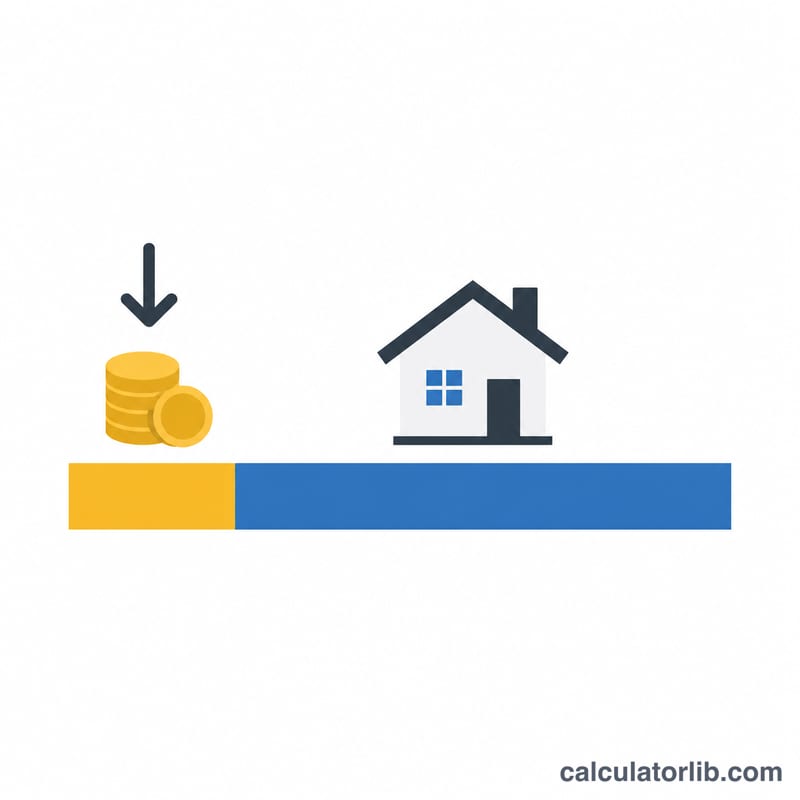
Suppose you are buying a home priced at $300,000 and plan to put down 20%. The down payment is \(300{,}000 \times \frac{20}{100} = 60{,}000\) $60,000. The loan amount needed is \(300{,}000 - 60{,}000 = 240{,}000\) $240,000.
Interpreting Your Down Payment Result
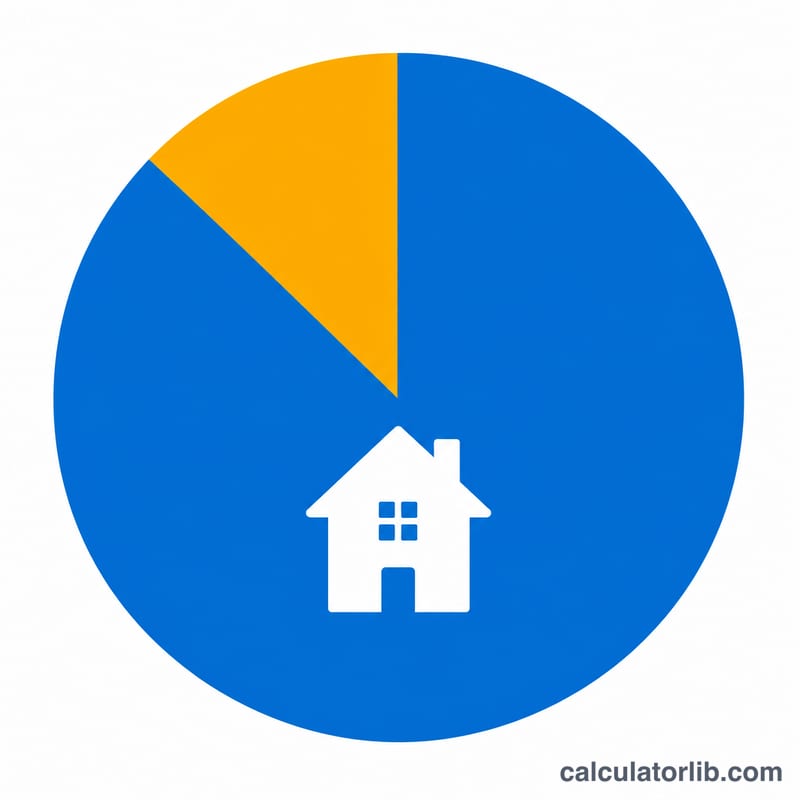
The calculator gives two numbers: the down payment amount (price × down payment % ÷ 100) and the remaining loan amount (price − down payment). The percentage you put down also sets your loan-to-value ratio: \(\text{LTV} = 100\% - \text{Down Payment }\%\). For example, a 20% down payment means an 80% LTV.
Some commonly cited reference points, mostly from the United States mortgage market:
- 20% down: This is the commonly cited threshold at which conventional mortgage lenders typically no longer require private mortgage insurance (PMI).
- 3.5% down (FHA): FHA loans have a minimum down payment of 3.5% for borrowers with a credit score of 580 or higher.
- 3% down (some conventional loans): Certain conventional loan programs allow as little as 3% down.
A larger down payment generally means a smaller loan, a lower LTV, and less interest paid over the life of the loan. A smaller down payment keeps more cash available but usually means a larger loan balance and possibly mortgage insurance.
Requirements vary by lender, loan program, and country. This is general information, not financial advice; confirm current terms with a lender or qualified advisor.
Key Terms: Down Payment, LTV, PMI and Principal
- Down payment
- The upfront portion of the purchase price you pay out of pocket rather than borrowing.
- Purchase price
- The agreed total price of the home, vehicle, or other asset being bought.
- Loan amount (principal)
- The amount you borrow: the purchase price minus the down payment. Interest is calculated on this balance as it is repaid.
- Loan-to-value (LTV) ratio
- The loan amount divided by the asset's value, expressed as a percentage. With no other adjustments, it equals 100% minus the down payment percentage.
- Private mortgage insurance (PMI)
- Insurance that protects the lender, not the borrower, if the borrower defaults. In the U.S., conventional loans with less than 20% down typically require it.
- Closing costs
- Fees paid to complete a real estate transaction, such as lender, appraisal, title, and recording fees. They are separate from the down payment and are not included in this calculation.
Central bank policy rates today
The latest official policy rates of major central banks, updated automatically — the benchmark that bank deposit and loan rates follow.
- Federal Reserve · United States
- 3.75–4.00%
- As of
- 2026-11-12
- Change in 1 year
- 0 pp
Latest change Up +25 bp Federal Reserve changed its rate on 2026-09-17: from 3.50–3.75% to 3.75–4.00%.
| Central bank | Policy rate | As of | Change in 1 year |
|---|---|---|---|
| Banco Central do Brasil (Selic) · Brazil | 13.75% | 2026-11-16 | −1.25 pp |
| Banco de México · Mexico | 6.25% | 2026-11-10 | −1.00 pp |
| Federal Reserve · United States | 3.75–4.00% | 2026-11-12 | 0 pp |
| ECB | 2.50% | 2026-11-16 | +0.50 pp |
| Sveriges Riksbank · Sweden | 2.00% | 2026-11-16 | +0.25 pp |
| Saudi Central Bank (SAMA) · Saudi Arabia | 4.50% | 2026-10-29 | 0 pp |
| Reserve Bank of Australia · Australia | 4.60% | 2026-10-31 | +1.00 pp |
| Central Bank of the Republic of Türkiye · Türkiye | 36.00% | 2026-11-06 | −3.50 pp |
| Bank of Russia · Russia | 14.00% | 2026-11-10 | −2.50 pp |
| People’s Bank of China · China | 3.00% | 2026-11-10 | 0 pp |
| Bank of Canada · Canada | 2.50% | 2026-11-13 | +0.25 pp |
| Reserve Bank of India · India | 5.50% | 2026-10-19 | 0 pp |
| Bank of England · United Kingdom | 4.00% | 2026-11-16 | 0 pp |
| Bank of Japan · Japan | 1.25% | 2026-11-10 | +0.75 pp |
| Bank of Korea · South Korea | 3.00% | 2026-11-02 | +0.50 pp |
Federal Reserve: key rates and overnight market rates
The rates that frame monetary policy and the overnight market rate they steer, each with the date of its latest published value.
| Rate | Level | As of | Change in 1 year |
|---|---|---|---|
| Federal funds target range | 3.75–4.00% | 2026-11-13 | 0 pp |
| Effective federal funds rate (EFFR) | 3.88% | 2026-11-13 | 0 pp |
| Secured Overnight Financing Rate (SOFR) | 3.90% | 2026-11-13 | −0.10 pp |
Each rate keeps the date of its own latest published value; overnight market rates are published on the next business day.
Latest figure: 2026-11-12 Data last updated 2026-11-16 · current
Source: Banco Central do Brasil ODbL; Bank for International Settlements (BIS) Terms of permitted use of BIS statistics; Federal Reserve Bank of New York New York Fed Terms of Use; Board of Governors of the Federal Reserve System Public domain (U.S. government work); European Central Bank ECB reuse policy; Sveriges Riksbank Riksbank open data terms; The World Bank Group CC BY 4.0; Reserve Bank of Australia 2026 RBA copyright terms (Cash Rate); Bank of Canada Bank of Canada terms of use; Bank of England Open Government Licence v3.0
The one-year change is computed by CalculatorLib from these data. The EFFR and SOFR are subject to the Terms of Use posted at newyorkfed.org. The New York Fed is not responsible for publication of the EFFR and SOFR by CalculatorLib, does not sanction or endorse any particular republication, and has no liability for your use.
Source details and methodology
- Banco Central do Brasil
- Bank for International Settlements (BIS) — Central bank policy rates
- Federal Reserve Bank of New York — Reference rates (EFFR, SOFR)
- Board of Governors of the Federal Reserve System
- European Central Bank
- Sveriges Riksbank
- The World Bank Group — World Development Indicators (FR.INR.LEND, FR.INR.RINR)
- Reserve Bank of Australia 2026
- Bank of Canada
- Bank of England
FAQ
How much should I put down on a house? A 20% down payment is common because it often avoids private mortgage insurance (PMI), but many loans allow far less — sometimes 3% to 5%.
Does a bigger down payment save money? Yes. A larger down payment reduces your loan principal, lowering both your monthly payment and total interest paid.
Can I enter any percentage? Yes, any value from 0% to 100%. A 100% down payment means you pay entirely in cash with no loan needed.