
What Is a Down Payment Percentage?
A down payment percentage tells you how much of a property's purchase price you are paying upfront in cash, rather than financing with a loan. It is one of the most important numbers in any home or large purchase, because lenders, mortgage insurance requirements, and interest rates all hinge on it. A 20% down payment, for example, often lets buyers avoid private mortgage insurance (PMI).
How to Use This Calculator
Enter the total purchase price of the property and the amount you plan to put down in cash. The calculator instantly shows your down payment as a percentage of the price, along with the resulting loan amount you would need to finance. Adjust either figure to compare scenarios — for instance, how much more cash you'd need to reach a 20% threshold.
The Formula Explained
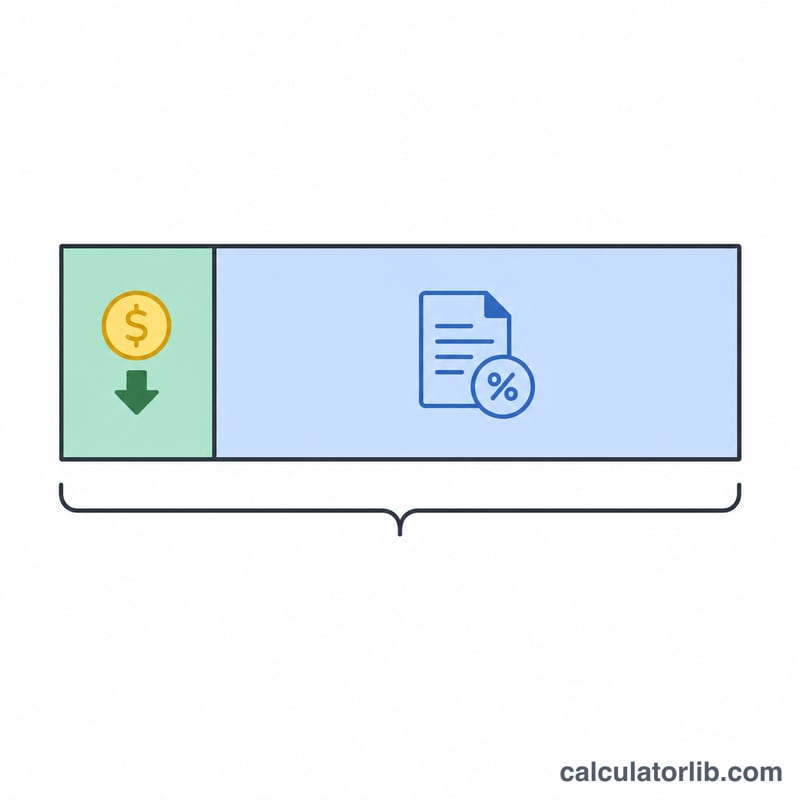
The math is a simple ratio: divide the down payment by the purchase price and multiply by 100 to convert it into a percentage. The loan amount is simply the purchase price minus the down payment.
$$\text{\% Down} = \frac{\text{Down Payment}}{\text{Purchase Price}} \times 100$$
Worked Example
Suppose you are buying a home for $300,000 and putting down $60,000. The percentage is $$(60{,}000 \div 300{,}000) \times 100 = 20\%.$$ Your loan amount would be $$300{,}000 - 60{,}000 = \$240{,}000.$$ With 20% down, you would typically avoid PMI on a conventional mortgage.
FAQ
What is a good down payment percentage? 20% is a common benchmark for conventional loans to avoid PMI, but many programs allow 3%–5% down.
Does a higher down payment lower my payments? Yes — a larger down payment reduces the loan amount, lowering both your monthly principal and total interest paid.
Can the down payment be more than the price? No. Your down payment should be less than the purchase price; otherwise no loan is needed.