
What Is a Savings Rate?
Your savings rate is the percentage of your income that you set aside instead of spending. It is one of the single most powerful indicators of financial progress, because the more of each paycheck you keep, the faster your wealth grows and the sooner you can reach goals like an emergency fund, a house deposit, or early retirement.
How to Use This Calculator
Enter the amount you saved over a period (a month, a paycheck, or a year) and your income for that same period. Make sure both figures cover the same timeframe. The calculator returns your savings rate as a percentage, plus how much you saved and how much you spent.
The Formula Explained
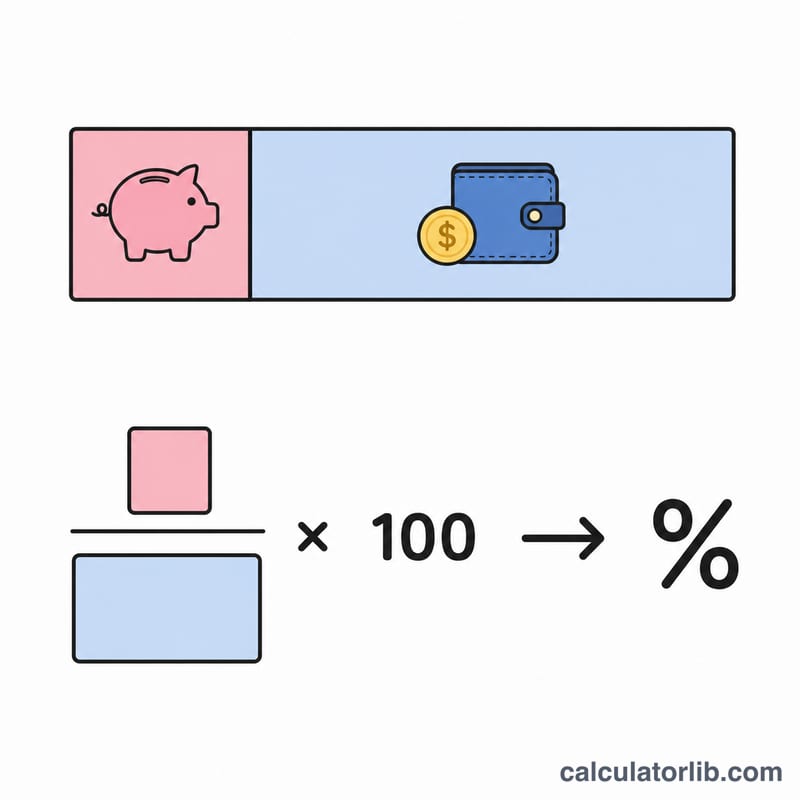
The math is simple: divide what you saved by what you earned, then multiply by 100 to convert the decimal into a percentage.
$$\text{Savings Rate} = \frac{\text{Amount Saved}}{\text{Income}} \times 100\%$$
Whether you use gross (pre-tax) or net (take-home) income is up to you — net income usually gives a more realistic picture of everyday saving.
Worked Example
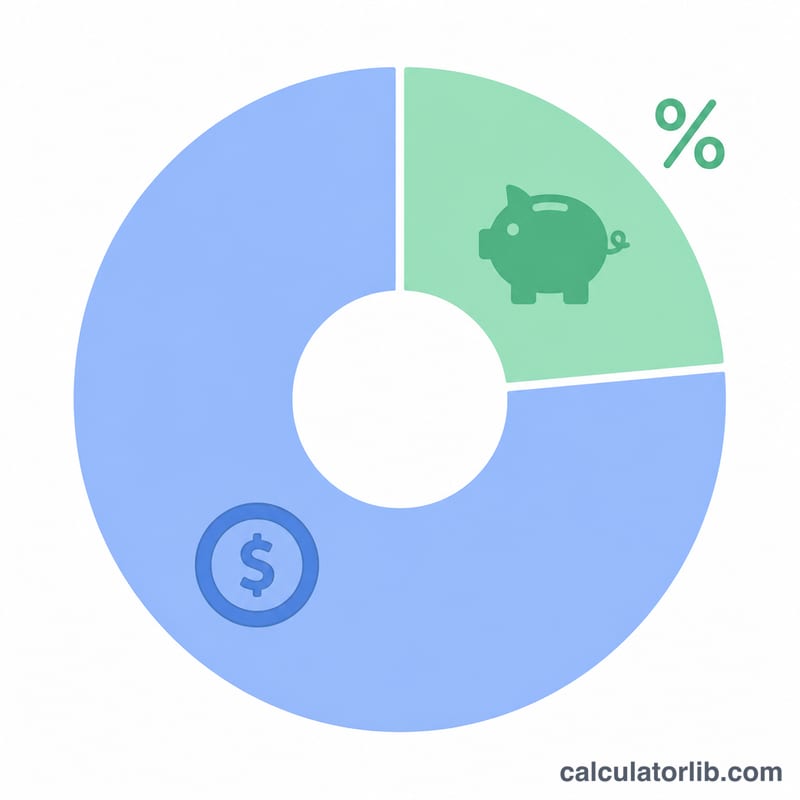
Suppose you earn $4,000 in a month and save $500 of it. Your savings rate is $$(500 \div 4{,}000) \times 100 = 12.5\%$$ That means you spent the remaining $3,500, or 87.5% of your income.
FAQ
What is a good savings rate? Many planners suggest aiming for at least 15–20% of income, though any positive rate is a good start and higher is better.
Should I use gross or net income? Either works as long as you stay consistent. Net (take-home) income is often more practical for budgeting.
Does this include employer retirement contributions? Only if you add them to both your saved amount and income. For a personal rate, most people count just their own contributions.