
What Is a Savings Rate?
Your savings rate is the share of your income that you keep instead of spend. It is one of the most powerful numbers in personal finance because it directly determines how fast your wealth grows and how soon you could reach financial independence. A higher savings rate means you live on less and bank more, shortening the time it takes to build an emergency fund, hit retirement goals, or pay off debt.
How to Use This Calculator
Enter your income (ideally take-home, after-tax pay) and your total spending for the same period. Choose whether the figures are monthly or annual. The calculator returns your savings rate as a percentage, the amount you saved for that period, and your equivalent monthly and annual savings so you can compare against goals.
The Formula Explained
The calculation is simple: $$\text{Savings Rate} = \frac{\text{Income} - \text{Spending}}{\text{Income}} \times 100\%$$ Subtracting spending from income gives the money left over (your savings). Dividing by income and multiplying by 100 converts it to a percentage. If you spend everything you earn, your rate is 0%. If you save half your income, your rate is 50%.
Worked Example
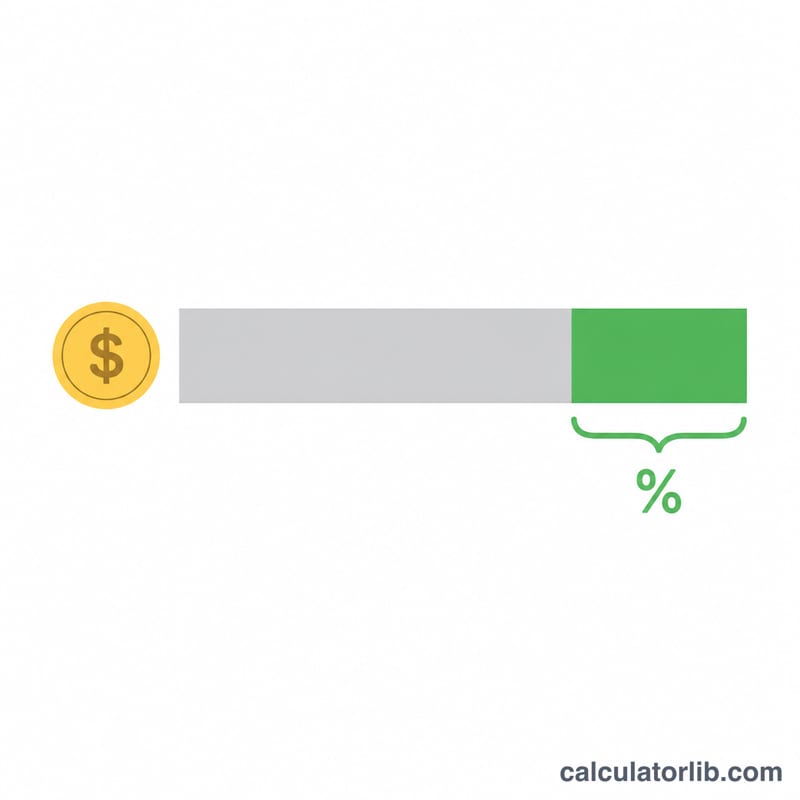
Suppose you take home $5,000 a month and spend $3,500. Your savings are \(\$5{,}000 - \$3{,}500 = \$1{,}500\). Divide by income: $$\$1{,}500 \div \$5{,}000 = 0.30$$ or a 30% savings rate. Over a year that is $18,000 saved — a strong foundation for investing or paying down debt.
FAQ
Should I use gross or net income? Net (after-tax) income gives the most realistic picture of how much you can actually save. Using gross income makes your rate look lower but is sometimes used for retirement-planning comparisons.
What is a good savings rate? Many planners suggest at least 15–20% of income. Those pursuing early retirement often target 40–70%, but any positive rate is progress.
Can the savings rate be negative? Yes — if you spend more than you earn, the result is negative, signaling you are drawing down savings or going into debt.