
What This Calculator Does
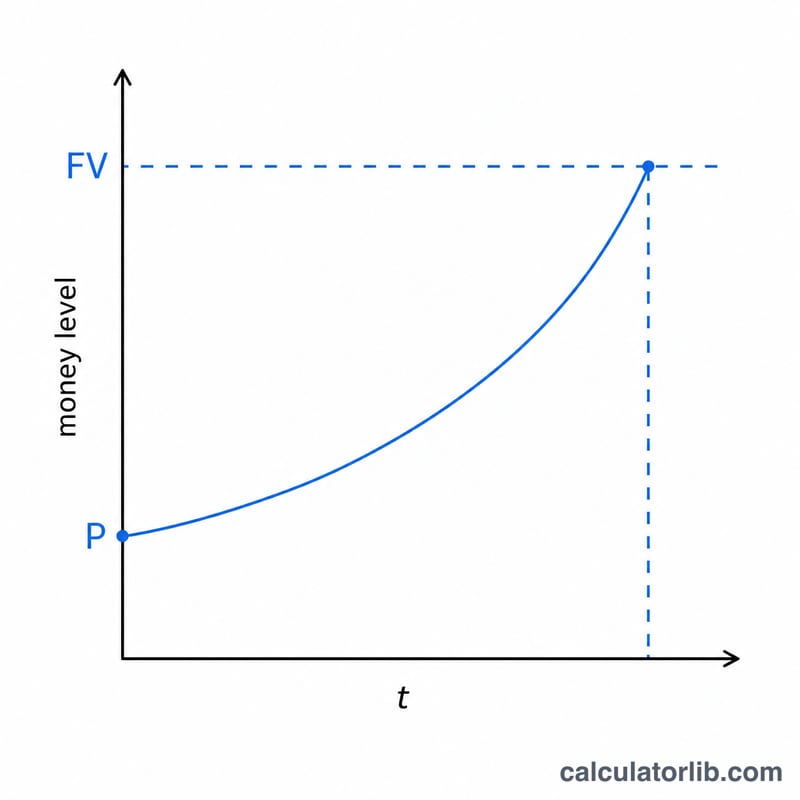
The Time to Reach Savings Goal Calculator tells you how many years it will take for your current savings to grow into a target amount, assuming the money earns compound interest at a fixed rate. It is ideal for planning emergency funds, down payments, vacations, or any lump-sum savings target where you are not adding new deposits but letting interest do the work.
How to Use It
Enter your savings goal (the future value you want to reach), your current savings balance (the present value), the annual interest rate as a percentage, and how often interest is compounded — annually, semi-annually, quarterly, monthly, or daily. The calculator returns the number of years required, broken down into whole years and months.
The Formula Explained
The growth follows the compound interest equation \(FV = P\left(1 + \frac{r}{n}\right)^{nt}\). Solving for time \(t\) gives:
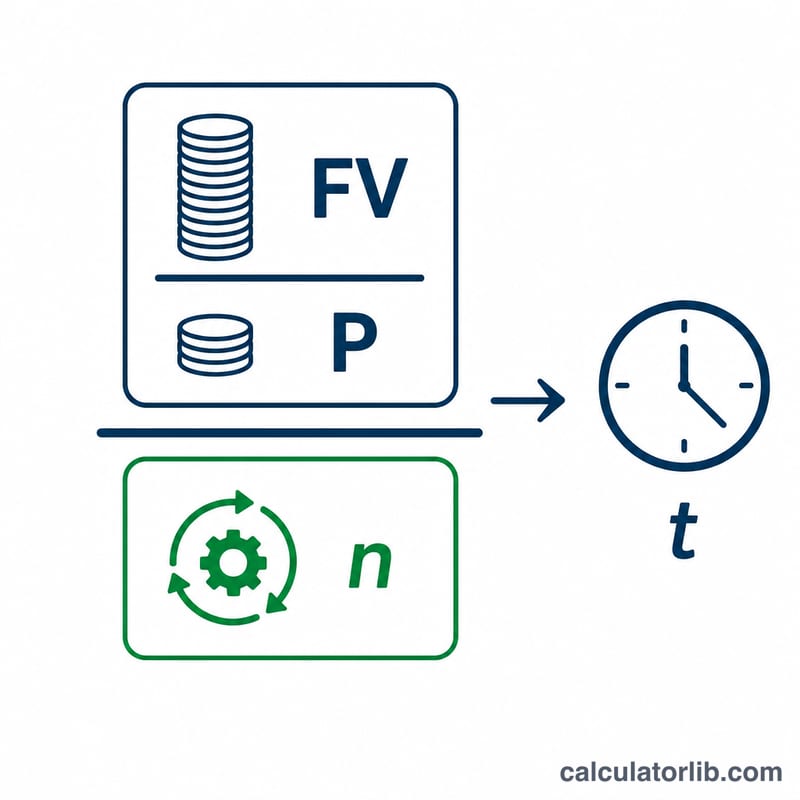
$$t = \frac{\ln\!\left(\dfrac{FV}{P}\right)}{n \cdot \ln\!\left(1 + \dfrac{r}{n}\right)}$$
Here \(FV\) is the goal, \(P\) is the present balance, \(r\) is the annual rate (as a decimal), and \(n\) is the number of compounding periods per year. The natural logarithm (\(\ln\)) appears because we are reversing an exponential growth process.
Worked Example
Suppose you have $5,000 and want to reach $10,000, earning 5% annual interest compounded monthly (\(n = 12\)). Then \(r/n = 0.05/12 \approx 0.0041667\), \(\ln(1.0041667) \approx 0.0041580\), and the denominator is \(12 \times 0.0041580 \approx 0.049896\). The numerator is \(\ln(10000/5000) = \ln(2) \approx 0.693147\). Dividing gives \(t \approx 13.89\) years — about 13 years and 11 months.
FAQ
Does this include monthly deposits? No. This calculator assumes a single lump sum growing on its own. Use a separate goal calculator if you make regular contributions.
What if my goal is less than my balance? If you already have enough, the time is effectively zero — you have reached your goal.
Why does compounding frequency matter? More frequent compounding earns interest slightly faster, shaving a small amount of time off your goal compared with annual compounding.