
What is private saving?
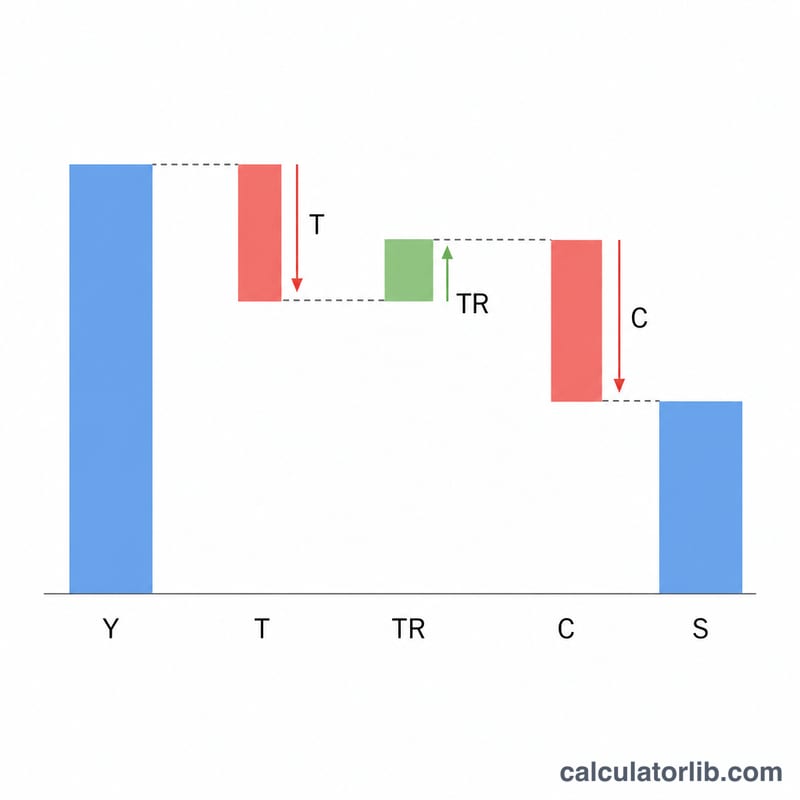
Private saving is the portion of after-tax income that households and businesses do not spend on consumption. In macroeconomics it is one half of national saving (the other being public saving). The standard identity is Private savings = \(S = \text{Y} - \text{T} + \text{TR} - \text{C}\), where Y is income, T is taxes paid, TR is government transfers received, and C is consumption spending.
How to use this calculator
Enter four values: your income (Y), the taxes you pay (T), any government transfers you receive such as subsidies or benefits (TR), and your total consumption (C). The calculator returns your private savings, your disposable income \(\text{Y} - \text{T} + \text{TR}\), and your savings rate as a percentage of disposable income.
The formula explained
First, disposable income is found by taking income, removing taxes, and adding transfers:
$$\text{Y} - \text{T} + \text{TR}$$Whatever of that disposable income is not consumed becomes saving. So private savings = disposable income − C. A positive figure means you are accumulating wealth; a negative figure means you are dissaving (spending more than you take home).
Worked example
Suppose income Y = 50,000, taxes T = 10,000, transfers TR = 2,000, and consumption C = 35,000. Disposable income:
$$50{,}000 - 10{,}000 + 2{,}000 = 42{,}000$$Private savings:
$$42{,}000 - 35{,}000 = 7{,}000$$The savings rate:
$$7{,}000 \div 42{,}000 \times 100 \approx 16.67\%$$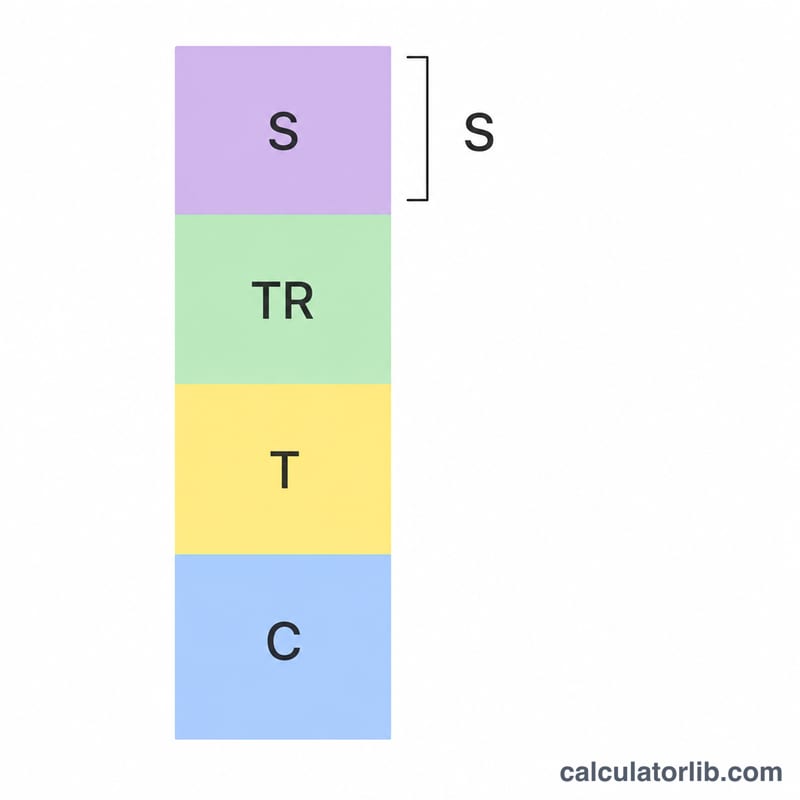
FAQ
Are transfers the same as taxes? No. Taxes flow from you to the government and reduce disposable income; transfers (benefits, subsidies) flow from the government to you and increase it.
Can savings be negative? Yes. If consumption exceeds disposable income, savings is negative, meaning you are borrowing or drawing down wealth.
Does this apply to a whole economy? Yes. The same identity works at the aggregate level, where Y is national income, T net taxes, TR transfers, and C aggregate consumption.