
What this calculator does
The Macro Percentage of Calories Calculator turns grams of fat, protein and carbohydrate into calories and shows what share of your daily energy each macronutrient provides. Knowing your macro split as a percentage helps you check whether a meal plan matches a target ratio (for example a 40/30/30 carb/protein/fat diet) rather than guessing from grams alone.
How to use it
Enter the grams of fat, protein and carbohydrate for a meal or a whole day. The calculator multiplies each by its energy density, adds them to get total calories, then expresses each macro as a percentage of that total. The three percentages always add up to 100%.
The formula explained
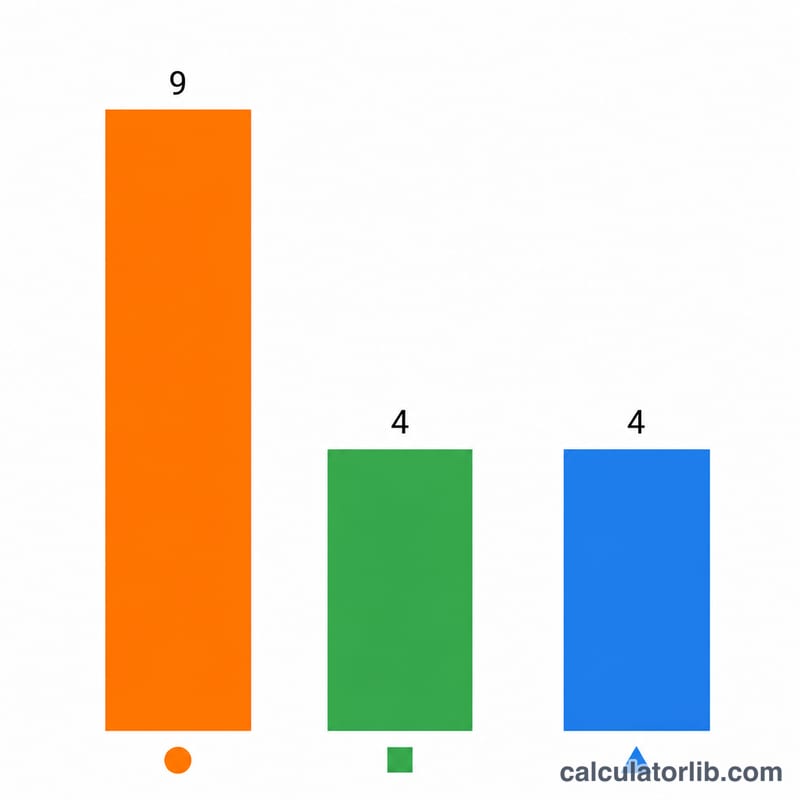
Macronutrients carry different amounts of energy: fat supplies 9 kcal per gram, while protein and carbohydrate each supply 4 kcal per gram. The percentage of calories from any macro is:
$$\%\text{Cal} = \left( \frac{\text{grams} \times \text{kcal/g}}{\text{total kcal}} \right) \times 100$$
where total kcal is the sum of fat, protein and carb calories.
Worked example
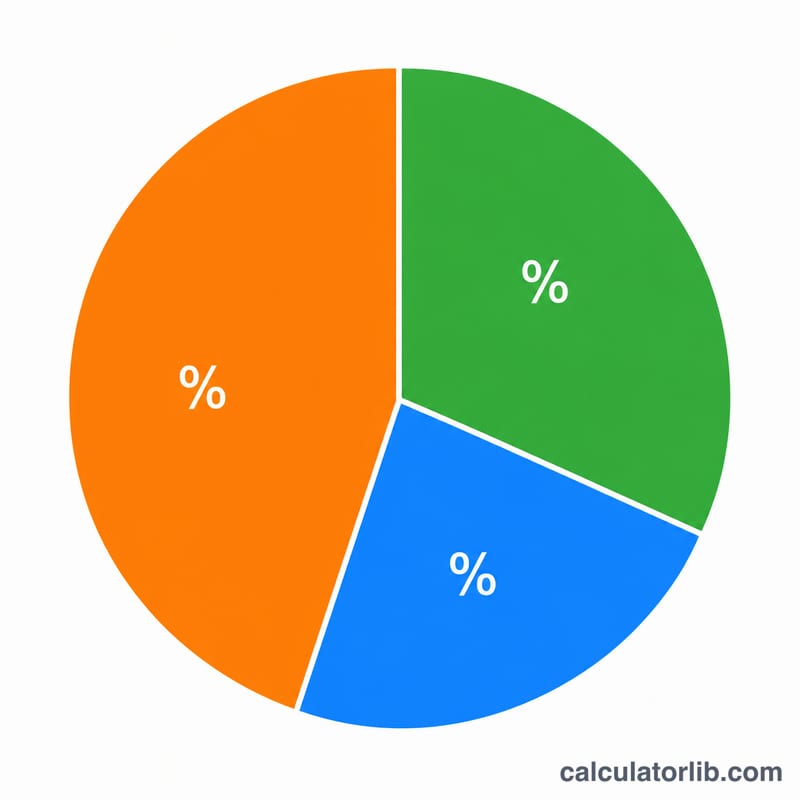
Suppose you eat 70 g fat, 150 g protein and 200 g carbs. Fat = \(70 \times 9 = 630\) kcal, protein = \(150 \times 4 = 600\) kcal, carbs = \(200 \times 4 = 800\) kcal. Total = 2,030 kcal. Fat percentage = \(630 \div 2{,}030 \times 100 \approx 31.0\%\), protein \(\approx 29.6\%\), carbs \(\approx 39.4\%\).
FAQ
Why does fat count as 9 calories per gram? Fat is more energy-dense than protein or carbohydrate, packing more than double the calories per gram, which is why even small amounts shift your percentages a lot.
Should I count alcohol or fiber? This tool covers the three main macros only. Alcohol (7 kcal/g) and fiber adjustments are not included.
Do the percentages always total 100%? Yes — each macro's calories are divided by the same total, so the three figures sum to 100% (aside from tiny rounding).