
What Is the Late Payment Interest Calculator?
When an invoice goes unpaid past its due date, the supplier is often entitled to charge interest on the outstanding amount. This calculator works out how much simple interest has accrued on an overdue payment based on the invoice amount, an annual interest rate, and the number of days the payment is late. It's useful for freelancers, small businesses and finance teams chasing overdue invoices.
How to Use It
Enter three values: the invoice amount still outstanding, the annual interest rate as a percentage (for example a statutory rate or the rate stated in your contract), and the number of days overdue since the payment was due. The calculator returns the interest owed, the total amount owed including the original principal, and the effective daily interest rate.
The Formula Explained
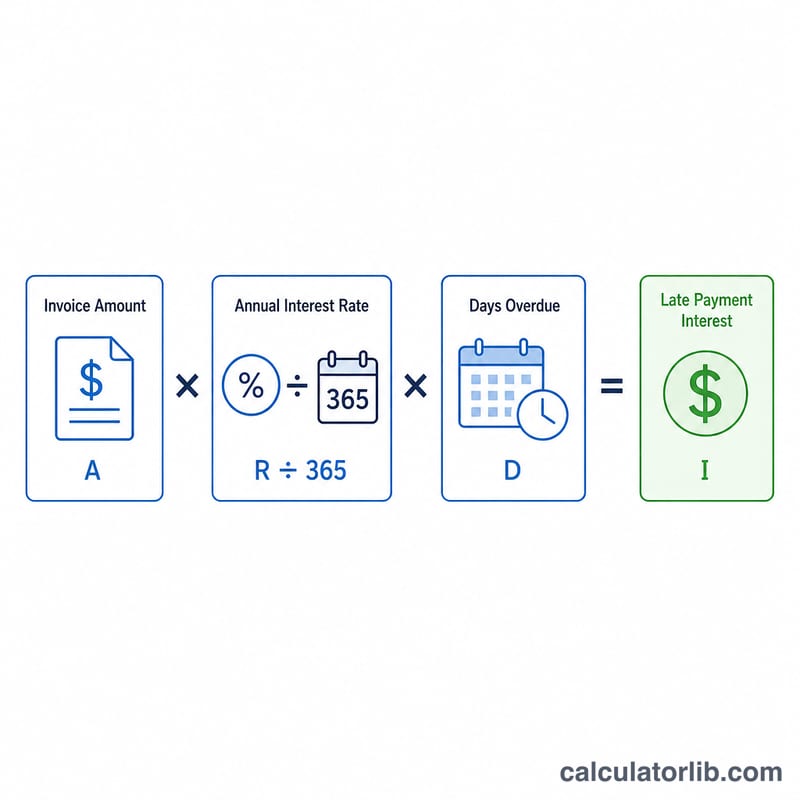
The tool uses simple daily interest:
$$\text{Interest} = \text{Amount} \times \frac{\text{annual rate}}{365} \times \text{days overdue}$$
The annual rate is divided by 365 to find the daily rate, multiplied by the outstanding amount, then multiplied by the number of overdue days. No compounding is applied, which matches how most statutory late-payment interest is calculated.
Worked Example
Suppose a £1,000 invoice is 30 days overdue and the agreed annual interest rate is 8%. The daily rate is \(8\% \div 365 = 0.0219178\%\) per day. Interest $$= 1{,}000 \times \frac{0.08}{365} \times 30 = \textbf{£6.58}.$$ The total now owed is \(£1{,}000 + £6.58 = \textbf{£1{,}006.58}\).
FAQ
Does it use compound interest? No — it applies simple interest, which is standard for most late-payment and statutory interest rules.
Which interest rate should I enter? Use the rate set in your contract or the statutory/base-plus rate that applies in your jurisdiction.
Is a 365-day year always correct? Most jurisdictions use a 365-day year for daily interest; some use 360. This calculator uses 365.