What this calculator does
Buying food for a party is guesswork until you turn it into arithmetic. This calculator converts four simple inputs — guest count, event length, menu type and whether alcohol is served — into concrete shopping quantities: total kilograms of food, appetizer pieces, main protein, sides, dessert servings, drink servings and ice. It uses standard catering rules of thumb for average adult appetites and works anywhere, since it deals only in quantities per person.
How to use it
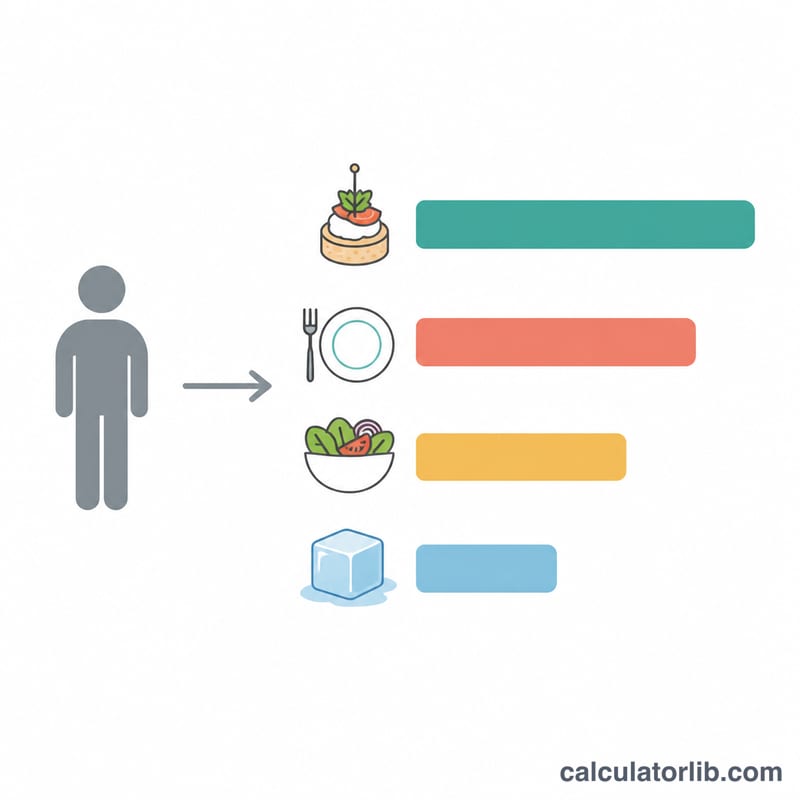
Enter the number of guests you actually expect (not the number invited), then the realistic length of the event in hours. Choose "snacks and appetizers only" for a cocktail-style gathering or "full meal" if there will be a main course. Finally say whether alcohol will be served, which shifts part of the drink total from soft drinks to alcoholic servings.
The formula explained
Appetizers scale with time, because people keep grazing. With \(G\) = guests and \(H\) = hours:
$$P = G \times \left[ p_1 + p_2 \times (H - 1) \right]$$where \(p_1 = 6\) and \(p_2 = 4\) for an appetizers-only menu, or \(p_1 = 4\) and \(p_2 = 2\) when a full meal is served. A full meal adds 0.2 kg of protein and 0.3 kg of sides per guest, dessert is 1.25 servings per guest, and each appetizer piece is counted at 30 g. Drinks follow the classic two-in-the-first-hour rule:
$$D = G \times (H + 1)$$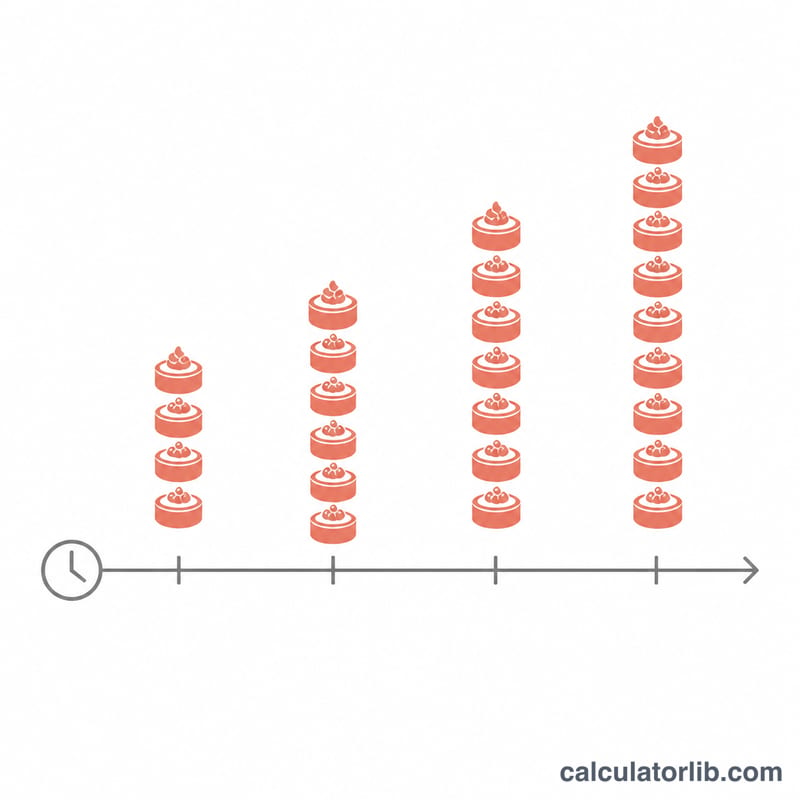
Worked example
Twenty guests, four hours, full meal, alcohol served:
$$P = 20 \times \left[ 4 + 2 \times (4 - 1) \right] = 200 \text{ pieces}$$$$\text{Food} = 200 \times 0.03 + 20 \times 0.2 + 20 \times 0.3 + 25 \times 0.1 = 18.5\,\text{kg}$$$$D = 20 \times (4 + 1) = 100 \text{ servings},\ 60 \text{ alcoholic},\ 40 \text{ soft}$$Plus \(0.7 \times 20 = 14\,\text{kg}\) of ice.
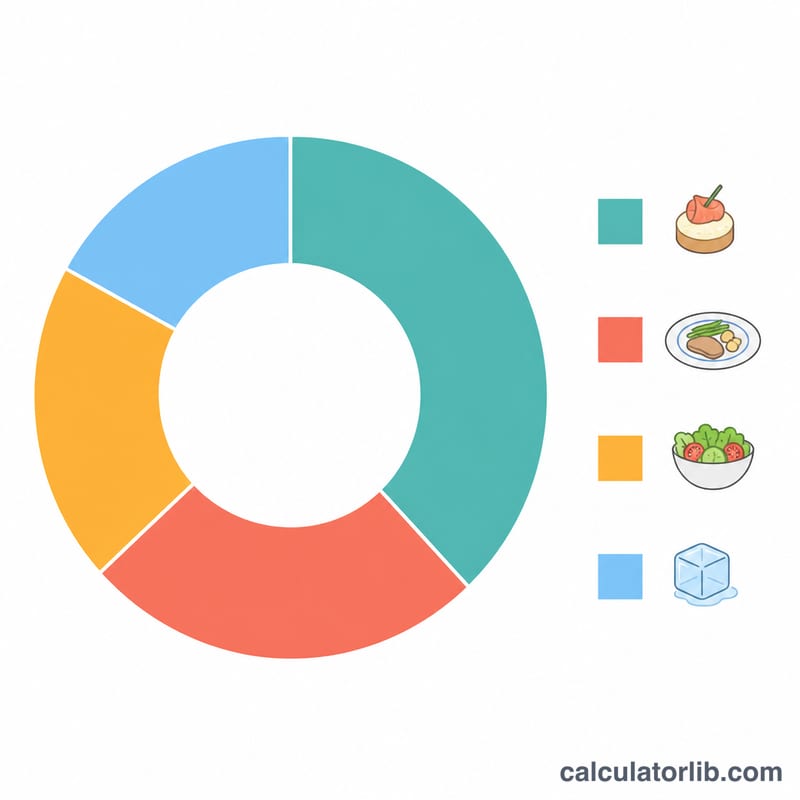
Standard Per-Guest Catering Quantities
This calculator builds every result from a small set of per-guest catering rules of thumb. These are general hospitality planning figures used widely in home and small-event catering — they are not a legal or national standard, and portion habits differ by country and by cuisine. All quantities below are metric (1 kg ≈ 2.2 lb).
| Item | Unit | Value used by this calculator | When it applies |
|---|---|---|---|
| Appetizer pieces — appetizers only (cocktail party) | pieces per guest | 6 in the first hour, +3 for each additional hour → \(6 + 3(H-1)\) | Menu = appetizers only: the finger food is the meal, so it must carry the whole event |
| Appetizer pieces — full meal | pieces per guest | 4 in the first hour, +2 for each additional hour → \(4 + 2(H-1)\) | Menu = full meal: appetizers only bridge the gap before the main course |
| Average appetizer piece weight | g per piece | 30 g (0.03 kg) | Mixed tray of canapés, skewers, sliders and dips; used to convert pieces into kilograms |
| Main protein (cooked, edible weight) | kg per guest | 0.2 kg | Full meal only; add ~15–25% if you buy bone-in or untrimmed cuts that lose weight in cooking |
| Side dishes (salads, starch, vegetables combined) | kg per guest | 0.3 kg | Full meal only; split across 2–3 sides rather than one large bowl |
| Dessert | servings per guest | 1.25 servings ≈ 0.125 kg at 100 g per serving | Full meal only; the extra 25% covers second helpings and uneven slicing |
| Drinks (all types) | servings per guest | \(H + 1\) servings — about one per hour plus one on arrival | Every event; a serving is 330 ml beer/soft drink, 150 ml wine or 30–40 ml spirits |
| Drink split — alcohol served | % of total servings | ≈60% alcoholic, ≈40% soft drinks and water | Adult evening events; shift toward soft drinks for daytime, family or driving-heavy guest lists |
| Drink split — no alcohol | % of total servings | 100% soft drinks, juice and water | Dry events, kids' parties, workplace gatherings |
| Ice | kg per guest | 0.7 kg | Every event; covers both chilling bottles in tubs and ice in glasses. Raise it in hot weather or for a long outdoor party |
The full-meal food total is therefore
$$\text{Total Food (kg)} = G\left[\,0.03\left(4 + 2(H-1)\right) + 0.2 + 0.3 + 0.125\,\right]$$where \(G\) is the guest count and \(H\) the event length in hours. For an appetizers-only menu the protein, sides and dessert terms drop out and only the piece count matters: \(0.03\,G\left(6 + 3(H-1)\right)\).
Turning the Numbers Into a Shopping List
The calculator gives you exact decimals; a shop sells packages. Work down the result line by line and round every item up to the next package you can actually buy.
- Protein → retail packs. The 0.2 kg per guest is cooked, edible weight. For 20 guests that is 4 kg: roughly 25 chicken breasts at 150–170 g each, or 8 packs of 500 g minced meat, or about 5 kg of bone-in cuts once you allow for bone and shrinkage. Buy in whole packs and let the surplus be tomorrow's lunch.
- Appetizer pieces → trays. Divide the piece count by the pieces per tray or per recipe batch. 200 pieces at 20 pieces per frozen tray is 10 trays; a homemade batch that yields 24 canapés means 9 batches. Rounding up here is cheap and prevents an empty platter in the first 30 minutes, when guests eat fastest.
- Drink servings → bottles and cans. Use the standard conversions: a 750 ml wine bottle ≈ 5 servings of 150 ml; a 2 L soft drink bottle ≈ 8 servings of 250 ml; a 330 ml can or bottle = 1 serving; a 700 ml spirits bottle ≈ 20 servings of 35 ml before mixers. So 60 alcoholic servings might be 6 wine bottles (30) + 30 beers, and 40 soft servings is 5 large bottles or 40 cans. Cans waste less than large bottles at a stand-up party.
- Ice → whole bags, bought last. Ice is commonly sold in bags of about 2 kg, 5 kg and 10 kg (in the United States, 7 lb, 10 lb and 20 lb). A 50-guest party needs 35 kg — seven 5 kg bags. Buy it the same day, as late as possible, and keep it in a closed cooler; ice bought the day before will have fused into a block or half melted.
- Add a buffer where service is unsupervised. Add roughly 10% for a self-serve buffet, where guests plate generously, and for teenage or very hungry crowds. On the 20-guest full-meal example, 18.5 kg becomes about 20.4 kg. Conversely, if several guests have said they will bring a dish, subtract that dish from your own list rather than adding to it — otherwise you cater twice.
- Plan cold storage before you buy. Drinks and ice take more space than food. Reserve one cooler or tub per 100 drink servings, keep raw protein on the lowest fridge shelf away from ready-to-eat platters, and remember that a fridge packed solid cools poorly. Chill drinks in ice water rather than in the fridge — it is faster and frees shelf space.
- Treat dietary variation as a mix shift, not a total shift. Vegetarian guests, children and late arrivals change what you buy, not how much. Convert a share of the protein line into a substantial vegetarian main in the same weight, count children at roughly half an adult portion but the same drink count, and hold back a small reserve of shelf-stable snacks for people who arrive in the last hour.
Finally, review the timeline: order or bake anything that keeps two days ahead, prep sides the day before, and leave only the ice, fresh bread and last-minute assembly for the day itself.
This article gives general planning information for portioning and shopping, not professional catering, nutrition or food-safety advice. Follow your local food-safety guidance for storage and holding temperatures, and consult a caterer or a qualified professional for allergy, medical or licensing questions.
FAQ
Should I round up? Yes. Round every line up to the nearest package size; leftovers are far cheaper than running out mid-party.
What about children? Count a child as roughly half an adult for food and drinks, and add extra soft drinks.
Does buffet service change the numbers? A self-serve buffet typically increases consumption by about 10 percent versus plated service, so add a margin if guests serve themselves.