
What is the Resultant Velocity Calculator?
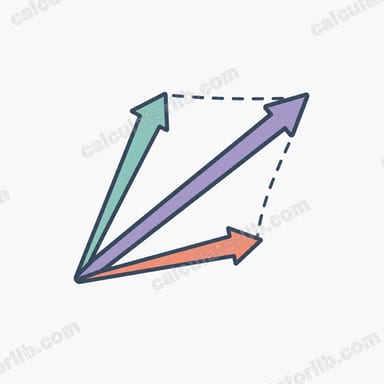
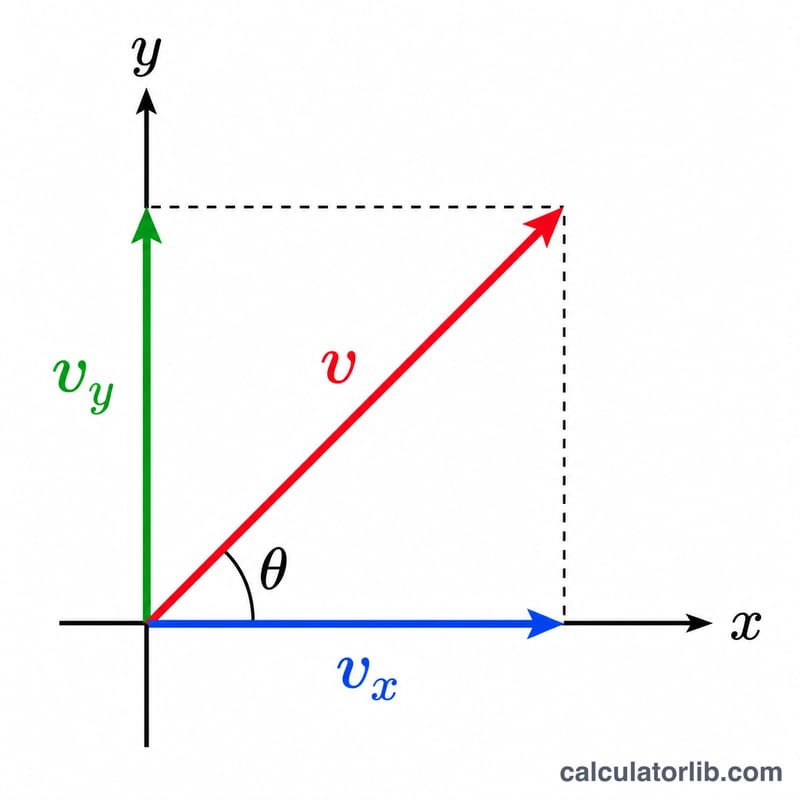
When an object moves with two perpendicular velocity components — one along the x-axis and one along the y-axis — its true motion is described by the resultant velocity. This calculator combines the horizontal component (vx) and the vertical component (vy) into a single velocity vector, returning both its magnitude (how fast) and its direction (which way, as an angle from the positive x-axis).
How to use it
Enter the x-component and y-component of the velocity in any consistent unit (m/s, km/h, ft/s, etc.). The calculator outputs the resultant speed in the same units and the direction in degrees. Positive angles point counter-clockwise from the +x axis; negative angles point clockwise (below the axis).
The formula explained
The two components form the legs of a right triangle, so the resultant magnitude follows the Pythagorean theorem: $$|\vec{v}| = \sqrt{\text{vx}^{2} + \text{vy}^{2}}$$ The direction comes from the two-argument arctangent, $$\theta = \operatorname{atan2}(\text{vy}, \text{vx})$$ which correctly accounts for the quadrant of the vector — something a plain \(\tan^{-1}\!\left(\frac{\text{vy}}{\text{vx}}\right)\) cannot do.
Worked example
Suppose \(\text{vx} = 3 \text{ m/s}\) and \(\text{vy} = 4 \text{ m/s}\). The magnitude is $$\sqrt{3^{2} + 4^{2}} = \sqrt{9 + 16} = \sqrt{25} = 5 \text{ m/s}$$ The direction is $$\operatorname{atan2}(4, 3) \approx 53.13^{\circ}$$ So the object moves at 5 m/s at about 53° above the x-axis.
FAQ
What units does it use? Any unit works as long as both components share the same unit; the result is in that same unit.
Why atan2 instead of arctan? atan2 uses the signs of both components to return the correct angle in the full −180° to +180° range, handling all four quadrants.
Can I use negative values? Yes. A negative vx or vy simply means the component points in the negative axis direction, and the angle reflects that.