
What is the SUVAT Calculator?
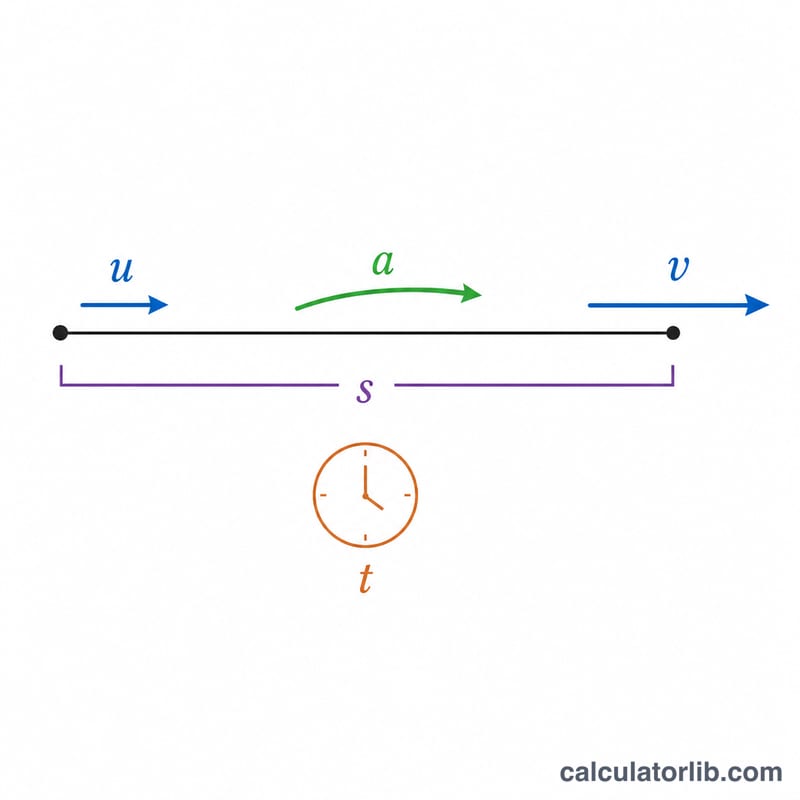
SUVAT is a memory aid for the five quantities used in the kinematic equations of motion for an object moving with constant acceleration: s (displacement), u (initial velocity), v (final velocity), a (acceleration) and t (time). This calculator takes the three most commonly known quantities — initial velocity, acceleration and time — and computes the final velocity and the displacement, plus a check value for v². It is a universal physics tool and applies anywhere.
How to use it
Enter the initial velocity u in metres per second, the acceleration a in metres per second squared (use 9.8 for free-fall under gravity), and the elapsed time t in seconds. Press calculate to see the final velocity v and displacement s. Use consistent SI units throughout for correct results.
The formulas explained
The four standard SUVAT equations are:
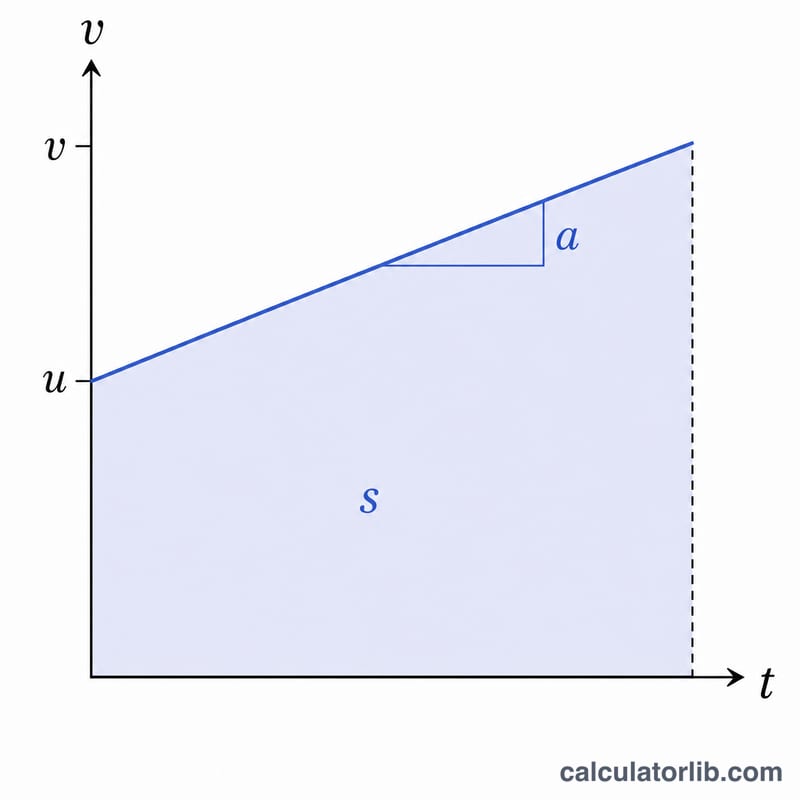
\(v = u + a \cdot t\) — final velocity equals initial velocity plus acceleration times time.
\(s = u \cdot t + \tfrac{1}{2}\, a \cdot t^{2}\) — displacement is the area under the velocity–time graph.
\(v^{2} = u^{2} + 2\, a \cdot s\) — links velocity and distance without time.
\(s = \tfrac{1}{2}(u + v) \cdot t\) — displacement from the average velocity.
This tool uses the first two as primary inputs and derives the rest.
Worked example
A car starts at \(u = 5\) m/s and accelerates at \(a = 2\) m/s² for \(t = 4\) s. Final velocity $$v = 5 + 2 \times 4 = 13 \text{ m/s}.$$ Displacement $$s = 5 \times 4 + \tfrac{1}{2} \times 2 \times 4^{2} = 20 + 16 = 36 \text{ m}.$$
FAQ
What units should I use? SI units: metres, seconds, m/s and m/s². As long as your inputs are consistent, the outputs are in matching units.
Can acceleration be negative? Yes. Use a negative value for deceleration or for downward motion when up is positive.
Do the SUVAT equations work with changing acceleration? No — they assume constant (uniform) acceleration. For varying acceleration you need calculus-based methods.