
What this calculator does
This tool solves problems of uniformly accelerated motion in one dimension — motion with constant acceleration. The five quantities involved are initial velocity (u), final velocity (v), displacement (s), acceleration (a) and time (t). These are often called the SUVAT variables. If you know any three of them, the other two are fully determined, and this calculator solves for them while showing the exact kinematic equations used.
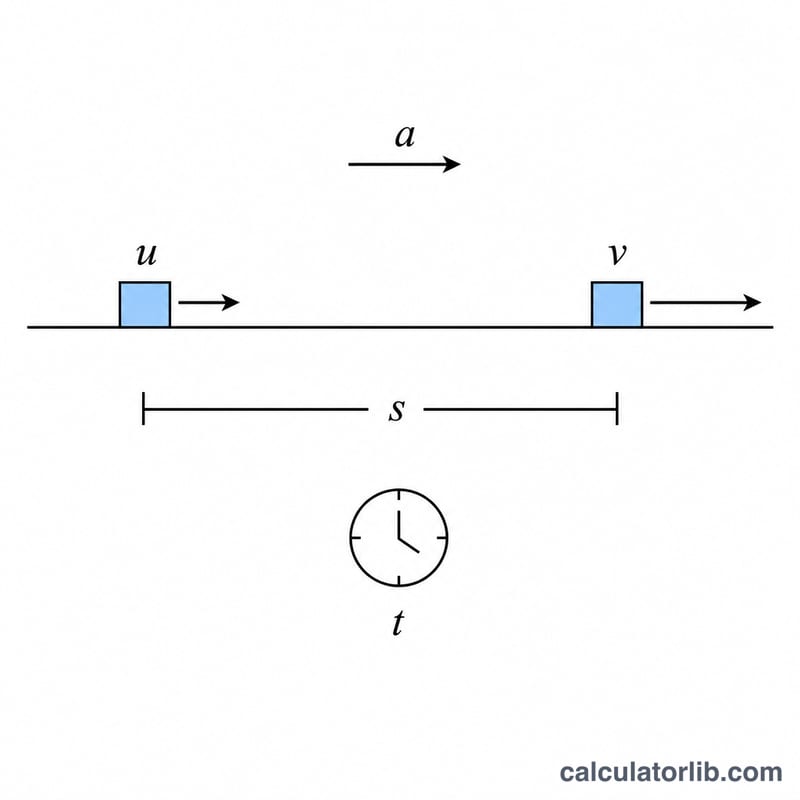
The five kinematic (SUVAT) equations
All constant-acceleration motion is described by five equations:
(1) \(v = u + a\cdot t\)
(2) \(s = u\cdot t + \tfrac{1}{2}\cdot a\cdot t^{2}\)
(3) \(s = \tfrac{1}{2}\cdot(u + v)\cdot t\)
(4) \(v^{2} = u^{2} + 2\cdot a\cdot s\)
(5) \(s = v\cdot t - \tfrac{1}{2}\cdot a\cdot t^{2}\)
Equation (3) is simply average velocity multiplied by time. The calculator picks the right combination of these equations for whichever three inputs you supply.
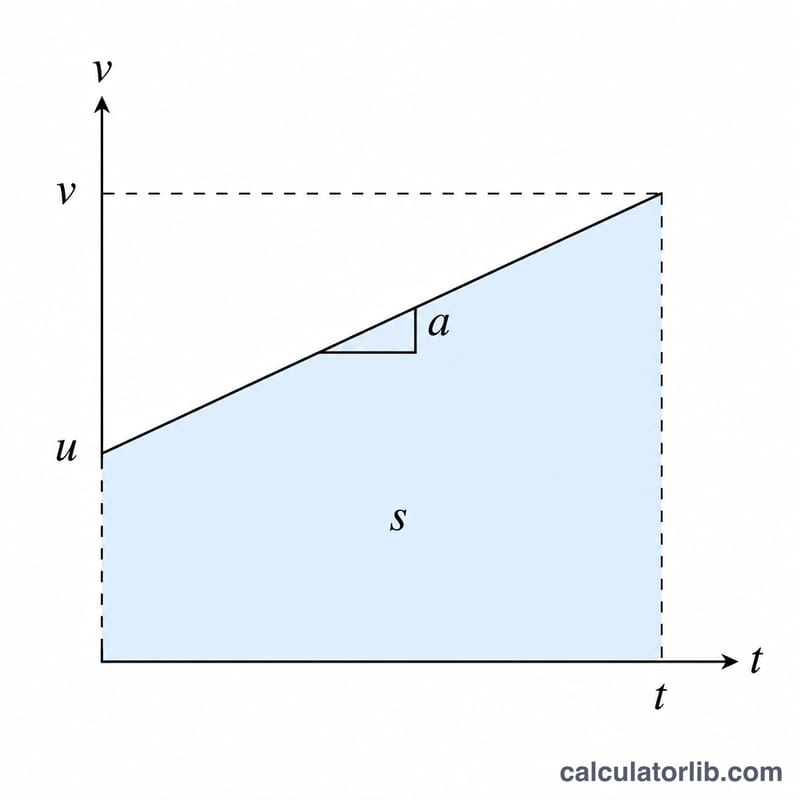
How to use it
Choose a calculation from the dropdown — it tells you which three values to enter and which two will be solved. Enter your three known values, pick the unit for each (m/s, km/h, knots, feet, miles, seconds, etc.), and optionally set the number of significant figures. Every input is converted to SI base units (m/s, m, m/s², s), the math is done, then each answer is converted back to your chosen unit.
Worked example
Find a and t given u = 5 m/s, v = 25 m/s, s = 100 m. Using equation (4): $$a = \frac{v^{2} - u^{2}}{2s} = \frac{625 - 25}{200} = 3 \text{ m/s}^2.$$ Using equation (3): $$t = \frac{2s}{u + v} = \frac{200}{30} = 6.667 \text{ s}.$$ Check: \(v = u + a\cdot t = 5 + 3\times 6.667 = 25\) m/s ✓.
FAQ
What does "no solution" mean? Some combinations are physically impossible or undefined — for example a square root of a negative number, a division by zero acceleration when velocity changes, or zero time when time is needed. The calculator reports these instead of returning nonsense.
Can I use negative numbers? Yes. Negative values represent motion in the opposite direction or deceleration; the equations stay valid.
Which square-root branch is used? For modes that solve a velocity from \(v^{2} = u^{2} + 2as\), the calculator returns the non-negative (principal) root by the standard physics convention.