
What is the Average Velocity Calculator?
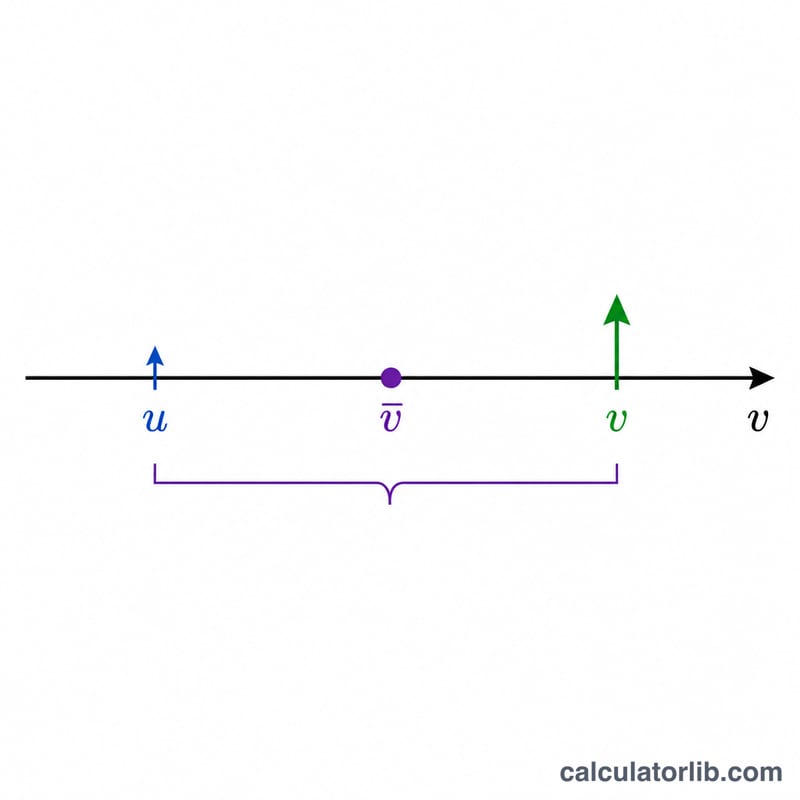
This calculator finds the average velocity of an object as the arithmetic mean of its initial velocity (u) and final velocity (v): \(\bar{v} = (v + u)/2\). It can also be rearranged to solve for the initial or final velocity when the average and one endpoint are known. Each velocity has its own unit dropdown, so you can mix units (for example km/h and m/s) and still get a correct, consistent answer. This is pure kinematics and applies the same way everywhere.
How to use it
1. Choose a calculation: find the average velocity, the initial velocity, or the final velocity. 2. Enter the two known velocities and pick a unit for each. 3. Pick the unit you want the answer reported in. 4. Optionally choose the number of significant figures, or leave it on "auto". The calculator converts every input to meters per second, applies the formula, then converts the answer into your chosen output unit.
The formula explained
For motion with constant (uniform) acceleration, the time-averaged velocity equals the simple mean of the endpoints:
$$\bar{v} = \frac{v + u}{2}$$
Rearranging gives the initial velocity \(u = 2\bar{v} - v\) and the final velocity \(v = 2\bar{v} - u\). Velocities may be negative; a negative value simply indicates the opposite direction.
Worked example
An object accelerates uniformly from \(u = 10\ \text{m/s}\) to \(v = 20\ \text{m/s}\). The average velocity is $$\bar{v} = \frac{20 + 10}{2} = \textbf{15 m/s}.$$ With mixed units: if \(v = 72\ \text{km/h}\) and \(\bar{v} = 15\ \text{m/s}\), then \(v = 72 \times 0.27778 = 20\ \text{m/s}\), so \(u = 2 \times 15 - 20 = \textbf{10 m/s}\).
Velocity Unit Conversion Table
The SI unit of velocity is the metre per second (m/s). All of the units accepted by this calculator are defined relative to the metre per second. To convert any speed into m/s, multiply by the factor in the second column; to convert from m/s back into that unit, multiply by the reverse factor in the third column (which is simply the reciprocal).
| Unit | Multiply by (to m/s) | Reverse factor (from m/s) |
|---|---|---|
| metre per second (m/s) | 1 | 1 |
| kilometre per hour (km/h) | 0.27778 | 3.6 |
| mile per hour (mph) | 0.44704 | 2.23694 |
| foot per second (ft/s) | 0.3048 | 3.28084 |
| knot (kn) | 0.51444 | 1.94384 |
| centimetre per second (cm/s) | 0.01 | 100 |
| inch per second (in/s) | 0.0254 | 39.3701 |
Worked example: a car travelling at 60 mph has a speed of \(60 \times 0.44704 = 26.82\) m/s. Converting that back to km/h gives \(26.82 \times 3.6 = \) 96.56 km/h. Because both the initial and final speeds are equal here, the average velocity equals that single speed expressed in km/h.
Key Terms & Variables
- Initial velocity (u)
- The velocity of the object at the start of the time interval being considered. In the average-velocity formula it is one of the two endpoint speeds; if the object starts from rest, \(u = 0\).
- Final velocity (v)
- The velocity of the object at the end of the time interval. Together with \(u\), it defines the change in motion over the interval.
- Average velocity (\(\bar{v}\))
- For motion under constant acceleration, the average velocity is the arithmetic mean of the initial and final velocities: \(\bar{v} = \dfrac{v + u}{2}\). This shortcut is valid only when acceleration is uniform; otherwise average velocity must be found from total displacement divided by total time.
- Uniform (constant) acceleration
- A condition in which velocity changes by equal amounts in equal time intervals — the acceleration \(a\) does not vary with time. This is the assumption that makes the midpoint formula \(\bar{v} = (v+u)/2\) exact, because the velocity-versus-time graph is a straight line.
- Displacement
- The change in position of the object — a vector quantity with both magnitude and direction. Under constant acceleration it equals average velocity multiplied by time: \(s = \bar{v}\,t\).
- Sign convention for direction
- Velocity is a vector, so each value carries a sign indicating direction along the chosen axis. Choose one direction as positive; motion the opposite way is negative. For example, with \(u = +20\) m/s and \(v = -10\) m/s (object reversed direction), the average velocity is \(\bar{v} = \dfrac{(-10) + (+20)}{2} = +5\) m/s, indicating a net motion in the positive direction.
FAQ
Is the average always (v + u)/2? Only when acceleration is constant. For non-uniform acceleration, the true average velocity is total displacement divided by total time and may differ.
Can I mix units? Yes. Each field has its own unit, and the answer is shown in the unit you select on the output field.
Can the answer be negative? Yes — velocity is a vector, so a negative result indicates motion in the opposite direction.