This calculator projects what a savings account will be worth at the end of a chosen term, given a starting balance, contributions that can grow each year, an interest rate, a compounding frequency and a tax rate on the interest. It runs the account month by month, so you get an end balance, a split of how much came from your own money versus interest, and a full schedule.
Reach for it when you're deciding how much to put aside each month, comparing two accounts whose rates or compounding differ, or checking whether a savings goal is reachable in the time you have.
The inputs, and what to put in them
| Input | Where the number comes from | Sensible range |
|---|---|---|
| Initial deposit | What's in the account today. Commas are fine (20,000). Leave it at 0 if you're starting from scratch. |
0 – any amount; negatives are accepted |
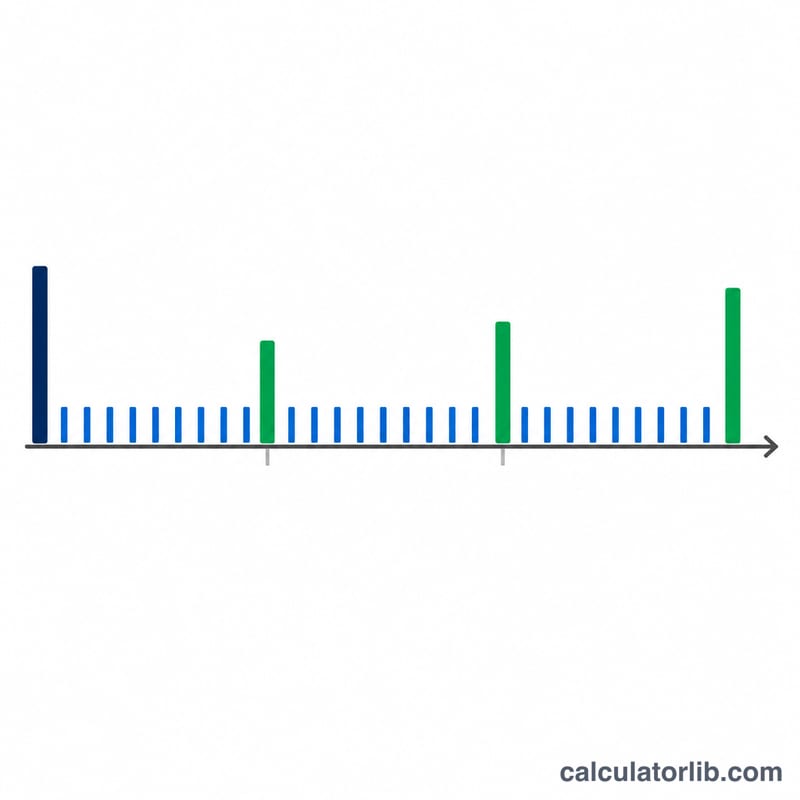
| Annual contribution | A once-a-year addition — a bonus, a tax refund, an annual IRA top-up. Credited in month 12 of each year. | 0 – 50,000 |
| Annual contribution increase (% /year) | How much that yearly amount grows — often expected inflation or a pay-rise rate. | 0 – 5 %, minimum −100 % |
| Monthly contribution | Your standing transfer, credited at the end of every month. | 0 – 5,000 |
| Monthly contribution increase (% /year) | Growth in that transfer. Steps once a year, not every month. | 0 – 5 %, minimum −100 % |
| Interest rate | The account's nominal annual rate — the APR quoted, not the APY. | 0 – 10 %; negatives rejected |
| Compound | How often the bank compounds, from annually to daily or continuously. Most US savings accounts compound daily or monthly. | — |
| Years to save | The term. Fractions are allowed — 2.5 and 0.75 both work. |
just over 0.1 up to 100 |
| Tax rate | Your marginal rate on interest income, if the account isn't tax-sheltered. Leave at 0 for an IRA or ISA. |
0 – 100 % |
The formula
The account is stepped forward one month at a time, always — the compounding choice only changes how much a month grows by. If r is the annual rate as a decimal and n is the number of compounding periods per year (1 for annually, 12 for monthly, 365.25 for daily), the monthly growth factor is:
$$f = \left(1 + \dfrac{r}{n}\right)^{n/12} \qquad\text{or}\qquad f = e^{\,r/12}\ \text{for continuous compounding}$$
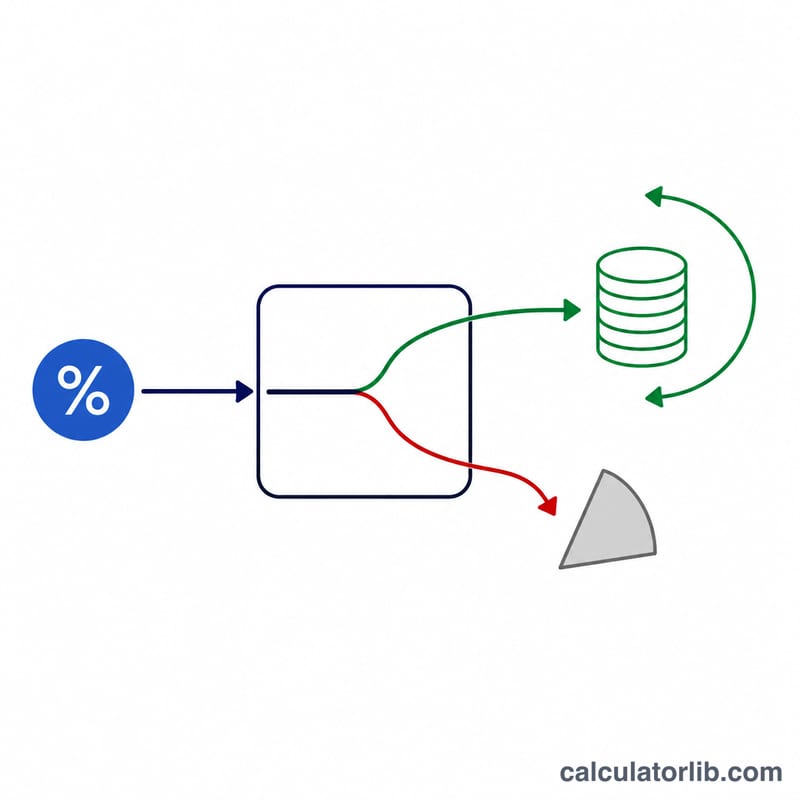
Each month, interest is taken on the opening balance, tax is withheld from that interest, and only then are contributions added:
$$B_m = B_{m-1}\cdot f - \bigl(B_{m-1}\cdot f - B_{m-1}\bigr)\cdot t \;+\; D_m$$
where t is the tax rate and Dm is that month's deposit — the monthly contribution, plus the annual contribution whenever m is a multiple of 12. Contributions grow by whole years, not by month:
$$D_m = C_{\text{mo}}(1+g_{\text{mo}})^{\lfloor (m-1)/12 \rfloor} + \bigl[\,12 \mid m\,\bigr]\; C_{\text{yr}}(1+g_{\text{yr}})^{\lfloor (m-1)/12 \rfloor}$$
There is no closed-form shortcut once contributions escalate and tax is withheld along the way — the month-by-month loop is the answer.
A worked example
Inputs: $20,000 initial deposit, $5,000 a year rising 3 % a year, no monthly contribution, 3 % interest compounded annually, 10 years, no tax.
The monthly growth factor is \(f = 1.03^{1/12} = 1.002466269772\).
- Month 1: $20,000.00 × 1.002466269772 − $20,000.00 = $49.33 interest → balance $20,049.33.
- Month 11: balance has climbed to $20,549.32, with no deposit yet.
- Month 12: $20,549.32 + $50.68 interest + $5,000.00 annual contribution = $25,600.00.
Year 1's interest is therefore exactly $600.00 — 3 % of the $20,000 opening balance, because the $5,000 arrived at the very end.
| Year | Deposit | Interest | Ending balance |
|---|---|---|---|
| 1 | $25,000.00 | $600.00 | $25,600.00 |
| 2 | $5,150.00 | $768.00 | $31,518.00 |
| 10 | $6,523.87 | $2,493.00 | $92,116.99 |
End balance: $92,116.99 — made up of the $20,000.00 initial deposit, $57,319.40 of contributions and $14,797.59 of interest. Year 2's $5,150.00 is $5,000 × 1.03; year 10's $6,523.87 is $5,000 × 1.039; and $57,319.40 is $5,000 × (1.0310 − 1) ÷ 0.03.
Rules that surprise people
Contributions earn nothing in the period that credits them. Every deposit lands at the end of its month, and the annual contribution lands in month 12 — not month 1. There's no beginning-of-period option. Assume the yearly contribution goes in at the start instead and you'd get $93,908.83 on the example above rather than $92,116.99 — $1,791.84 too optimistic over ten years.
The increases skip year 1. Both "increase % /year" boxes leave the first year at the raw amount and apply the first bump in year 2. With $1,000/year and $100/month both escalating 5 %, the deposits total $2,200.00 in year 1, $2,310.00 in year 2 and $2,425.50 in year 3 — and the monthly transfer stays flat at $100.00 for twelve months, then steps to $105.00 at month 13.
Compounding matters more than it looks. Interest is credited monthly on screen whatever you pick; the frequency only sets the monthly factor. On the example above, the same 3 % gives $92,116.99 annually, $92,344.42 monthly, $92,364.85 daily and $92,365.54 continuously — so picking "monthly" for an account that compounds annually quietly adds $227.43, and nothing on the schedule looks wrong.
A part-year term adds a short month that pays no contribution. The term is rounded up to a whole month, and that extra month earns only partial interest and takes no deposit at all — not even the annual one when it happens to fall on month 12. Enter 0.99 years and the end balance is $20,593.91 with no contributions line at all; enter 1 year and it's $25,600.00. The same trap at 1.99 years credits $5,000 of contributions where 2.00 years credits $10,150.
"Total contributions" and the schedule's first Deposit cell mean different things. Year 1 (and month 1) shows a Deposit of $25,000.00 — that includes your $20,000 opening balance. The summary's Total contributions of $57,319.40 excludes it, because the initial deposit has its own line.
Tax is withheld every month, not at year end. Set the tax rate above 0 and a Tax column appears in both schedules, the interest line is relabelled "after tax", and every figure moves — at 25 % the example becomes $88,086.45, with $10,767.06 of interest after tax and $3,589.02 of tax. Each summary line is rounded from its own exact total, so they can disagree with the headline by a cent: those three lines plus the $20,000 initial deposit add to $88,086.46. That's rounding, not an error.
How the End Balance Changes Across Scenarios
The clearest way to read this calculator is to fix one baseline and then move a single input at a time. The baseline below is a $20,000 initial deposit, $500 per month, no annual lump contribution, no escalation, a 4% nominal annual rate compounded monthly, 10 years to save, and a 0% tax rate on interest. Every row changes exactly one thing.
| Scenario (one change from baseline) | End balance | Total contributed | Total interest (after tax) | Tax withheld |
|---|---|---|---|---|
| Baseline — 4%, monthly compounding, 0% tax, no escalation | $103,441.55 | $80,000.00 | $23,441.55 | $0.00 |
| Compounding changed to daily (365.25), same 4% nominal | $103,485.85 | $80,000.00 | $23,485.85 | $0.00 |
| Compounding changed to annually, same 4% nominal | $102,953.07 | $80,000.00 | $22,953.07 | $0.00 |
| Rate raised from 4% to 5% | $110,581.35 | $80,000.00 | $30,581.35 | $0.00 |
| Tax on interest set to 22% | $97,620.06 | $80,000.00 | $17,620.06 | $4,969.75 |
| Tax on interest set to 32% | $95,107.49 | $80,000.00 | $15,107.49 | $7,109.41 |
| Monthly contribution escalated 3% per year (starting year 2) | $113,402.49 | $88,783.28 | $24,619.21 | $0.00 |
Three things stand out. First, compounding frequency barely matters: at the same 4% nominal rate, moving from annual to daily compounding adds about $533 over ten years — roughly 0.5% of the balance. Second, the rate matters a lot: one extra percentage point adds about $7,140 here. Third, tax on interest is a direct haircut on the interest only: at a 22% rate the contributions are untouched but roughly $4,970 of interest never lands in the account, and the compounding of that lost interest is lost too.
The escalation row is worth separating: most of its $9,961 advantage over the baseline comes from simply paying in $8,783 more, not from extra compounding. Escalation is a savings-behaviour lever, not a yield lever.
These figures are illustrative outputs of this calculator's own month-by-month engine, where interest is credited monthly, contributions land at the end of their period, and both escalation rates begin in year 2. Cent-level differences from a bank statement are normal, because real institutions round each posting and use their own day-count conventions.
Key Terms Used by This Calculator
- Initial deposit (principal), \(P\)
- The money already in the account on day one. It compounds for the entire term, so it does the heaviest lifting per dollar of any input.
- Nominal annual rate (APR), \(r\)
- The quoted yearly rate before compounding is applied. It is divided by the number of compounding periods to get the periodic rate \(i = r/(100\,n)\). A quoted rate alone is not a return — it needs a compounding frequency attached to it.
- Annual percentage yield (APY, effective annual yield)
- What the nominal rate actually earns over one year once compounding is included:
At \(r = 4\%\) the APY is 4.0000% compounded annually, 4.0742% monthly, 4.0809% daily and 4.0811% continuously — the same spread that produces the small differences in the scenario table. In the United States, deposit accounts are advertised by APY under Regulation DD (the Truth in Savings Act); other countries use comparable effective-rate disclosures, such as the EU's and UK's AER for savings.
- Compounding frequency, \(n\)
- Periods per year behind each menu option: annually 1, semiannually 2, quarterly 4, monthly 12, semimonthly 24, biweekly 26, weekly 52, daily 365.25 (a leap-year average; some banks use a flat 365), and continuously, the mathematical limit as \(n \to \infty\).
- Monthly growth factor, \(f\)
- Because this calculator credits interest monthly no matter which frequency you choose, it converts your choice into the equivalent monthly multiplier
where \(t\) is the tax rate written as a decimal. Each month the balance is multiplied by \(f\), then that month's contribution is added.
- Contribution escalation
- A once-a-year step-up applied to the annual and/or monthly contribution, each with its own percentage. The increases start in year 2, so year 1 uses the amounts exactly as you typed them; in year \(k\) the monthly amount is \(M\,(1+g_m)^{k-1}\).
- End-of-period contribution timing
- Contributions are credited at the end of the month or year (an ordinary annuity), so each one earns no interest in the period it arrives. Paying in at the start of each period instead would add roughly one extra period of interest on the contributions.
- Marginal tax rate on interest
- The percentage of each interest credit removed as tax. Use the rate that applies to your next dollar of income, not your average rate, because savings interest sits on top of your other income in most systems.
- Total contributions vs total interest
- The end balance splits into money you paid in (initial deposit plus every contribution) and money the account generated. Only the second part is potentially taxable.
- After-tax (net) interest
- Interest actually kept. Because tax is taken from every credit at the same rate, the tax withheld relates to net interest by \(\text{tax} = \text{net interest}\times t/(1-t)\) — at 22%, keeping $17,620 of interest means about $4,970 was taxed away.
What Your End Balance Actually Tells You
Read the split before you read the total. The end balance answers two different questions at once: how much you saved, and how hard the account worked. In the baseline above, $80,000 of the $103,442 is your own money and only about $23,442 (23%) is interest. Stretch the same inputs to 25 years and the balance becomes $311,340.05 on $170,000 contributed — interest is now about 45% of the total. Interest share rises with term length because early deposits get the most compounding periods; that is why the year-by-year table is more informative than the single final figure.
It is a scenario, not a guarantee. The projection holds one rate constant for the whole term. Real savings accounts, money market accounts and cash ISAs pay variable rates that move with central-bank policy and with the bank's own funding needs; even fixed-term deposits or CDs only fix the rate until maturity. Treat the output as "what happens if 4% persists", and run a pessimistic case (say, 1–2%) alongside the optimistic one. Nothing here accounts for account fees, minimum-balance penalties, promotional rates that expire, or deposit-insurance limits.
How the tax field behaves. The calculator withholds tax from every monthly interest credit at the rate you enter. That models interest being taxed as ordinary income at your marginal rate, and it is deliberately conservative — it removes the tax immediately so the lost amount also stops compounding. It does not describe an actual bank practice: in the United States, banks normally report interest on Form 1099-INT and withhold nothing (backup withholding is the exception), so you pay at filing time. Other systems genuinely do withhold at source — for example a flat withholding on deposit interest in several EU countries. If your jurisdiction taxes savings interest at a flat rate, or exempts an allowance before tax applies, enter your own effective rate rather than a headline income-tax bracket.
Setting tax to 0 models a shelter. A 0% entry represents an account where interest is not taxed as it is earned — a US IRA or 401(k) (tax-deferred, so tax may apply on withdrawal instead), a Roth IRA or a UK cash ISA (tax-free), or a comparable registered account such as a Canadian TFSA. Check which one matches your account, because "deferred" and "exempt" produce identical projections here but very different outcomes at withdrawal.
All figures are nominal. Nothing is adjusted for inflation, so a projected $311,340 in 25 years does not buy what $311,340 buys today. This is exactly why the escalation fields exist: setting the contribution increase near the long-run inflation rate — commonly around 2–3% in the inflation targets of the US Federal Reserve, the ECB and the Bank of England — keeps the real value of your contributions roughly constant instead of letting them quietly shrink. To judge purchasing power, either deflate the end balance yourself or re-run the projection using a real (inflation-adjusted) interest rate.
A practical way to use the output:
- Compare the end balance against a target and adjust the monthly contribution, not the rate — the contribution is the input you control.
- Check the total-interest line against the total contributed to see whether the plan is being driven by saving or by yield.
- Re-run with your marginal tax rate on to see the after-tax reality, then with 0% to value a tax-sheltered wrapper.
- Re-run yearly, because the rate you were quoted will have changed.
This page provides general information and a mathematical projection only — it is not financial, tax or investment advice, and it cannot account for your personal circumstances. For decisions about which account or tax treatment suits you, consult a qualified professional in your own country.
FAQ
Why doesn't my first year's interest include my contributions?
Because deposits are credited at the end of each period. In year 1 the only money earning interest is your opening balance, so the interest is exactly the rate times that balance — $600.00 on $20,000 at 3 %. Your contributions start earning from the following month.
Should I enter the APR or the APY?
Enter the nominal annual rate (APR) and set the compounding frequency to match the account. If you enter an APY and also pick daily compounding, you'll count the compounding twice and overstate the result.
Can I enter half a year, or 18 months?
Yes — type 0.5 or 1.5. Just remember the part-month at the end pays no contribution, so a term like 1.99 years drops a whole annual contribution. If you want every contribution counted, use a whole number of years.
What happens if I leave the initial deposit at zero?
It works fine — the "Initial deposit" line just disappears. With the example's contributions and no starting balance, the end balance is $65,238.66.
Why is there no year-by-year table for a one-year term?
At twelve months or less there's only one table to show — the month-by-month one — so the annual/monthly toggle isn't offered. From thirteen months up, both schedules appear.