
This calculator projects what a lump sum plus ongoing deposits grows into over a set term, then strips out the two things that quietly eat the result: the tax you owe on the interest each year, and the inflation that erodes what the final balance can actually buy. It is the tool to reach for when a bank quotes you a rate and you want the number that matters — not the headline balance, but the after-tax, inflation-adjusted one.
Reading the inputs
| Input | Where the value comes from | Sensible range |
|---|---|---|
| Initial investment | What you are putting in on day one. Commas are fine. | $0 – $1,000,000 |
| Annual contribution | A once-a-year deposit — a bonus, a tax refund, an IRA top-up. | $0 – $30,000 |
| Monthly contribution | Your recurring transfer. Applied every month of the term. | $0 – $5,000 |
| Contribute at the beginning / end | Whether each deposit lands before or after that month's interest. | See the traps — this one is worth thousands |
| Interest rate | The nominal annual rate from the account's disclosure, before compounding. | 0.01% – 12% |
| Compound | How often the account credits interest, from annually through daily and continuously. | Match the disclosure; monthly and daily are the common ones |
| Investment length | Years and months, added together. Months are not capped at 11. | 1 – 40 years |
| Tax rate | Your marginal rate on interest income. Enter 0 for a tax-sheltered account. | 0% – 40% |
| Inflation rate | Long-run US inflation runs near 2–3%. | 0% – 6% |
How the math works
Whatever compounding frequency you pick is first collapsed into a single effective annual rate — the rate that, applied once a year, produces the same growth. The calculator takes the twelfth root of that and steps forward one month at a time.
\(e = \left(1 + \dfrac{r}{n}\right)^{n} - 1\) for a rate \(r\) compounded \(n\) times a year, or \(e = \mathrm{e}^{r} - 1\) for continuous compounding. The monthly rate actually used is
$$r_m = (1 + e)^{1/12} - 1$$
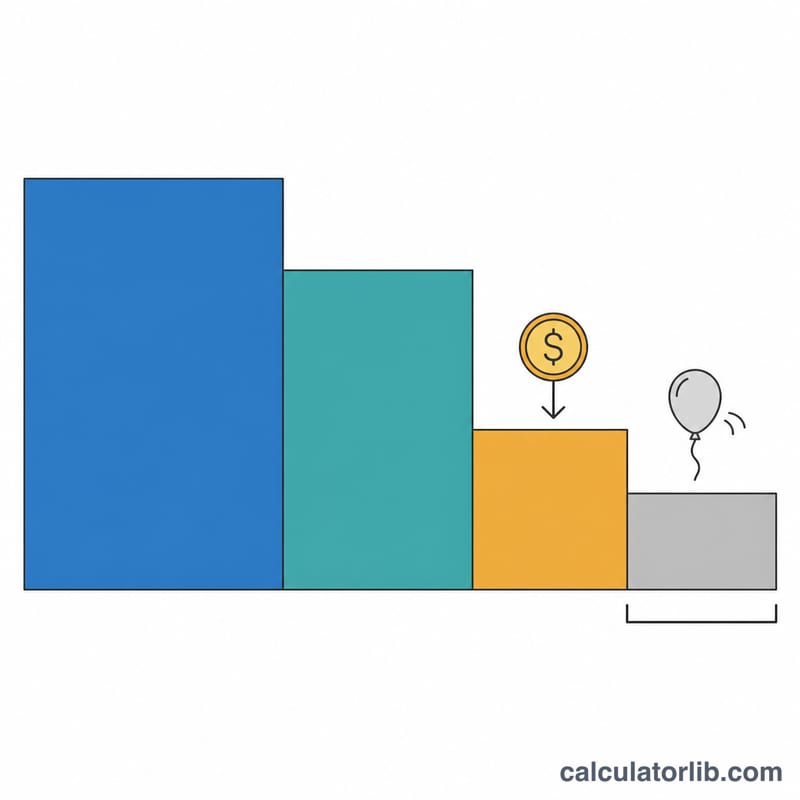
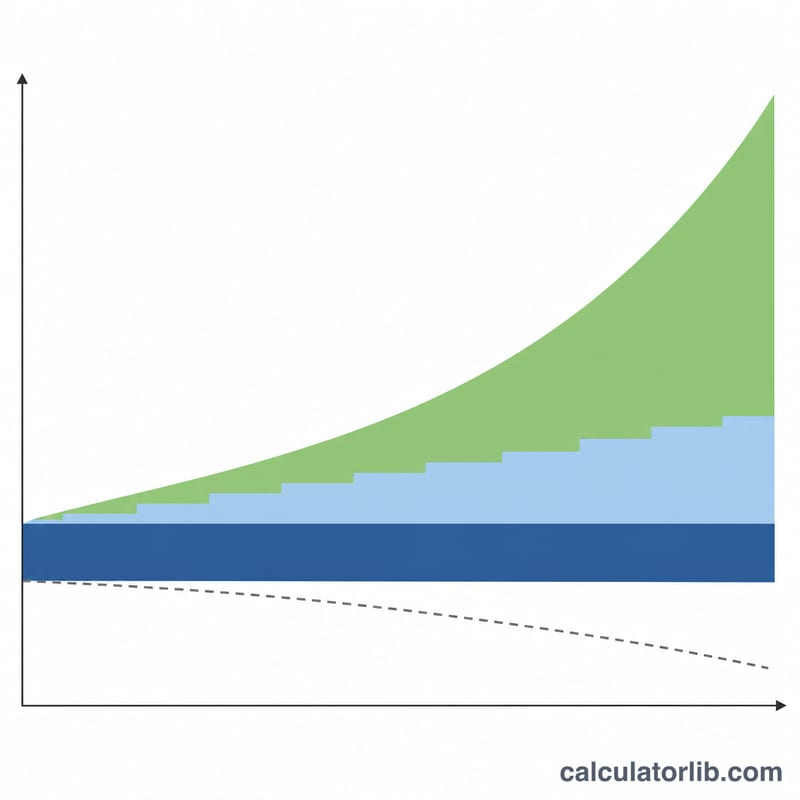
Each month the balance earns \(b \times r_m\), loses the tax on that interest, and receives your deposits. At the end, the buying-power line divides the balance by \((1 + i)^{t}\), where \(i\) is inflation and \(t\) is the term in years.
A worked example
$25,000 to start, $400 a month, contributed at the beginning, 6% compounded annually, 10 years, a 22% tax rate and 3% inflation.
The effective annual rate is 6% exactly, so the monthly rate is \(1.06^{1/12} - 1 = 0.00486755\) — note that this is not 6% ÷ 12 = 0.005. Month one: the $400 goes in first, giving $25,400; interest is 25,400 × 0.00486755 = $123.64; tax takes 22% of that, $27.20; the balance closes at 25,400 + 123.64 − 27.20 = $25,496.44.
Repeat 120 times:
| Ending balance | $100,283.95 |
| Total principal | $73,000.00 |
| Total contributions | $48,000.00 |
| Total interest | $34,979.42 |
| Interest of initial investment | $19,771.19 |
| Interest of the contributions | $15,208.23 |
| Total tax | $7,695.47 |
| Total interest after tax | $27,283.95 |
| Buying power after inflation | $74,620.67 |
The checks: total principal is 25,000 + 48,000 = $73,000, and 100,283.95 − 73,000 = $27,283.95, which is the interest after tax, not the $34,979.42 total. The split lines come from 25,000 × 1.0610 − 25,000 = $19,771.19, with the remaining $15,208.23 attributed to the contributions. Buying power is 100,283.95 ÷ 1.343916 ≈ $74,620.67.
The rules that surprise people
Compounding frequency does less than you think. Interest is credited twelve times a year no matter what you select — the frequency only sets the effective annual rate. That is why choosing "annually" still produces a monthly schedule with twelve different interest rows, not eleven zeros. On the default settings, month one earns $101.85, not the $104.17 you get by dividing the rate by twelve, and month twelve still lands exactly on $26,250.00.
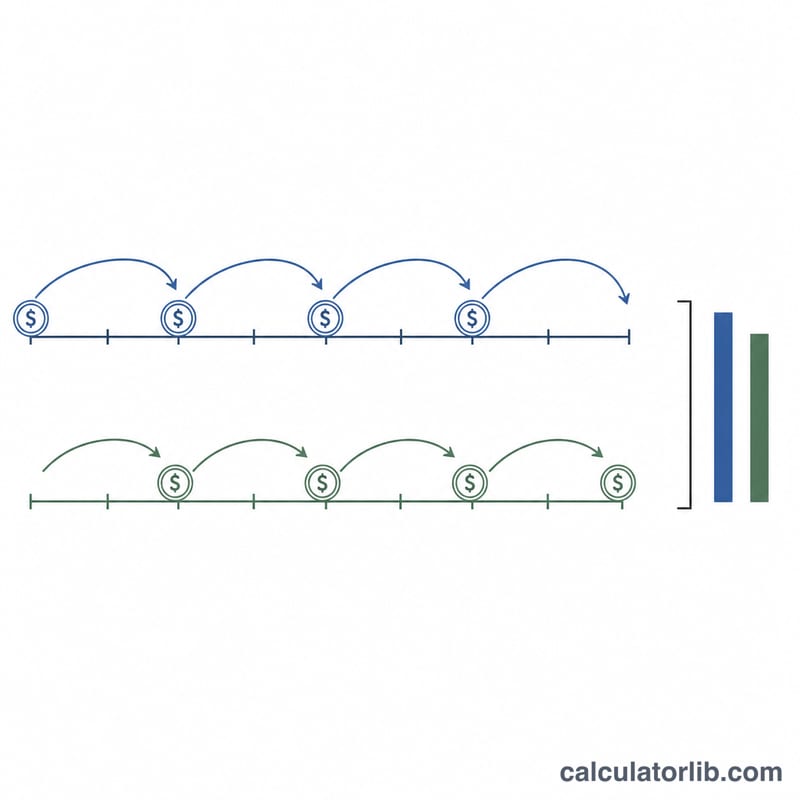
"Beginning or end" can delete a whole contribution. The radio moves the annual deposit between month 1 and month 12 of each year. If your term has extra months — say 5 years 6 months — the stub year never reaches its month 12, so "end" simply never makes that year's deposit. On $20,000 with $5,000 a year at 5%: "beginning" contributes $30,000 and ends at $61,005.42; "end" contributes $25,000 and ends at $54,466.42. Even on a whole-year term the timing alone is worth $1,381.41 ($54,535.20 vs $53,153.79).
"Daily" uses 365.25 days, and is not the same as "continuously." On the defaults, daily gives $54,798.28 and continuous gives $54,799.03. They stay close, then diverge over long terms.
"Interest of initial investment" ignores your tax rate. That line is a standalone compound-growth formula on the opening deposit alone. On the default inputs it reads $5,525.63 whether tax is 0% or 25% — even though 25% tax drops the ending balance from $54,535.20 to $51,957.36. "Interest of the contributions" is then whatever is left over, so the two always add to the pre-tax total interest.
Two labels don't mean what they say. "Total principal" includes your initial investment (on the defaults, $45,000 = $20,000 + $25,000 of contributions), and "Total interest" is before tax. The month-1 deposit cell also carries the opening balance, so it reads $25,000.00 rather than $5,000.00.
Lines and tables appear and disappear. Set inflation to 0% and the buying-power line vanishes rather than showing an unadjusted figure. Set both contributions to zero and the three split lines vanish. And the schedules are suppressed entirely for terms of twelve months or less — a 1-year term shows a summary and nothing else, while 13 months shows two annual rows.
The yearly table won't add up from the monthly one. Yearly totals are computed from unrounded monthly figures and rounded once. On the defaults, the twelve printed month-1 interest cells sum to $1,249.98, but the year-1 row prints $1,250.00. The gap is a cent or two, in either direction, and it is not an error.
Common questions
Why does my balance grow every month when I picked annual compounding?
Because the engine always steps monthly, spreading the annual rate across twelve months via the twelfth root. Each month shows real growth, and the December balance lands exactly where once-a-year compounding would put it.
Does the tax rate reduce my final balance?
Yes — tax is withheld from interest every month, so it slows compounding, not just the final total. It just doesn't touch the "interest of initial investment" line.
Can I enter 18 in the months box?
Yes. Months are not capped at 11; 0 years 18 months and 1 year 6 months both give $32,021.72 on the default settings. Fractional entries are truncated, so 5.9 years is treated as 5.
Beginning or end — which should I pick?
Match your actual habit: "beginning" if you deposit at the start of each period, "end" if the money lands after interest posts. If your term includes partial months, check the last row of the annual schedule to confirm the final contribution is where you expect it.
What inflation rate should I use?
2–3% is the usual long-run assumption. Entering 0 removes the buying-power line rather than showing an unadjusted number, so if that line disappears, that is why.
What Your After-Tax, Inflation-Adjusted Result Means
The calculator prints several numbers, and each answers a different question. Read them in this order.
- Nominal ending balance — the account value in future dollars at the end of the term, after tax has already been deducted from each period's interest. This is the number a statement would show.
- Total interest — the nominal ending balance minus everything you put in (initial investment + all annual and monthly contributions). It is interest net of tax, because tax is taken out as it is earned.
- Interest from the initial deposit vs. interest from contributions — the same total split by source. The first is what the opening balance \(P\) earned on its own; the second is what the deposits \(D_k\) earned. Early in a plan the contribution share is small (each deposit has had little time to compound); over long terms it usually overtakes the initial-deposit share.
- Tax paid on interest — the cumulative tax withheld from interest over the whole term.
- Inflation-adjusted (real) balance — the nominal balance deflated to today's purchasing power:
$$A_{\text{real}}=\frac{A_{\text{nominal}}}{(1+f)^{t}}$$
where \(f\) is the annual inflation rate and \(t\) the term in years. The real balance is expressed in today's dollars, so it is the correct figure to compare against a goal quoted at today's prices ("I need $75,000 for a deposit at current prices"). Comparing that goal to the nominal balance overstates how far you have got.
Whether you gain purchasing power at all depends on the after-tax effective annual rate \(e\) versus inflation:
$$1+r_{\text{real}}=\frac{1+e}{1+f}$$
The real return is negative whenever the after-tax effective rate is below inflation — a 4% account taxed at 25% earns 3% after tax, which loses purchasing power against 3.5% inflation even though the nominal balance keeps rising.
What the tax figure assumes
The model applies the tax rate to interest as it is credited, every period, at one flat marginal rate: \(i=\frac{r}{n}\left(1-\tau\right)\). That is a reasonable picture of interest paid into an ordinary taxable savings or bond account, but it deliberately ignores three things. It overstates tax for tax-sheltered accounts — a US 401(k)/IRA, a Roth-style account, a UK ISA, a Canadian TFSA and similar wrappers defer or exempt the tax, so enter a tax rate of 0% (and, for tax-deferred accounts, treat the result as pre-withdrawal-tax). It ignores the distinction between ordinary-income and capital-gains treatment, which in many countries are taxed at different rates. And it takes no account of allowances, thresholds or a rate that changes as your income changes. Tax rules are national: the rate you enter must be your own jurisdiction's marginal rate on investment income.
Other limits of the projection
The interest rate, the tax rate and the inflation rate are all held constant for the entire term, and the projection includes no fees — no platform, fund or account charges, which reduce the effective rate directly. Real-world returns vary year to year; a constant-rate projection shows the smooth average path, not the sequence of ups and downs an investment actually follows.
This section is a factual explanation of the arithmetic the calculator performs. It is general information, not financial or tax advice, and no figure here is a recommendation about what you should invest in or how you should be taxed. For decisions about your own money, consult a qualified professional in your country.
How the Result Changes Across Scenarios
Every row below starts from the same base case and changes exactly one factor. Base case: $25,000 initial investment, $400 per month (no annual contribution), 6% nominal rate, monthly compounding, contributions at the end of each period, 22% tax on interest, 3% inflation, 10-year term. All figures use the same method as the calculator: the nominal rate and compounding frequency are converted to an after-tax effective annual rate \(e\), then to the internal monthly rate \(r_m=(1+e)^{1/12}-1\), and the nominal result is divided by \((1+f)^{t}\). "Tax paid" is the cumulative tax withheld on interest over the term. Figures are rounded to whole dollars.
| Factor varied | Setting | Nominal balance | Tax paid | Inflation-adjusted balance |
|---|---|---|---|---|
| — (base case) | Monthly compounding, end of period, 22% tax, 3% inflation, 10 yr | $100,945 | $7,882 | $75,112 |
| Compounding frequency | Annually | $100,243 | $7,684 | $74,590 |
| Daily (365/yr) | $101,009 | $7,900 | $75,160 | |
| Continuously | $101,011 | $7,900 | $75,161 | |
| Contribution timing | Beginning of each period (annuity due) | $101,183 | $7,949 | $75,289 |
| Tax rate on interest | 0% (tax-sheltered account) | $111,037 | $0 | $82,622 |
| 32% | $96,718 | $11,162 | $71,967 | |
| Inflation rate | 0% | $100,945 | $7,882 | $100,945 |
| 2% | $100,945 | $7,882 | $82,810 | |
| 5% | $100,945 | $7,882 | $61,971 | |
| Term | 20 years | $222,102 | $28,516 | $122,973 |
| 30 years | $415,391 | $69,495 | $171,136 |
Which lever matters most? Holding the 10-year term fixed, the inflation assumption moves the real balance by far the most — about $38,974 between 0% and 5% inflation, even though the nominal balance never changes. Tax is second (roughly $10,655 of real balance between 0% and 32%). Compounding frequency and contribution timing are almost noise by comparison: annual versus continuous compounding is worth about $571 of real balance, and shifting contributions to the start of each period about $177. Across the whole table, time dominates everything: extending the term from 10 to 30 years more than doubles the real balance despite 3% inflation eroding it for twenty extra years.
Note: the 22% and 32% rates are US federal marginal income-tax brackets, used here purely as illustrative values. Tax on interest income differs by country — enter your own jurisdiction's marginal rate, or 0% for a tax-sheltered account. The 2% inflation row reflects the inflation target adopted by several major central banks, not a guaranteed rate. These scenarios are arithmetic illustrations, not financial advice.
Key Terms Defined
- Principal / initial investment (\(P\)) — the amount already in the account on day one, before any contribution is added.
- Contribution (\(D_k\)) — money added during the term: the monthly deposit added every month, plus the annual deposit added once a year. Contributions are not interest, so they are excluded from the "total interest" figure.
- Compound interest — interest credited on the balance including previously credited interest, so the base that earns interest grows each period. Simple interest, by contrast, always pays on the original principal only.
- Nominal annual rate (\(r\)) — the quoted, headline yearly rate. On its own it is incomplete: its real meaning depends on how often it compounds.
- Compounding periods per year (\(n\)) — how many times interest is credited annually: 1 (annually), 2, 4, 12, 24, 26, 52, 365, or continuously.
- Effective annual rate (APY, \(e\)) — the rate that produces the same growth in one year once compounding is taken into account: $$e=\left(1+\frac{r}{n}\right)^{n}-1$$ It is the only fair basis for comparing offers with different compounding frequencies.
- Continuous compounding — the limit as \(n\to\infty\), where interest is credited instantaneously: $$e=\mathrm{e}^{r}-1$$ It sets the upper bound on what any compounding frequency can deliver at a given nominal rate.
- Monthly rate used internally (\(r_m\)) — the month-equivalent of the effective annual rate, $$r_m=(1+e)^{1/12}-1$$ used so that monthly deposits can be applied on a monthly schedule regardless of the stated compounding frequency.
- Ordinary annuity (end of period) — contributions made at the end of each period; each deposit earns interest for one period less.
- Annuity due (beginning of period) — contributions made at the start of each period. Its future value is the ordinary-annuity value multiplied by \((1+r_m)\).
- Marginal tax rate on interest income — the percentage of each additional dollar of interest paid in tax, at your top applicable rate. Rates, allowances and whether interest is taxed as ordinary income or as capital gains are set nationally and differ from country to country.
- Nominal value — an amount stated in the money of the future date it occurs, with no adjustment for price changes.
- Real (inflation-adjusted) value — the same amount restated in today's money by dividing by \((1+f)^{t}\), where \(f\) is annual inflation and \(t\) is years.
- Purchasing power — the quantity of goods and services a sum of money can buy. It falls when prices rise, which is why a rising nominal balance can still represent a loss in real terms.
These definitions describe the arithmetic used by the calculator. They are general information, not financial or tax advice.