What is paper GSM?
GSM stands for grams per square meter, the international (ISO 536) way of expressing paper weight, also called grammage. It tells you how much one square meter of that paper weighs, independent of the sheet size you happen to be holding. Copy paper is typically 70-90 gsm, letterheads 100-120 gsm, flyers 130-170 gsm, business cards and covers 250-350 gsm, and corrugated liners run far higher. This calculator derives grammage from a physical measurement, which is the only reliable way to check an unlabelled stock or verify a delivery against its spec.
How to use it
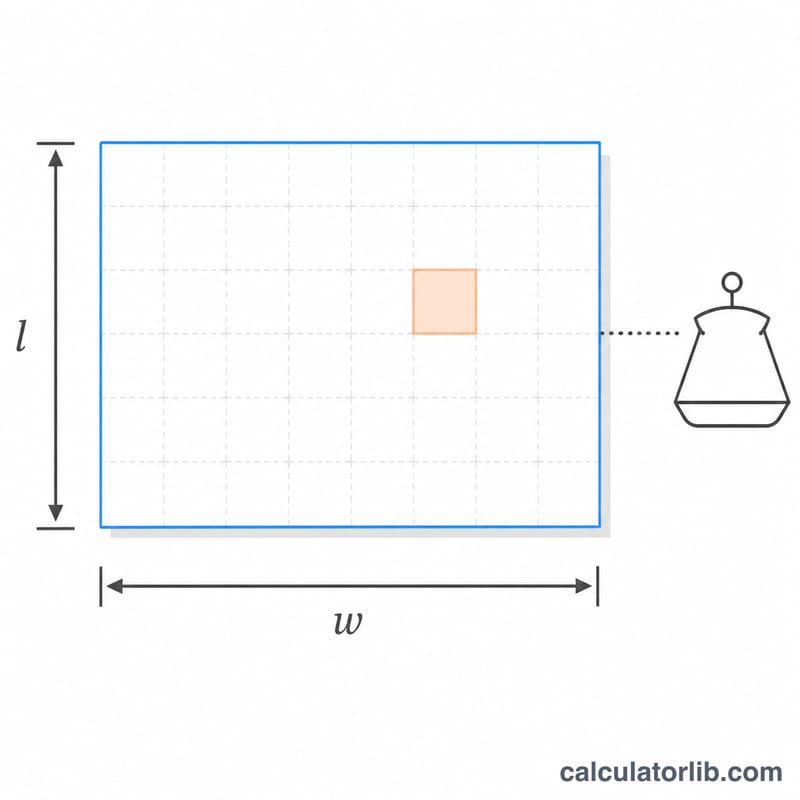
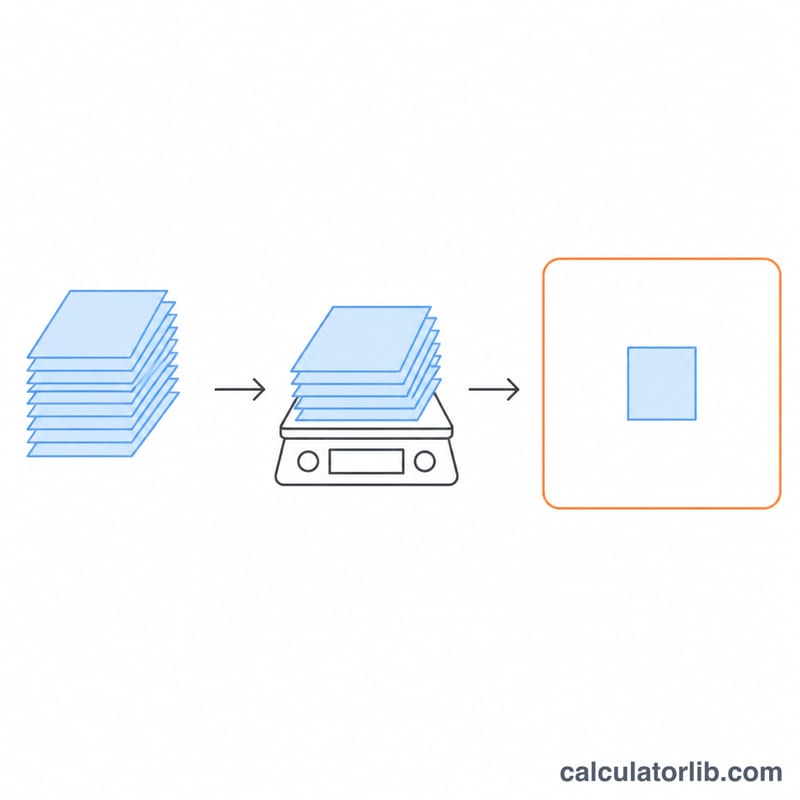
Cut or take sheets of a known size, count them, and weigh the stack on a kitchen or jewellery scale. Enter the sheet width and length in millimeters, the number of sheets, and the total weight in grams or kilograms. The calculator returns grammage plus the sheet area, the weight per sheet and the equivalent US text basis weight.
The formula
With \(w\) and \(l\) the sheet width and length in mm, \(n\) the sheet count and \(m\) the total mass in grams:
$$\text{GSM} = \frac{m}{n \times \left(\frac{w}{1000}\right) \times \left(\frac{l}{1000}\right)}$$Dividing each dimension by 1000 converts millimeters to meters, so the denominator is the total measured area in square meters.
Worked example
A ream of 500 A4 sheets (210 x 297 mm) weighs 2500 g. One sheet covers
$$A = 0.210 \times 0.297 = 0.06237\,\text{m}^2$$so the ream covers \(500 \times 0.06237 = 31.185\,\text{m}^2\) and
$$\text{GSM} = \frac{2500}{31.185} \approx 80.17\,\text{g/m}^2$$which is standard 80 gsm office paper.
Common Paper GSM Ranges by Product Type
Grammage (GSM, g/m²) is the mass of one square metre of paper. The measurement itself is standardised — ISO 536 defines how grammage is determined (sample area, conditioning, weighing) — but the product bands below are industry conventions, not an ISO-specified classification. Mills, regions and print shops draw the boundaries slightly differently, so treat the ranges as orientation rather than as a specification.
The US basis-weight column is a conversion of the same sheet expressed in the American system, where a "weight" in pounds refers to 500 sheets of a named basis size. The basis size is stated in every row because 80 lb Text and 80 lb Cover are completely different papers.
| Paper type / use | Typical GSM | US basis-weight equivalent (basis size named) | Notes |
|---|---|---|---|
| Newsprint | 40–55 | ≈27–37 lb Text (25×38 in) | Bulky, high-opacity-per-gram groundwood furnish; low cost, yellows with age. |
| Tracing paper / bible (thin printing) paper | 45–60 | ≈30–41 lb Text (25×38 in) | Chosen for translucency or for page count in thick books; needs high strength at low grammage. |
| Standard copy / office paper | 70–90 | ≈19–24 lb Bond (17×22 in) | 75–80 gsm is the usual office default; 80 gsm ≈ 21–22 lb Bond. Duplex printing favours ≥80 gsm. |
| Premium office / laser paper | 90–100 | ≈24–27 lb Bond (17×22 in) | Better opacity and stiffness; reduced show-through on double-sided work. |
| Letterhead / stationery | 100–120 | ≈27–32 lb Bond (17×22 in) | Often watermarked or cotton-content; the weight signals "correspondence" rather than "copy". |
| Brochure / flyer text stock | 130–170 | ≈88–115 lb Text (25×38 in) | 148 gsm ≈ 100 lb Text. Folds cleanly without creasing; common for coated litho work. |
| Light card / postcard | 200–250 | ≈74–92 lb Cover (20×26 in) | 216 gsm ≈ 80 lb Cover. Self-supporting when held; typical for mailers and menus. |
| Business card / cover stock | 250–350 | ≈92–129 lb Cover (20×26 in) | 270 gsm ≈ 100 lb Cover. Usually creased rather than folded. |
| Folding carton / boxboard | 350–450+ | ≈129–166+ lb Cover (20×26 in) | Often specified by caliper (e.g. 14–24 pt) as well as grammage, because stiffness drives packaging performance. |
Boards above roughly 250 gsm are frequently called "board" or "card" rather than "paper"; some national conventions place that dividing line at 224 gsm. Again, the label is convention — the grammage number is the objective quantity.
FAQ
Is higher GSM always thicker? No. Grammage is mass per area; thickness (caliper) also depends on bulk. A lightly calendered uncoated 120 gsm sheet can feel thicker than a dense coated 130 gsm sheet.
How many sheets should I weigh? As many as your scale allows. Weighing 10 or 100 sheets spreads the scale resolution error across every sheet and gives a far more accurate grammage than one sheet alone.
What is the lb figure? It is the US text (book) basis weight for a 500 sheet ream of 25 x 38 inch stock, roughly GSM divided by 1.48. US cover, bristol and index grades use different basis sizes, so the conversion factor differs for them.