What this calculator does
This tool is based on United States practice: Prague Powder #1 (also sold as Pink Cure #1, Insta Cure #1) contains 6.25% sodium nitrite and 93.75% salt, while Prague Powder #2 contains 6.25% sodium nitrite, 4% sodium nitrate and 89.75% salt. It converts a meat weight into the exact gram dose of cure needed to hit a target ingoing nitrite level, and tells you how much plain salt to add on top to reach your total salt percentage. USDA guidance for most comminuted products is 156 ppm ingoing nitrite, with 200 ppm as the maximum; dry-cured whole muscle rules differ, so check your own product label and regulations.
How to use it
Enter the meat weight and its unit, pick the cure type, then set the target ingoing nitrite in ppm and the total salt percentage you want in the finished product (2.0-2.5% is typical for salami). The calculator reports the cure in grams, teaspoons and ounces, plus the milligrams of nitrite and nitrate delivered.
The formula
With \(M\) = meat mass in grams and \(P\) = target nitrite in ppm (mg per kg):
$$C = \frac{P \times M}{1{,}000{,}000 \times 0.0625}$$The salt already inside that cure is \(C \times f_{salt}\), so the extra plain salt is
$$E = M \times \frac{S}{100} - C \times f_{salt}$$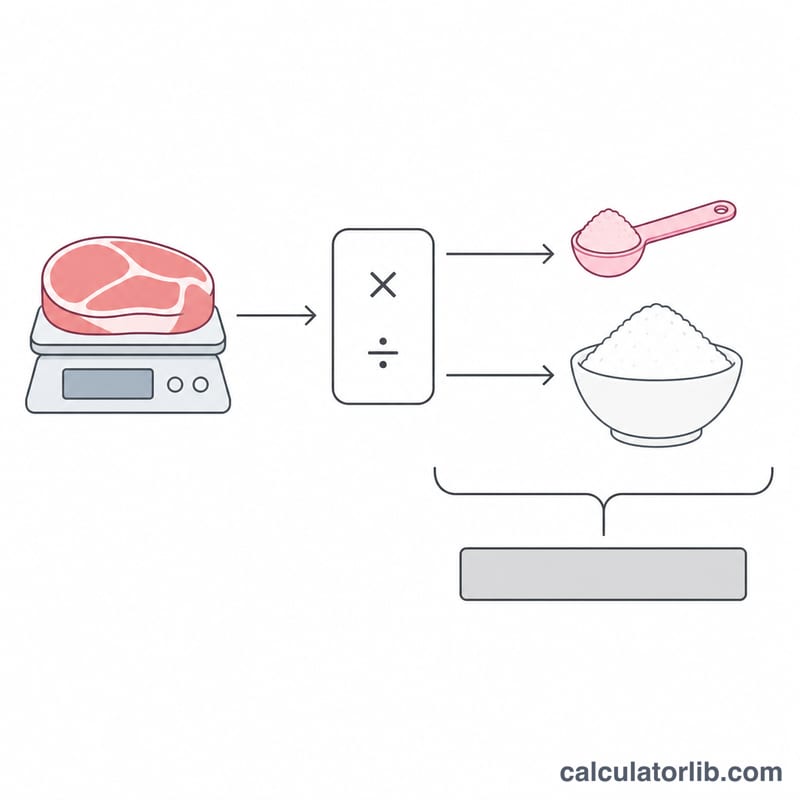
Worked example
10 lb of salami meat, Prague Powder #2, 200 ppm nitrite, 2.5% total salt. First the mass:
$$M = 10 \times 453.59237 = 4535.92\,\text{g}$$$$C = \frac{200 \times 4535.92}{62{,}500} = 14.51\,\text{g}$$That cure carries \(14.51 \times 0.8975 = 13.03\,\text{g}\) of salt, and the salt target is \(4535.92 \times 0.025 = 113.40\,\text{g}\), so you add about \(100.37\,\text{g}\) of plain salt.
Cure Type and Regulatory Nitrite Limits
The limits below are United States rules for federally inspected meat plants, set in 9 CFR 424.21(c) and summarised in the USDA FSIS processing guidelines. They are expressed as ingoing parts per million (mg of sodium nitrite per kg of meat at the time of mixing or pumping), not as residual nitrite in the finished food. Other countries (EU, UK, Australia, Japan) regulate nitrite differently — often as a residual limit or as a maximum added quantity — so if you are not curing under USDA rules, check your own national food standard.
| Product class (US) | Correct cure | Cure composition | Max ingoing sodium nitrite | Max ingoing sodium nitrate | Typical cure period |
|---|---|---|---|---|---|
| Comminuted / emulsified products (fresh-style sausage, bologna, frankfurters, summer sausage) | Prague Powder #1 | 6.25% sodium nitrite, 93.75% salt | 156 ppm | 1,718 ppm (rarely used) | Cured during mixing; cooked or fermented the same day or within 1–2 days |
| Immersion-cured (brined) whole muscle — hams, corned beef, pastrami | Prague Powder #1 | 6.25% sodium nitrite, 93.75% salt | 200 ppm | 700 ppm | Days to weeks; equilibrium brines commonly 5–14 days depending on thickness |
| Massaged or pumped whole muscle (other than bacon) | Prague Powder #1 | 6.25% sodium nitrite, 93.75% salt | 200 ppm | 700 ppm | Hours to a few days, then thermal processing |
| Bacon, pumped or immersion cured | Prague Powder #1 | 6.25% sodium nitrite, 93.75% salt | 120 ppm, and 550 ppm sodium erythorbate or ascorbate is required | Not permitted in bacon | Typically 5–10 days, then smoking/cooking |
| Dry-cured products (dry-cured ham, pancetta, coppa, salami dried without cooking) | Prague Powder #2 | 6.25% sodium nitrite, 4% sodium nitrate, balance salt (~89.75%) | 625 ppm | 2,187 ppm | Weeks to many months of salting plus drying |
Two points that cause most of the confusion:
- 156 ppm is the ceiling for comminuted product, not a universal target. It corresponds almost exactly to the familiar home rule of 0.25% Prague Powder #1 by meat weight (2.5 g per kg), which is why so many sausage recipes land on it. The 200 ppm figure applies to immersion-cured and pumped/massaged whole muscle, and dry-cured product may go far higher because the nitrite is consumed slowly over months.
- Cure #2 is for products that are dried, never cooked. The 4% sodium nitrate acts as a slow reservoir: nitrate-reducing bacteria convert it to nitrite over weeks, which is pointless — and simply wasteful — in a sausage that will be cooked in 24 hours. Never substitute one for the other on a gram-for-gram basis without recalculating; the nitrite fraction happens to be the same 6.25%, but the intended use is not.
Sodium nitrite is acutely toxic in quantities far smaller than table salt, which is why curing salts are sold pre-diluted and dyed. Weigh cure on a scale, never scoop it, and keep it out of reach of children. This article is general food-safety information, not professional or regulatory advice — commercial processors should work from the current text of 9 CFR and their inspection authority.
Key Terms Explained
- Ingoing nitrite (ppm)
- Milligrams of sodium nitrite added per kilogram of meat at the moment of mixing. This is the number US regulations control and the number this calculator solves for. It says nothing about how much nitrite survives in the finished product — most of it is consumed within hours.
- Residual nitrite
- The nitrite still measurable in the product after processing and storage. It is typically a small fraction of the ingoing dose, because nitrite reacts with myoglobin, proteins and fats, and decays faster at low pH, high temperature and in the presence of a cure accelerator. Residual nitrite drops further during aging, which is exactly why long-dried products need nitrate.
- Sodium nitrite (NaNO₂) vs. sodium nitrate (NaNO₃)
- Nitrite is the active agent: it fixes the cured pink colour, produces the characteristic cured flavour, retards rancidity, and — critically — inhibits Clostridium botulinum. Nitrate is inert by itself; it is a slow-release precursor that nitrate-reducing bacteria convert into nitrite over weeks. Nitrate is useless in a product cooked the same day and essential in one dried for months.
- Prague Powder #1 (pink cure #1, Insta Cure #1, tinted cure mix)
- 6.25% sodium nitrite, 93.75% sodium chloride. For anything that will be cooked, hot-smoked or eaten within a few weeks: sausages, bacon, ham, corned beef, pastrami, smoked poultry.
- Prague Powder #2 (pink cure #2, Insta Cure #2)
- 6.25% sodium nitrite plus 4% sodium nitrate, balance salt. For products that are dry-cured and air-dried without cooking: dry-cured hams, coppa, pancetta, salami and other long-fermented, long-dried sausages. Do not use it in anything cooked promptly, and do not swap the two mixes without recalculating.
- Equilibrium (EQ) curing
- Weigh the meat, calculate a fixed percentage of salt and cure for that exact weight, and apply all of it — usually vacuum-sealed or in a measured brine — until the salt distributes evenly. The meat cannot become saltier than the number you chose, so timing is forgiving and the result is repeatable. This is the method the calculator's total-salt-percentage input is built around.
- Overnight / salt-box (dredge) curing
- The traditional method: bury the meat in an excess of salt-and-cure mixture and pull it after a set time. Saltiness depends on time, temperature and surface area rather than on arithmetic, so it is harder to reproduce and easy to over-salt — but it is fast and requires no scale precision on the salt side.
- Total salt percentage
- All sodium chloride in the batch — the salt inside the cure plus the plain salt you add — divided by the meat weight. Around 1.5–2.0% reads as pleasantly seasoned; 2.5–3.0% is firmly preserved and typical of dried and fermented products. Because Prague Powder is 93.75% salt, the cure's contribution has to be subtracted from the plain-salt figure.
- Comminuted product
- Meat that has been ground, chopped, minced or emulsified rather than left as intact muscle — sausage, bologna, frankfurters, meatloaf. Because the cure is mixed uniformly through the mass, curing is essentially instantaneous, and the US ingoing limit for this class is lower (156 ppm) than for whole muscle.
- Cure accelerator (sodium erythorbate / sodium ascorbate)
- A reducing agent that speeds the conversion of nitrite to nitric oxide, giving faster and more stable colour fixing, lower residual nitrite, and less nitrosamine formation during high-heat cooking. US rules require 550 ppm of erythorbate or ascorbate in pumped bacon (which is why bacon's nitrite limit is only 120 ppm) and permit it broadly elsewhere. Erythorbate and ascorbate are interchangeable in this role; ascorbate is simply the vitamin C form.
- Why the cure is dyed pink
- The rose colour comes from a trace of food dye (commonly FD&C Red No. 3 in US products) added for one reason only: so that a curing mix containing a toxic concentration of sodium nitrite can never be mistaken for table salt, sugar or a seasoning blend. The dye has no curing function and is present at levels far too low to colour the meat. Store cure in a clearly labelled container, and never treat pink colour alone as proof of which cure — #1 or #2 — is in the jar.
This section is general food-safety information for home and small-scale curing, not professional, medical or regulatory advice. If you are producing for sale, follow your national inspection authority's current requirements and validated process schedules.
FAQ
Can I substitute #1 for #2? No. Cure #1 is for products cooked or eaten within weeks; cure #2 adds nitrate as a slow reservoir for long dry-cured salami and hams.
Why weigh instead of using teaspoons? Cure density varies with packing and humidity, so a teaspoon can be off by 15% or more. A 0.1 g scale is the only safe method.
Is 0.25% cure the same as 156 ppm? Roughly: 2.5 g of cure per kg gives 156 ppm nitrite, which is why the classic ratio is 1 level teaspoon per 5 lb of meat.